
The Daughter Who Vanished to Uncover Her Parents' Deepest Secret


A long time later, my life was my own. I lived in a modern apartment hundreds of miles away, the city stretching out beneath my balcony. The hum of traffic was a comforting, anonymous backdrop to a life I had meticulously built. I was a successful architect, my days filled with blueprints and designs, creating structures that were honest, solid, and true. My nights, however, were often quiet, marked by a profound solitude that sometimes felt like freedom, sometimes like an echo of what was lost.
My phone chimed, a notification from Aunt Beatrice. We spoke often, our bond strengthened by shared truths and a quiet understanding.
“Clara’s still in the house,” Beatrice’s voice was soft, laced with a familiar sadness. “She rarely leaves. Just to the grocery store, perhaps, or to visit Evelyn’s grave. The light in her eyes… it never quite came back after Arthur left.”
“And Liam?” I asked, my voice carefully neutral. I hadn’t spoken to my brother since I left.
“He’s a young man now,” she said. “He keeps to himself, mostly. Works for a firm downtown. He comes to see Clara every Sunday, brings her groceries. He’s trying, I think. Trying to make sense of it all.”
I pictured Clara, frail and reclusive, wandering through the empty rooms of the house Arthur had abandoned. I imagined her touching the polished surfaces, memories of a false life swirling around her. It was a tragedy of her own making, yes, but also a raw wound inflicted by Arthur’s cold ambition.
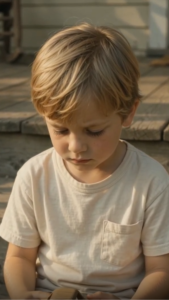
In the old house, Liam moved with a quiet melancholy. One afternoon, while helping Clara clear out some dusty old boxes from the attic, he found a small, ornate wooden chest tucked away behind a stack of unused photo albums. It was labeled simply, in Clara’s hand: “Mother’s Correspondence.”
He paused, a strange premonition gripping him. Clara had gone out for a rare walk, leaving him alone in the quiet house. He lifted the lid. Inside lay dozens of letters, thin airmail paper, addressed to Clara from Aunt Beatrice. And many more from Clara to Beatrice, detailing her despair after Arthur’s departure.
Liam sat on the dusty floor, reading. The words painted a vivid, agonizing picture. Clara’s raw grief, her confusion, Beatrice’s gentle guidance as she helped Clara piece together the truth. He read about Evelyn’s subtle clues, the coded diary, Mr. Henderson’s complicity, the depth of Arthur’s deceit. He read about the initial affair, Clara’s terror, Arthur’s threats.
He saw his mother, not as the passively distant figure he had known, but as a young woman caught in a devastating trap. He saw his father, not as a strong, successful patriarch, but as a ruthless manipulator. And he saw himself, the favored son, oblivious to the painful, fabricated reality that had always surrounded them.
His hands trembled as he read his own name, mentioned briefly in Clara’s despairing letters: *“Liam doesn’t understand, he never will. I can’t bear to tell him the truth about his father, about his sister.”*
The weight of it, the layers of lies that had sustained his “perfect” childhood, crushed him. His father, his hero, had built their entire family on a foundation of cruel deceit, robbing his sister of her identity and his mother of her peace. He had lived in a gilded cage, blind to the suffering of those around him.
A cold, hard knot formed in his stomach. This truth, now fully exposed to him, was too painful, too shattering to bear. It would forever taint every memory, every holiday, every family dinner. It would shatter the last remaining fragments of his idealized world.
Liam stood up, the box of letters heavy in his arms. He walked silently out to the backyard, to the old fire pit where they used to roast marshmallows on summer nights. The iron grate was rusted, the bricks blackened with old ash.
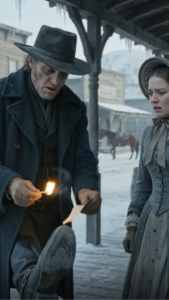
He opened the box one last time, looking at the faded ink, the familiar handwriting. With a decisive, wrenching movement, he emptied the contents into the pit. He lit a match, the small flame flickering bravely against the encroaching twilight. The dry paper caught quickly, curling at the edges, then bursting into hungry orange. He watched as the words, the secrets, the pain, turned to ash, twisting into the evening air and dissipating into nothingness. He offered no tear, no prayer, just a grim, resolute silence. Some truths were too much to carry. He would bury this one, deep and final.
On my own quiet balcony, high above the city, I watered my small, thriving rosemary plant. Its fragrant leaves released a sharp, clean scent into the evening air. The city lights began to twinkle, a million tiny stars mirroring the vast, indifferent sky. I ran my fingers over the rough texture of the pot.
I built a life on my own terms, free from their shadow, but freedom sometimes feels like a hollow space where a family used to be. The quiet ache remains, a constant reminder of the love I never fully received, and the family I ultimately had to lose to find myself. Sometimes, the freedom we fight for leaves us standing in a silence louder than any argument, forever longing for a love that never truly was.
More Stories






+ There are no comments
Add yours