
Councilwoman's Nephew Begs for Help From His Aunt in Public, Uncovering a Family Conspiracy That Threatens Her Career


The court order, granting me limited, supervised access to David’s old house for a search, was a small but significant victory. Lillian had fought it tooth and nail, claiming harassment, but Judge Hayes had seen enough merit to allow it.
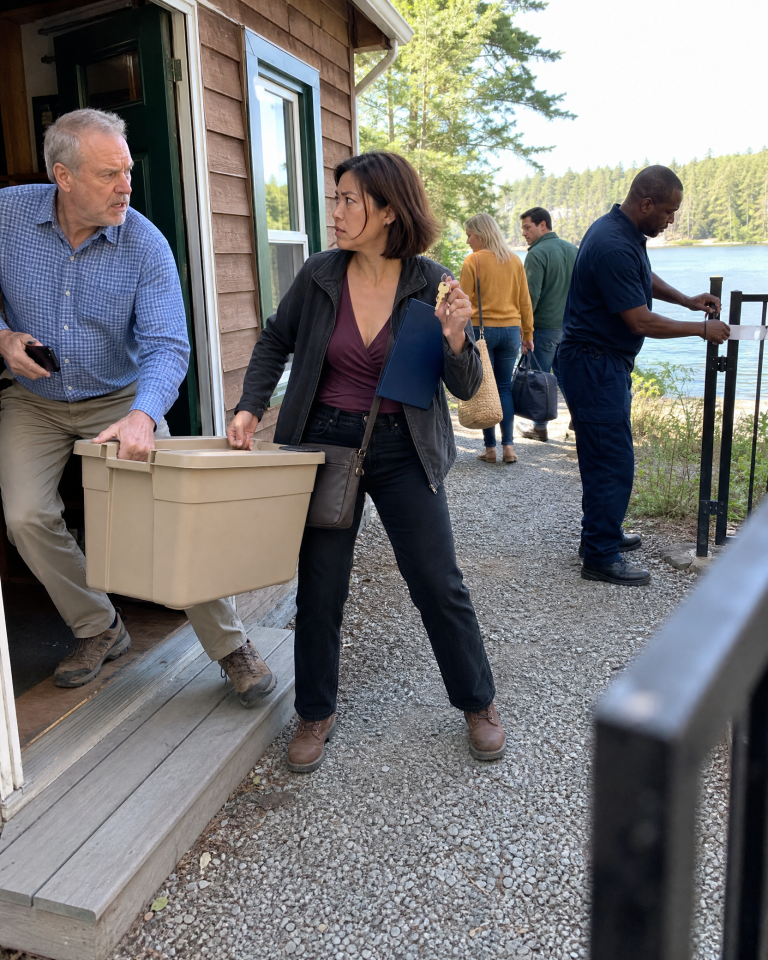
Two days later, I stood in David’s old house, a knot of anticipation and dread in my stomach. A grim-faced Lillian sat on the sofa downstairs, watched by a court-appointed observer, her eyes burning holes in my back.
“You have two hours, Councilwoman Jensen,” the observer stated, checking her watch. “And stay out of any areas not specified in the order.”
I nodded, gripping the banister as I ascended the creaking stairs to the attic. The air grew heavier with each step, thick with dust and memories.
The attic was a chaotic jumble of David’s past. Boxes overflowing with old books, camping gear, dusty photo albums, and a myriad of unfinished projects. It felt like an archaeological dig into his life.
I breathed in the scent of aged paper and forgotten wood, a poignant reminder of my brother. This place, once a sanctuary for his hobbies, now held a crucial secret.
My eyes scanned the stacks of boxes, searching for anything resembling a collection of wooden trains. There were dozens of toys, old and new, scattered everywhere.
“Mom’s train. Empty inside,” I repeated Leo’s words to myself, trying to conjure the image.
I started with a large, unlabeled box in the corner, carefully lifting out each object. Old board games, faded textiles, a broken guitar. Nothing.
Lillian’s contempt for David’s sentimental clutter now felt ironically helpful. She would never have bothered to examine any of this closely.
I found a smaller box, nestled beneath some blankets. Inside were several handmade wooden trains, beautifully crafted, clearly David’s handiwork. My heart pounded.
I picked them up, one by one, examining them. Each was solid, beautifully painted. None felt hollow. None seemed to have a hidden compartment.
My hopes began to sink. What if Leo had remembered wrong? What if the train had been lost, or perhaps even thrown away by Lillian in her regular purges?
The thought sent a cold wave of fear through me. Lillian, in her disregard for David’s sentimental possessions, would have discarded something like this without a second thought, seeing it as worthless.
I spent another hour, meticulously sifting through everything remotely toy-like. My hands were grimy, my clothes covered in dust. The air was thick with it.
I found a collection of Leo’s baby toys, a small rocking horse, a box of mismatched building blocks. No hollow trains.
The court observer’s voice floated up the stairs. “One hour remaining, Councilwoman.”
Panic began to set in. I was running out of time. Lillian would be downstairs, no doubt savoring my fruitless efforts.
I returned to the box of handmade wooden trains, picking up each one again, desperate for a clue. There were five of them, a small locomotive and four various cars. They were all lovingly carved, miniature masterpieces.
I ran my fingers over the smooth wood of each, feeling for any seams, any irregularities. All felt solid.
“Empty inside,” Leo had said. It had to be a compartment.
I picked up the caboose, a deep blue one, larger than the others. I turned it over in my hands, checking the bottom, the sides. Nothing.
My gaze fell on the back of the caboose. There was a faint, almost imperceptible line along the grain of the wood. It was expertly carved, blending seamlessly with the natural pattern.
I pressed along the line. Nothing. I tried twisting it. Still nothing.
Then, I noticed a tiny, raised bump, no bigger than a pinhead, near the bottom edge of the panel. I pressed it with my thumb.
With a soft click, a small section of the back panel of the caboose popped open slightly, revealing a shallow, hollow compartment within.
My breath hitched. I could hear the blood rushing in my ears. This was it.
My hands trembled as I carefully pried open the panel further. Inside, tucked tightly and wrapped in a piece of oilskin, was a sealed, water-stained envelope.
It was exactly as Leo had described. David had built a hidden sanctuary within a seemingly innocuous, sentimental object.
I carefully pulled out the envelope, my heart pounding in my chest. It was old, the paper slightly brittle, and the water damage clearly visible along one edge.
The observer called out, “Thirty minutes, Councilwoman.”
I quickly closed the panel of the caboose, tucking the envelope securely into my inner jacket pocket. I made sure the compartment was completely hidden again.
I spent the remaining twenty minutes quickly tidying up the boxes, making it seem like I had searched but found nothing of significance. I didn’t want Lillian to know what I had discovered.
As I descended the stairs, Lillian looked up, a smirk playing on her lips. “Find any treasure, Sarah? Or just more of David’s junk?”
Her casual dismissal of David’s possessions, her belief that nothing of real value could be hidden in his sentimental clutter, was her fatal flaw.
“Nothing but dust,” I replied, keeping my expression neutral. “Just as I expected.”
She laughed, a thin, triumphant sound. “Exactly. David never had anything of real worth.”
The words were a brutal, dismissive cruelty, aimed at erasing David’s value entirely. But I knew she was wrong.
I exited the house, the envelope feeling like a live thing against my chest. The fight was far from over, but now, I held David’s truth in my hand.
Lillian’s smug expression faded as I walked past her, a faint flicker of unease in her eyes. Perhaps she sensed a shift, even if she didn’t know why.
I got into my car, the key shaking slightly as I put it in the ignition. I drove for a few blocks, then pulled over to a quiet side street.
I needed to see what David had hidden. I needed to know the truth.
More Stories










+ There are no comments
Add yours