
My Executive Neighbor Mocked Me for Touching a Vintage Bow at the Company Retreat — He Didn't Know I Built It 25 Years Ago


The ringing of my doorbell at 7:00 AM the next morning was sharp and insistent, cutting through the pre-dawn quiet. I was still savoring the discovery Evelyn had made, the undeniable proof now sitting on a USB stick on my bedside table. But the sudden, aggressive knocking told me this wasn’t a friendly visit.
I peered through the peephole. Two burly men in dark suits stood on my porch, their faces unsmiling. One held a clipboard. Behind them, parking his sleek black sedan at the curb, was Lyle O’Connor, the HR Director.
And on his own porch next door, sipping coffee from a ceramic mug, stood Julian Kincaid. His gaze was fixed on my house, a faint, predatory smile playing on his lips.
I opened the door, a cold dread washing over me.
“Mr. Gable?” the taller man asked, his voice flat and authoritative. “We are with Vanguard Corporate Security. We have a civil search order authorized by Kincaid-Apex for the seizure of corporate intellectual property.”
He held out a document. It wasn’t a police warrant, but a corporate internal order, signed by CEO Marcus Carver, stating “probable cause for IP theft and unauthorized retention of proprietary corporate assets” by Arthur Gable.
“IP theft?” I scoffed. “This is absurd. Everything in my workshop is my own, or historical archives, properly logged.”
“We have reports, Mr. Gable,” O’Connor interjected, stepping forward slightly, his face impassive. “That you have been retaining physical logbooks and schematics that are, in fact, company property. This ‘audit’ is to ensure compliance.”
It was a blatant lie, a direct consequence of Julian’s memo about my “cognitive decline” and “mishandling” of archives. They weren’t auditing; they were seizing. They were trying to destroy the physical evidence I possessed.
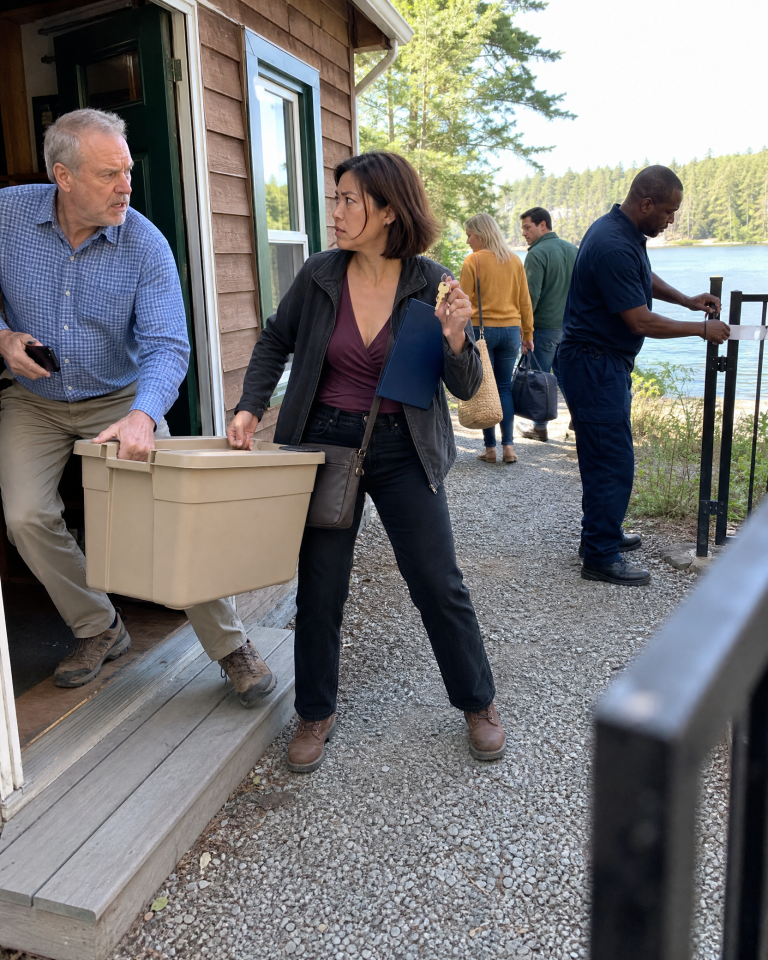
The security officers, without further pleasantries, pushed past me into my house. Their methodical search began in my living room, then moved to the den, and finally, inevitably, to my garage workshop.
I watched them, helpless. They were professional, efficient. They didn’t smash anything, didn’t make a mess, but their purpose was clear: to remove every trace of my original work. They opened every cabinet, rifled through every drawer, their gloved hands touching my beloved tools and notebooks with a detached indifference.
“Here we go,” one of them announced, pulling out a stack of leather-bound notebooks from a dusty shelf beneath my workbench. These were my private, decades-old workshop logbooks, filled with my hand-drawn sketches, calculations, and observations. The physical manifestation of my life’s work.
Julian watched from his porch, still sipping his coffee. Our eyes met across the lawn. He raised his mug in a silent, mocking toast. A triumphant, cold satisfaction radiated from him. He thought he had won. He thought he was erasing me.
The security officers began carefully loading my logbooks, several boxes worth, into the back of a waiting corporate van. My stomach churned, but a quiet, almost secret smile touched my lips. Julian had clearly underestimated me. He didn’t know about the redundancy.
More Stories







+ There are no comments
Add yours