
My Executive Neighbor Mocked Me for Touching a Vintage Bow at the Company Retreat — He Didn't Know I Built It 25 Years Ago


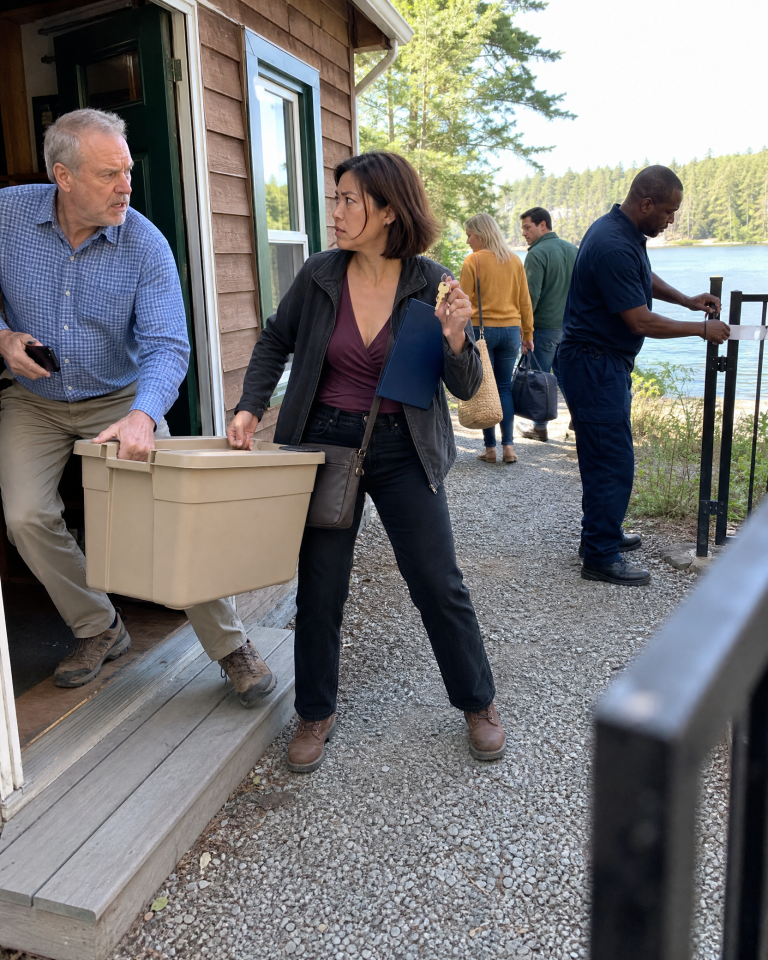
I watched the corporate security van pull away, its rear tires crunching on the gravel of my driveway. Julian remained on his porch, his smug expression fixed, as if supervising the final act of my professional demise. He saw the empty shelves in my garage, the barren workbench, and believed he had successfully erased my history.
But as the van turned the corner, disappearing from sight, a profound sense of calm settled over me. There was no panic, no despair. Only a quiet, resolute certainty. Julian had taken the physical, but he hadn’t taken the truth.
Evelyn, who had witnessed the entire, unnerving process from her car parked down the street, hurried back to my house. Her face was pale with concern.
“Arthur, they took everything,” she said, her voice tight. “Your logbooks, your notes… all your original work. How do we fight this now?”
I turned to her, a faint smile on my face. “They took the paper, Evelyn. But they didn’t take the memory. And they certainly didn’t take the digital.”
Her brow furrowed in confusion. “What do you mean?”
I led her back into my kitchen, pulling out a chair. “Twenty years ago,” I began, pouring us both a glass of water, “my late wife was a visionary, even more so than I. She foresaw the fragility of physical records, especially for intellectual property.”
I took a sip of water. “After a minor fire in her university lab in 2003, she became obsessed with redundancy. She insisted that every single schematic, every calculation, every experimental observation—even her rough ideas—be digitized.”
Evelyn’s eyes widened. “You mean… these were already backed up?”
“More than backed up,” I clarified. “She developed a system. Every night, after we finished in the workshop, she would scan and upload everything. Not just a simple copy, but an encrypted, timestamped mirror of every single physical page, every drawing, every handwritten note.”
I pulled out the small USB stick Evelyn had given me the previous night, where she’d stored the forum posts. I then slid a different, older, heavier USB drive from my shirt pocket, one I always carried.
“This drive,” I explained, holding it up, “contains the decryption key and the exact server address. She uploaded everything to a secure, off-site cloud server she created, long before most people even understood what ‘the cloud’ was.”
I opened my laptop again, inserting the new drive. “The best part, Evelyn, is that the system automatically recorded the source of any external access attempts, for security reasons. And it logged every upload with a precise date and time.”
I typed in a series of commands, and a complex directory structure appeared on the screen, filled with folders spanning decades. I navigated to a folder labeled “K-A Prototypes – Composite Materials – 2004.”
“When Julian accessed and then copied those files for his Usenet posts back in 2004,” I said, pointing to a log entry that indicated external file access, “my wife’s system recorded it. Not just the file, but the IP address of the accessing machine.”
I clicked on the log. A string of numbers appeared. “This,” I stated, tapping the screen, “is the IP address of his college dormitory room back in 2004. Timestamped, logged, and irrefutable proof that he downloaded and viewed my proprietary files years before he ever worked for Kincaid-Apex, and well before he presented them as his own ‘project’ online.”
Evelyn stared at the screen, then at me, her mouth slightly agape. The physical books were gone, but the digital ghost, complete with an immutable chain of custody, was now our weapon. Julian thought he was seizing evidence; in truth, he had merely driven me to retrieve the definitive proof of his deception.
More Stories







+ There are no comments
Add yours