
CHAPTER 1: The Whispered Command
Part 1
✨ **My Younger Sister Had Me Shoved to the Back of Her Campaign Launch — Then Her Political Rival Exposed the Truth.**
I just attended my younger sister’s campaign launch.
Within minutes, she leaned in close and whispered that my appearance was ruining her perfect political image and I needed to disappear to the back.
My parents, watching from the stage, remained silent.
I was already turning my wheelchair, ready to endure another public humiliation for the family name, when Senator Holloway, a political rival, suddenly rose from the VIP section.
Her five words silenced the entire ballroom, but it was the silence from my own family that truly broke my heart.
The spotlight, which had been fixed on Vivian as she beamed from the podium, snapped away, caught by the unexpected movement. A ripple of whispers spread through the impeccably dressed crowd, then a hush fell. Senator Regina Holloway, sharp and elegant even in the dim lighting of the VIP section, slowly walked toward the main aisle. She stopped precisely at the edge of the stage, her gaze sweeping across the room until it settled, for a fleeting moment, on me.
Vivian’s perfect smile faltered. Her eyes, usually so composed, darted nervously between Holloway and our parents on stage. My father, Senator Jonathan Albright, a towering figure even at 98, subtly stiffened. My mother, Eliza, a formidable woman in her own right, gripped her husband’s arm.
Holloway took a deep breath, her voice cutting through the silence with unexpected clarity.
“A family’s strength,” she declared, “is its truth.”
The words hung in the air, heavy and loaded. Not an attack, not an accusation, but a statement that resonated with an unsettling precision. Vivian’s face hardened, a mask of forced composure returning.
“Senator Holloway,” Vivian began, her voice tight, “this is hardly the forum for…”
Holloway cut her off with a dismissive wave of her hand.
“Oh, I assure you, Governor Davies, and Mrs. Albright-Chambers,” Holloway said, nodding to Vivian’s husband, who stood beside her looking increasingly uncomfortable. “It is *exactly* the forum. Especially when a candidate’s entire gubernatorial campaign is reportedly being bankrolled by, shall we say, a rather… opaque entity.”
She paused, letting the implication sink in.
“The ‘Albright Land Trust’,” Holloway continued, her tone now laced with pointed curiosity, “a foundation, I understand, that mysteriously came into substantial holdings decades ago. Holdings made accessible, ironically, by a great personal sacrifice.”
Her eyes flickered to me again, a silent, knowing acknowledgment. My stomach twisted. She wasn’t just attacking Vivian; she was exposing the painful core of our family’s carefully constructed myth.
A buzzing started. Not conversation, but the frantic clicking of cameras and the low murmur of reporters scrambling. The perfectly orchestrated launch was unraveling.
Vivian’s mouth opened and closed, no words coming out. Her eyes, filled with cold fury, finally landed on Holloway.
My parents, frozen on stage, were silent. They offered no defense, no explanation. Just that familiar, crushing silence.
A reporter, emboldened by Holloway’s bold move, shouted from the back.
“Senator Holloway, are you implying financial impropriety with the Albright Land Trust?”
Holloway offered a small, enigmatic smile.
“I am merely suggesting,” she said, her gaze fixed on Vivian, “that transparency begins at home. Especially when that home is built on a legacy that deserves a true accounting.”
Another reporter, this time from a major network, pushed forward, microphone extended toward Vivian.
“Mrs. Albright-Chambers, can you confirm the source of your campaign funds and the origins of the Albright Land Trust?”
Vivian’s eyes, wide with panic, scanned the rapidly descending media. She had no answer. The stage lights, once illuminating her triumphant ascent, now highlighted only her trapped, furious expression as news anchors demanded answers about the trust, and the true extent of Vivian’s reliance on Eleanor’s past came to light.
Part 2
The media storm raged for days.
Vivian’s campaign team put out a statement, full of vague promises about “future transparency.”
My parents remained publicly silent.
Privately, their silence felt like a new wound.
I asked Dr. Carter to help me look into the Albright Land Trust.
He was hesitant at first, worried about my stress.
But he saw the quiet determination in my eyes.
He started by digging through public records, corporate filings, anything he could find.
It took weeks of poring over documents, late nights in my study.
We found dozens of transactions, all legal on the surface.
Then Dr. Carter stumbled upon a discrepancy in the original trust deed’s filing date.
It led us to a small, obscure law firm downtown.
The assistant there, a young woman named Brenda, looked terrified when I mentioned the Albright name.
She pulled a thick, dusty file from a back cabinet.
Inside, tucked away, was an amendment to the Albright Land Trust.
It drastically restructured the trust’s proceeds.
A significant portion was redirected.
Directly into Vivian’s political campaign funds.
And her personal accounts.
It was all meticulously documented.
My gaze fell to the signature line.
There, at the bottom, was my own name.
Eleanor Albright.
Faded, but undeniably mine.
Brenda’s voice was barely a whisper.
She pointed to the faded signature.
“That’s your signature, Mrs. Albright,” she confirmed.
Then she showed me the date.
It was dated two days after the fire.
Two days after the accident that had left me unconscious in the hospital, unable to move or speak.
Chapter 2: The Silent Burden of the Trust
I rolled my wheelchair into the elegant sitting room, a crisp copy of the amended trust agreement resting on my lap. My parents, Senator Jonathan and Eliza Albright, sat stiffly on a damask sofa, their faces masks of practiced composure. The afternoon light, usually so warm in this room, felt cold and sterile.
“Mother, Father,” I said, my voice steady despite the tremor in my hands. “I found this.”
I held out the document, my finger tracing the section that diverted funds into Vivian’s campaign.
My father barely glanced at it. “Eleanor, what is this nonsense?”
My mother, however, narrowed her eyes. “Where did you get that?”
“It’s about the Albright Land Trust,” I explained. “The amendment, signed when I was recovering. It funnels money to Vivian’s campaign and personal accounts.”
My father scoffed, a dismissive wave of his hand. “That was for family stability.”
“To protect the legacy,” my mother added, her voice flat. “It was a necessary measure.”
My heart clenched. “Necessary? While I was incapacitated? My signature was impossible then.”
My mother straightened, her posture rigid. “You are being dramatic, Eleanor.”
“It was done to ensure the family’s future, a future you seemed intent on jeopardizing with your persistent… frailties.”
The words landed like a physical blow, a specific, callous dismissal of my suffering. My father nodded in agreement, his gaze distant.
“You’re ungrateful,” he said, his voice laced with long-held resentment. “Always stirring up trouble, always a reminder.”
A reminder of the fire, of the disruption to their perfect family narrative. My existence, scarred and inconvenient, was the true burden to them, not the financial maneuverings.
Chapter 3: Echoes in the Grand Hall
A week later, a thick envelope arrived. Dr. Ben Carter, my loyal physician and aide, brought it to me with a furrowed brow. The Albright family crest, embossed in gold, mocked me from the upper corner.
“This came from Vivian’s campaign office,” he said, his voice tight. “They want you to stop attending events.”
I tore open the seal, pulling out a formal letter. It cited “scheduling conflicts” and vague “health concerns” as reasons for my absence from future public gatherings. My stomach churned.
“They’re trying to silence you, Ellie,” Dr. Carter burst out, slamming a fist lightly on my desk. “This is outrageous.”
He pointed to a specific sentence, emphasizing the thinly veiled insult. “To ensure a smooth and focused campaign, we recommend Ms. Albright prioritize her well-being away from the public eye.”
It was a public slap in the face, a calculated attempt to isolate me and justify it under the guise of concern for my health. They wanted me out of sight, out of mind.
I closed my eyes for a moment, picturing Vivian’s perfect, unblemished smile. She saw me as a problem to be managed, not a sister to be respected.
“They won’t succeed,” I said, my voice quiet but firm. “Not this time.”
My resolve hardened, turning the bitter sting of exclusion into a fierce, unwavering determination. This was no longer just about the money; it was about their fundamental contempt.
Chapter 4: A Politician’s Smile
The very next day, Vivian appeared on every news channel, her image broadcast across the nation. I watched from my living room, the television a harsh reminder of her polished facade. She stood before a backdrop of American flags, her smile flawless.
“The Albright Land Trust is a cornerstone of our community,” she declared, her voice resonating with manufactured sincerity. “It’s a testament to the selfless spirit of my family.”
She paused, looking directly into the camera. “My dear sister, Eleanor, exemplified that spirit with her incredible resilience and sacrifice decades ago. We honor her every day.”
The words were a betrayal, sweet poison delivered with a politician’s practiced ease. She spun a narrative of philanthropy and heroism, never once mentioning the hidden amendment. She praised my “sacrifice” while actively profiting from it.
Dr. Carter stood beside me, shaking his head. “It’s a complete whitewash, Ellie.”
“The public will buy it,” I murmured, watching the glowing comments scroll beneath the broadcast.
They did. News anchors praised her transparency, her devotion to family. The initial media scrutiny of the trust, sparked by Senator Holloway, seemed to vanish, replaced by a chorus of approval.
My isolation felt complete, reinforced by a public that saw Vivian as a hero and me as a tragic, grateful beneficiary. Her callous appropriation of my story for political gain was a fresh wound, a specific kind of cruelty that felt deeper than any financial theft.
Chapter 5: The Grandfather’s Secret Safe
The Albright family study, filled with the scent of old leather and forgotten ambition, felt like a mausoleum. Dr. Carter, ever cautious, helped me navigate the maze of floor-to-ceiling bookshelves. We were searching for anything my grandfather might have hidden.
“He was a man of many secrets,” I mused, running my hand along a row of dusty law tomes. “He always kept his true intentions close.”
I remembered him, a stern but principled man, often frustrated by my father’s more pragmatic approach to politics. Something about him felt… different.
My fingers brushed against a section of dark mahogany. A slight give. I pushed, and a narrow panel swiveled inward, revealing a small, dark recess.
“What’s this?” Dr. Carter whispered, leaning closer.
Inside, nestled in a velvet lining, was a small, lead-lined safe, heavy and cool to the touch. Its antique dial, intricately engraved, glinted faintly.
“Grandfather’s,” I breathed, a sudden chill running down my spine. “He never trusted banks with his most important papers.”
With a combination I vaguely recalled from childhood, the tumblers clicked, and the heavy door swung open. Inside lay a single, yellowed envelope, sealed with a broken wax emblem.
I pulled out the contents: my grandfather’s original, sealed last will and testament, dated decades before the fire. My eyes scanned the dense legal text.
Near the end, buried deep, was a section titled “Legacy Preservation Clause.” It spoke of “core values of public service and self-sacrifice,” implying a mechanism for reassessing inheritance if these values were violated. The implication hung heavy in the air, a silent challenge from the grave.
Chapter 6: The Unspoken Value
The Legacy Preservation Clause was unlike anything I had ever seen in a will. I spent hours poring over its dense legal language, the words echoing with my grandfather’s forgotten principles. Dr. Carter sat beside me, equally transfixed.
“It’s a moral compass,” I explained, tracing the ornate script. “He tied a significant portion of the family’s assets, including the land that formed the trust, to these values.”
Dr. Carter shook his head slowly. “Conditional inheritance. That’s extremely rare, especially for someone of your grandfather’s wealth.”
“He foresaw it,” I said, a dawning realization. “He knew his descendants might prioritize power over integrity.”
The clause stipulated that inheritors must demonstrate a tangible commitment to “public welfare” and “self-sacrifice.” Vivian’s blatant financial diversions, her calculated public image, all felt like a profound violation of its spirit. My grandfather had built a trap for precisely this kind of avarice.
Dr. Carter’s expression shifted, his concern deepening. “Ellie, this wasn’t just hidden; it was buried. Your family went to great lengths to ensure no one ever found this.”
The very existence of the clause, meticulously concealed, highlighted the family’s betrayal. They hadn’t just amended the trust; they had actively suppressed a mechanism designed to prevent their precise actions, dismissing my grandfather’s principles as inconvenient. This calculated disrespect for his legacy was another personal wound.
Chapter 7: A Calculated Ostracization
The whispers began subtly, then grew more pronounced. Invitations to family dinners and social events, once a staple of my calendar, simply stopped arriving. My phone, once filled with calls from distant relatives and family friends, grew silent.
A specific incident stood out. Mrs. Henderson, a long-time family friend, visited me, ostensibly to “check in.” She patted my hand with a pitying look.
“Eleanor, dear,” she began, her voice dripping with false sympathy. “Vivian’s campaign is under so much pressure.”
“Perhaps it’s best if you… don’t stir up trouble.”
She then launched into a careful, rehearsed speech about the importance of “rest” for someone of my age, hinting that my “recent confusion” was becoming a topic of discussion. My own family was actively orchestrating my social isolation, painting me as mentally unstable.
It was a cold, cruel move, designed to discredit me without ever directly confronting my accusations. My parents, through their vast network, were effectively turning my world into a silent, empty space. My phone felt like a brick, my social calendar a blank page.
Even Dr. Carter noticed the shift. “They’re tightening the circle, Ellie,” he observed, watching me sort through a stack of unanswered mail. “It’s a classic political tactic.”
The blatant attempts to portray me as frail and confused, dismissing my intelligence and agency, felt like a specific, demeaning humiliation. They were stripping away my credibility, one whispered rumor at a time.
Chapter 8: Holloway’s Briefing
A few days later, an unexpected email arrived, routed through an anonymous, encrypted address Dr. Carter had set up for me. It was from Senator Regina Holloway’s office, requesting a private meeting. “A courtesy call,” the message stated, “between distinguished members of the community.”
I arrived at her discreet Capitol Hill office, a sense of cautious anticipation bubbling within me. Senator Holloway, sharp and formidable, greeted me with a firm handshake. Her gaze, however, held a flicker of something deeper than mere political courtesy.
“Eleanor,” she said, her voice softer than I expected. “Your grandfather was a man of integrity.”
“He believed in public service,” I replied, a slight catch in my throat.
She leaned forward, her expression serious. “Political power, especially when it’s dynastic, can warp even the purest intentions.”
She didn’t mention the Albright Land Trust directly, but her words were a clear acknowledgment of the storm brewing around Vivian. She spoke of “ruthless ambition” and the “sacrifices made for legacy,” subtly confirming the tactics my family employed.
“Some battles require… unconventional means,” she added, her eyes meeting mine. “And some truths are worth fighting for, no matter the cost.”
She then slid a small, unmarked data stick across her polished desk. “This contains an encrypted channel, Eleanor. For discretionary information, should you ever need it.”
Her subtle offer of support, a quiet gesture of respect for my grandfather’s values and my own struggle, was a shock. It revealed a hidden connection, a strategic interest that went beyond simple political rivalry, providing a critical lifeline in my isolation.
Chapter 9: The Codicil’s Revelation
The encrypted channel from Senator Holloway hummed with a cryptic message a few days later: “Look for precedents cited in Legacy Preservation Clause. Specifically, focus on oversight mechanisms for ‘profound moral failings.’” My heart quickened.
I spent hours, with Dr. Carter’s help, cross-referencing legal documents and ancient statutes, guided by Holloway’s precise, veiled hint. The legal jargon was dense, but a specific reference to an “Oversight Committee” kept surfacing in connection with conditional bequests.
Then, tucked away in a rare, privately printed legal journal from the 1950s, I found it. A lesser-known codicil to my grandfather’s will. It was dated only weeks before his death, suggesting a last-minute addition.
This codicil explicitly detailed the activation of a hidden “Oversight Committee.” The committee, composed of “respected, non-family public figures,” was empowered to challenge and reallocate trust assets. It specifically cited cases where the primary inheritor failed to uphold the Legacy Preservation Clause’s moral requirements, using the chilling phrase “profound moral failings.”
Dr. Carter gasped, his finger tracing the words. “Ellie, this changes everything.”
My grandfather had laid a double trap, a failsafe against the very corruption Vivian now embodied. The codicil was a secret, a legal bomb waiting to explode, and Senator Holloway was clearly aware of it. The realization sent a jolt of hope through me, a tangible path forward.
Chapter 10: The Committee’s Shadow
The weight of the codicil, its implications staggering, settled over me. My grandfather had truly anticipated every possibility, even the betrayal from within his own bloodline. He had created a mechanism for justice that bypassed the family entirely.
I immediately accessed the encrypted channel, sending a concise message to Senator Holloway, confirming my discovery of the codicil. Her response was swift, a brief text that simply read: “Confirmed. The committee is active.”
My breath hitched. “Active?” I repeated aloud, disbelief coloring my voice.
Dr. Carter looked at me, his eyes wide. “What does that mean?”
“It means my grandfather’s Oversight Committee has been quietly working,” I explained, the pieces clicking into place. “Holloway knew. They’ve been gathering evidence on Vivian’s misuse of the trust for weeks.”
The realization was a shock. Senator Holloway hadn’t just hinted; she had been a silent supporter, a covert ally from the start. She had guided me, knowing I would uncover the truth.
The committee was close to making a public statement. The shadow of my grandfather’s long-dead hand was reaching out, threatening to expose Vivian and the Albright dynasty. A sense of vindication, cold and sharp, washed over me, tempered by the knowledge of the impending storm.
Chapter 11: Mounting Pressure
My parents, sensing the ground shifting beneath them but still oblivious to the Oversight Committee’s full scope, intensified their efforts to control me. Their tactics grew cruder, more overtly aggressive. A week after Holloway’s message, a formal letter from the family’s senior legal counsel arrived.
It was a blatant intimidation tactic, accusing me of “slandering Vivian Albright-Chambers” and threatening “immediate legal action” if I continued to “harass” the family. The envelope, thick with expensive paper, held a specific kind of threat: a financial burden designed to break me.
“They’re scared,” Dr. Carter noted, his face grim as he read over the letter. “This isn’t about protecting Vivian’s reputation; it’s about shutting you down.”
The sheer audacity of accusing *me* of harassment, after their years of manipulation and my recent public humiliation, was a fresh outrage. It solidified my resolve further. They thought they could scare me off with legal threats, just as they had tried to silence me with social ostracization.
They failed to understand that their pressure only fueled my determination. Each new attempt to diminish me, each petty cruelty, reaffirmed the necessity of exposing their deceit. This wasn’t just my battle anymore; it was a fight for the integrity my grandfather had tried to preserve.
Chapter 12: Vivian’s Hubris
Oblivious to the gathering storm, Vivian projected an image of serene confidence. I watched her on the evening news, giving a triumphant interview to a major political outlet. She sat framed by a campaign banner, her smile radiating certainty.
“The Albright Land Trust rumors are merely politically motivated attacks,” she dismissed with a wave of her hand. “My family stands united against baseless accusations.”
She spoke of the “unwavering unity” of the Albright family, a calculated lie that rankled me deeply. Her tone was dismissive, almost smug, painting me as a bitter, misguided old woman.
Then came the announcement that tightened a knot in my stomach. “I am excited to announce the culmination of this campaign: my statewide gubernatorial debate, live next Tuesday evening.”
Her eyes sparkled with anticipation. She believed she had won, that I was silenced, and that her path to the governor’s mansion was clear. She completely underestimated the precise nature of the trap I, with Holloway’s quiet guidance, had laid.
Her hubris was palpable, a specific, chilling display of overconfidence. She had no idea that the very night she planned to claim her victory, the truth of her deceit and the collapse of her carefully constructed world would be broadcast.
Chapter 13: Preparing for the Final Battle
The air in my study was thick with anticipation. Dr. Carter, his usual cautious demeanor replaced by a quiet intensity, helped me arrange the stack of documents. Each piece of paper represented a decade of lies, a thread in the elaborate tapestry of deceit.
“The original will, the codicil,” I murmured, tapping the yellowed parchment. “The amended trust, the lawyer’s assistant’s confirmation.”
Then, with a heavy sigh, I placed the final, most painful piece of evidence on top: a faded, sealed incident report from our old boarding school. Its presence was a silent testament to the ultimate betrayal.
“Are you sure about this, Ellie?” Dr. Carter asked, his voice soft with concern. “This will be… difficult.”
“It’s the only way, Ben,” I replied, my gaze fixed on the boarding school report. “The only way to finally tell the truth.”
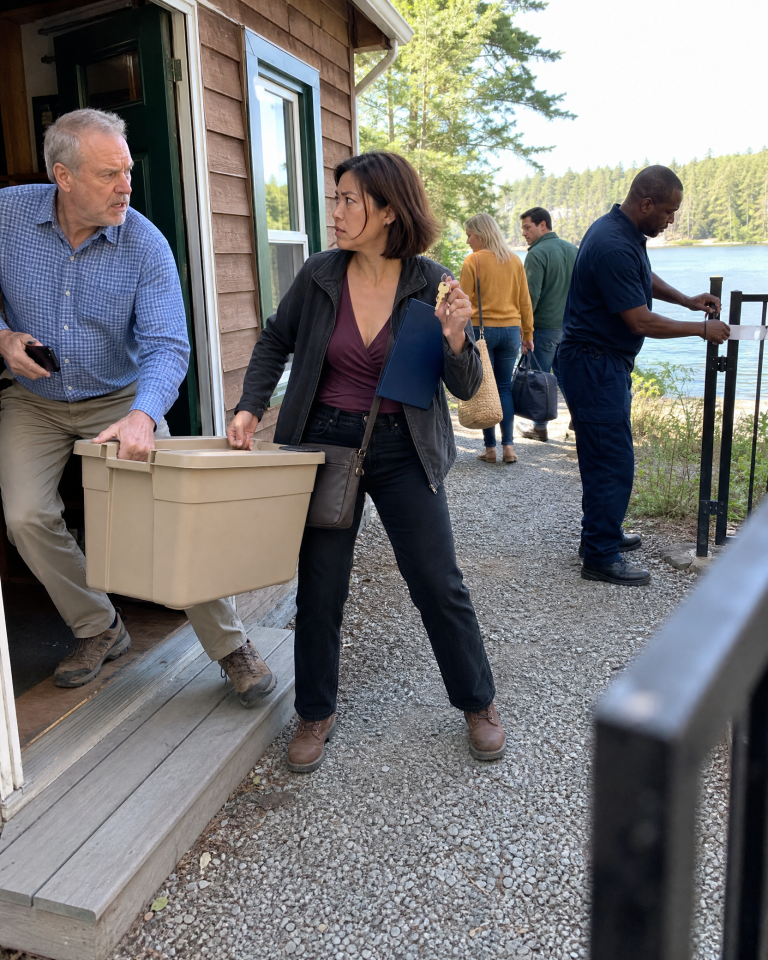
I had arranged the private meeting with Vivian for the following afternoon, at the secluded lakeside cabin that had once been our family refuge. It was a place where we could not be interrupted, where the final, crushing blows could be delivered in absolute privacy.
Mentally, I rehearsed the confrontation, bracing myself for the emotional toll. I knew Vivian would fight, but I was armed with undeniable truth. The weight of it felt immense, a profound mix of dread and resolute purpose.
Chapter 14: The Lakeside Cabin
The lakeside cabin, nestled among towering pines, usually offered a sense of peaceful retreat. Today, it felt charged with an electric tension, the stillness before a storm. I sat in my wheelchair by the large window, looking out at the shimmering water, waiting.
Vivian’s sleek black sedan pulled up the gravel driveway precisely on time. She stepped out, radiating confidence and impatience, her designer suit impeccable. She entered the cabin, her heels clicking crisply on the hardwood floor.
“Eleanor,” she said, her tone clipped, “I don’t have much time. I have a debate to prepare for.”
She didn’t offer a hug or even a genuine smile, just a perfunctory nod. Her eyes scanned the room, dismissing the scattered documents on the table with a flick of her gaze. She assumed I was here for a desperate plea, a sisterly intervention, perhaps begging for reconciliation or a private financial settlement.
She probably expected me to offer a public endorsement in exchange for some small allowance. The thought of it was a specific, cutting insult. She had no idea of the true purpose of this meeting, only that it was a brief, inconvenient delay before her triumphant debate.
She sat down opposite me, crossing her legs, a look of bored expectation on her face. Her casual dismissal of my presence, her certainty of her own power, was chilling. She was walking into a trap, utterly blind to its jaws.
Chapter 15: The Unveiling of Truth
I met Vivian’s impatient gaze, my own expression calm and composed. The stillness in the cabin was almost deafening. This was not a plea. This was an accounting.
“Vivian,” I began, my voice quiet, reflective. “Do you remember this cabin? How we used to come here as children?”
She shifted in her seat, agitated. “Eleanor, I truly don’t have time for a trip down memory lane. Get to the point.”
Her dismissal spurred me on. I reached for the stack of documents, sliding them deliberately across the polished table, placing them directly between us. The yellowed parchment of the original will, the formal language of the codicil, and the damning preliminary findings from the Oversight Committee.
Vivian’s confident facade, which had seemed so impenetrable moments before, began to crack. Her eyes darted from document to document, her smile faltering. The color drained from her face, leaving her features stark and vulnerable.
She reached out, her hand trembling slightly as she picked up the committee’s report. “What… what is this?” she whispered, her voice barely audible.
The shock was palpable, her carefully constructed world beginning to crumble before her eyes. The truth, meticulously gathered and presented, was now undeniable. Her composure had shattered.
Chapter 16: The Legacy Shattered
“That, Vivian,” I said, my voice steady, “is the Oversight Committee’s preliminary findings.”
Her gaze flew to me, panic now evident in her eyes.
“The Legacy Preservation Clause and the codicil,” I continued, gesturing to the documents, “empower them to act.”
I explained, calmly and systematically, how the committee was poised to make a public statement before her debate. They would expose her financial manipulation of the Albright Land Trust, detailing the exact amounts diverted and the specific clauses she had violated. It would utterly destroy her career, her carefully cultivated reputation, and the Albright dynasty’s name.
Vivian exploded. “No! You can’t do this, Eleanor! You’re betraying the family! You’re a bitter old woman, always jealous!”
She lashed out, her voice rising, a desperate torrent of denial and personal attacks. Her face was contorted with rage, the polished politician gone.
I let her rant, then, when she finally paused for breath, I reached for the last document. With a slow, deliberate movement, I placed the faded, sealed incident report from our old boarding school onto the table. It was fragile, its corners soft with age.
“This,” I said, my voice steady, “is the truth about the fire. The truth I protected you from.”
Vivian stared at the report, her eyes wide with dawning horror. Her name was visible on the cover. The report detailed her reckless actions with forbidden fireworks in the attic, the precise moment she ignited the blaze, not an accidental spark. My decades-long cover-up, the years of pain and physical scarring I had endured to save her from expulsion and family disgrace, lay exposed.
Her face crumpled, the last vestiges of her strength giving way. The silence that followed was deafening, filled only with the echoes of a shattered legacy.
Chapter 17: The Aftermath of Silence
Vivian stared at the incident report, then at me, her eyes hollow. The rage had drained from her face, replaced by a raw, empty despair. Her political ambitions, her entire perception of her past, were utterly shattered. She had nothing left to say.
After what felt like an eternity, she slowly pushed herself up from the chair. She didn’t look at the scattered documents, nor did she meet my gaze. Her movements were stiff, like a marionette with cut strings.
She simply turned and walked out of the cabin, the heavy wooden door closing with a soft thud behind her. No apology, no word of acknowledgment, just the crushing weight of their broken bond left in the silence.
I sat alone, the papers still strewn across the table. The weight of the revelation, the finality of it all, pressed down on me.
Hours later, my phone vibrated. Dr. Carter’s text message was brief: “News channels reporting Vivian’s sudden withdrawal from gubernatorial race. Citing ‘personal family matters’.” The political world, already buzzing, would soon erupt with the full story.
The victory felt hollow, tinged with a profound sadness. I had won the truth, but lost the sister I had once sacrificed everything for. The cost was immense.
Chapter 18: A Dynasty’s Retreat
The news spread like wildfire. The Oversight Committee, once a hidden safeguard, issued a carefully worded public statement confirming its intervention. They detailed the specific financial improprieties concerning the Albright Land Trust and Vivian’s campaign. The media frenzy was immediate and brutal.
Within days, a brief, terse statement from the Albright parents hit the wire. Senator Jonathan Albright and Eliza Albright announced their “immediate retirement from public life,” citing “health reasons” and the desire to “spend more time with family.” The thinly veiled excuses fooled no one.
Their political influence, once unassailable, evaporated overnight. The Albright dynasty, built on decades of carefully managed lies and exploitation, collapsed in disgrace. Their name, synonymous with power, was now irrevocably tainted.
My phone chimed with a private message from Senator Holloway. “Eleanor,” it read, “Justice is often a quiet victory, but a profound one. Your grandfather would be proud.” Her quiet, private message of respect was a small comfort amidst the wreckage.
I knew their retreat was not just political; it was also social. The elite circles they had so carefully cultivated would now shun them. Their carefully constructed world had imploded, a consequence of their own deceit.
The truth had finally come to light, bringing down a corrupt empire, but the personal scars remained, fresh and aching.
Chapter 19: The Birthday Rose
On my next birthday, the sun streamed warmly onto my patio. I sat, watching a single, gnarled rose bush I had planted decades ago, its petals now a vibrant, hopeful red. It had survived neglect, harsh winters, and countless storms.
Dr. Ben Carter arrived with a small, unpretentious cake, its frosting a simple white. He didn’t mention Vivian or the Albright family, just offered a quiet smile.
“Happy Birthday, Ellie,” he said, placing the cake gently on the table.
His unwavering loyalty, his quiet companionship, was a solace. We sat in comfortable silence for a moment, the only sound the gentle rustle of the rose’s leaves.
After a moment of quiet reflection, I reached out to gently touch the soft petals of the rose. Its thorns were still sharp beneath my fingers.
“Some scars never truly heal, not from fire, nor from the cold silence of betrayal,” I murmured, my voice soft but firm, “but even in their ache, they remind us of what we truly saved, and what we couldn’t.”




+ There are no comments
Add yours