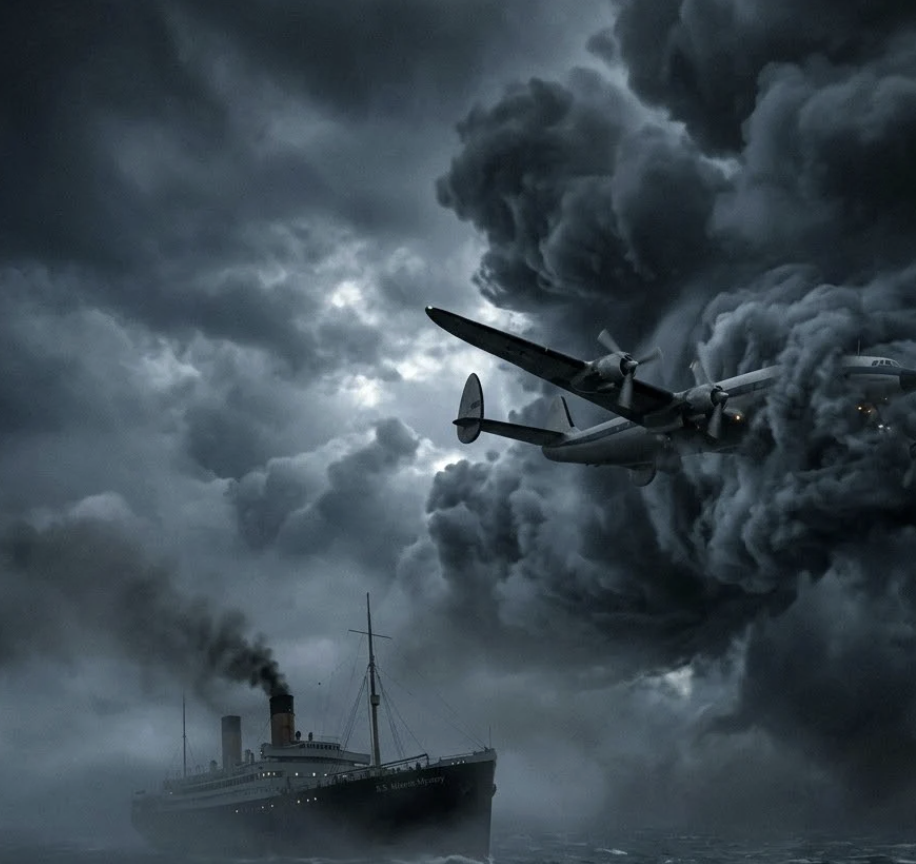
There is a stretch of ocean where maps look ordinary, but stories do not.
For decades, ships, planes, and entire crews have vanished there, leaving behind no wreckage, no final message, and sometimes no explanation at all.
And even today, the name Bermuda Triangle still makes people wonder what the ocean is hiding.
The Bermuda Triangle is usually described as a region of the western North Atlantic Ocean, roughly connecting Florida, Bermuda, and Puerto Rico. On a map, it does not look frightening. There are no warning signs printed across the water, no red border, no official line where ordinary sea becomes mystery. Ships pass through it. Planes cross it. Cruise routes and commercial traffic move through the region every day.
Yet for generations, people have spoken about this area differently.
They call it the Devil’s Triangle.
They whisper about vanished ships.
They remember aircraft that never returned.
They imagine pilots staring at spinning compasses, captains calling into static, and families waiting beside radios for messages that never came.
What makes the Bermuda Triangle so powerful is not one single disappearance. It is the pattern people believe they see. A ship leaves port and never reaches land. A plane takes off on a routine mission and vanishes into clouds. Search crews go looking and sometimes become part of the story themselves. Each case adds another layer to the legend until fact and fear become almost impossible to separate.
One of the earliest and most haunting cases often linked to the Bermuda Triangle is the disappearance of the USS Cyclops in 1918.
The Cyclops was not a small boat lost in rough weather. It was a massive U.S. Navy ship, carrying hundreds of people and a heavy cargo of manganese ore. It departed from the Caribbean region, heading toward Baltimore. Then it disappeared. No distress call. No wreckage. No bodies recovered. Nothing that gave families a clear final answer.
More than 300 people were gone.
For the families left behind, the worst part was not only grief. It was uncertainty. A death with no body is a wound that never fully closes. A disappearance at sea leaves loved ones trapped between mourning and hope. Maybe there was an explosion. Maybe the ship broke apart. Maybe it sank quickly in heavy seas. Maybe the crew never had time to call for help. Theories came and went, but no confirmed wreck was found.
The ocean kept its secret.
Then came another famous chapter in the legend: Flight 19.
On December 5, 1945, five U.S. Navy torpedo bombers took off from Fort Lauderdale, Florida, on a training mission. It should have been routine. The pilots were not supposed to become part of history. They were supposed to fly, train, navigate, and return.
They never came back.
Radio transmissions suggested confusion. The flight leader reportedly believed his instruments were malfunctioning or that the aircraft had become lost. The weather worsened. Fuel ran low. Search efforts began. Then even more tragedy followed when a rescue aircraft sent to look for them also disappeared.
The story was terrifying because it sounded like something from a nightmare.
A group of planes lost over open water.
A rescue mission vanishing too.
No simple answer.
No recovered aircraft to close the case.
Flight 19 became one of the most famous Bermuda Triangle stories, and it helped shape the public imagination. People pictured five planes flying in formation, then slowly drifting into a strange world where compasses failed and the ocean below no longer looked familiar. Whether the true explanation involved navigation errors, worsening weather, fuel exhaustion, or a combination of human and environmental factors, the mystery became larger than the facts.
That is how legends grow.
They begin with real fear.
Then unanswered questions turn into stories.
By the 1950s and 1960s, writers and magazines began connecting different disappearances into a single pattern. Cases that happened years apart were placed under one mysterious label. The Bermuda Triangle became more than a geographic area. It became a symbol.
People wanted to know why.
Why this part of the ocean?
Why so many stories?
Why did some cases seem to leave no trace?
Theories multiplied.
Some were scientific.
Some were dramatic.
Some were almost unbelievable.
People suggested violent storms. Rogue waves. Human error. Mechanical failure. Compass variation. Strong currents. Methane gas. Secret military activity. Even aliens and Atlantis entered the conversation.
The more unusual the theory, the more attention it received.
But behind the dramatic ideas were real dangers.
The Atlantic Ocean in that region can be unpredictable. Storms can form quickly. Tropical weather can become deadly. The Gulf Stream is powerful and can carry debris far from a wreck site. Deep ocean trenches make recovery difficult. A small error in navigation can become catastrophic when surrounded by endless water.
Many experts argue that the Bermuda Triangle is not uniquely dangerous compared with other heavily traveled parts of the ocean. That does not make the disappearances less tragic. It simply means the mystery may say as much about human imagination as it does about the sea.
Still, not every case has a satisfying ending.
And that is exactly why the legend survived.
People do not remember only the explanations. They remember the empty spaces. The ships that never sent one last message. The planes that vanished from the sky. The searches that found nothing. The families who waited for answers and received only theories.
For every expert who says the mystery is exaggerated, there is someone else who asks:
Then where are the wrecks?
Where are the final recordings?
Why did some experienced crews vanish without warning?
Why do certain stories still feel unfinished?
The Bermuda Triangle became famous because it lives in that uncomfortable space between logic and uncertainty. It invites explanation, then resists emotional closure. It tells us the ocean is not fully knowable. It reminds us that even in the modern age, with radar, satellites, GPS, and advanced search technology, the sea can still erase a human journey almost completely.
But the strangest part of the Bermuda Triangle may not be the disappearances themselves.
It may be what happened afterward.
Because once the world gave this region a name, every incident inside it became part of something bigger. A missing boat was no longer just a missing boat. A lost plane was no longer only an aviation tragedy. Each new story was pulled into the legend, whether it truly belonged there or not.
The Bermuda Triangle became a mirror.
People looked at it and saw what frightened them most.
For sailors, it was the fear of the sea.
For pilots, it was the fear of instruments failing above endless water.
For families, it was the fear of never knowing what happened.
For the public, it was the fear that the world still contained places where truth could disappear.
And perhaps that is why the Bermuda Triangle never faded away.
Not because every story is impossible to explain.
But because some mysteries do not need to be impossible to be haunting.
They only need to remain incomplete.
As the Bermuda Triangle became famous, something unusual happened.
The legend began to grow faster than the evidence.
Every strange disappearance in the region seemed to strengthen the myth. Every unexplained detail became proof in the minds of believers. Every missing wreck, every confused radio message, every sudden storm, every abandoned vessel helped build the same chilling idea: something was wrong with this part of the ocean.
But researchers began asking a different question.
Was the Bermuda Triangle truly more dangerous than other busy ocean routes?
The answer was not as dramatic as the legend.
Many experts found that the region sees enormous amounts of traffic. Ships, private boats, military aircraft, cargo vessels, and passenger planes have crossed it for decades. When a heavily traveled region experiences accidents, the raw number of incidents can appear frightening. But that does not automatically mean the area itself is supernatural or uniquely cursed.
In other words, the Bermuda Triangle may seem terrifying partly because so many people pass through it.
Still, that explanation does not erase the fear.
Statistics may calm researchers, but they do little for families who lost someone without answers.
Take the USS Cyclops. Even if the most reasonable theories involve cargo problems, rough seas, structural failure, or other natural causes, the emotional reality remains devastating. A huge Navy ship vanished with hundreds aboard, and the wreck has never been conclusively found. That kind of disappearance leaves room for imagination because the ocean never gave back enough evidence to close the story.
Flight 19 works the same way.
Investigators and historians have pointed toward navigation confusion, worsening weather, and fuel exhaustion. Those explanations are plausible. They are grounded. They fit what is known about aviation risk at the time. But the image of five military planes vanishing together remains powerful because there was no final recovered aircraft sitting in a hangar to tell the complete story.
The facts point one direction.
The imagination runs in another.
That tension is the heart of the Bermuda Triangle.
Over the years, scientists and skeptics offered many practical explanations. Sudden storms can overwhelm vessels. The Gulf Stream can scatter wreckage far from the point of sinking. Deep waters can hide debris forever. Human error can turn dangerous quickly at sea. Mechanical failure can leave crews helpless. Rogue waves, rare but real, can rise with terrifying force and destroy vessels before distress calls are made.
None of these explanations require monsters, portals, or alien ships.
But they do require accepting something equally frightening.
Nature does not need to be supernatural to be deadly.
The ocean is vast, powerful, and indifferent. It does not preserve every clue. It does not guarantee closure. It can swallow steel, silence radios, scatter debris, and leave families with nothing but a date, a route, and a last known position.
Perhaps that is why supernatural theories became so popular.
They gave shape to fear.
A mysterious force feels easier to imagine than random tragedy. A curse feels more memorable than bad weather. A hidden power beneath the waves feels more satisfying than a chain of ordinary failures ending in disaster.
People want stories to have meaning.
The Bermuda Triangle offered meaning, even when evidence did not.
In the 1970s, books and television programs helped turn the legend into a cultural phenomenon. The Bermuda Triangle became a household phrase. It appeared in documentaries, magazines, classroom conversations, late-night radio shows, and dinner-table debates. For many Americans, it became one of those mysteries everyone knew, even if they could not name every case.
Parents warned children about it.
Students wrote reports about it.
Writers built entire theories around it.
The region became less a place than an idea.
An idea that somewhere between Florida, Bermuda, and Puerto Rico, the normal rules might not always apply.
But the more the legend spread, the more complicated the truth became.
Some cases linked to the Bermuda Triangle were later explained. Some were shown to have occurred outside the commonly described area. Some details were exaggerated in retellings. Some stories changed as they passed from article to book to television special. Facts became smoother, darker, and more mysterious with each version.
That does not mean every mystery was fake.
It means the legend became a mixture.
Real disappearances.
Incomplete investigations.
Natural hazards.
Human mistakes.
Media exaggeration.
Public fascination.
And unanswered questions that refused to die.
That mixture made the Bermuda Triangle nearly impossible to dismiss completely.
Because even when one story is explained, another remains open.
Even when experts provide reasonable causes, people ask why so many cases feel strange.
Even when statistics suggest the region is not unusually deadly, the stories continue to carry emotional power.
The Bermuda Triangle survives because it is not only about evidence.
It is about uncertainty.
It is about the way humans respond when the world does not give clean answers.
In many ways, the Bermuda Triangle is less a mystery of geography than a mystery of memory.
Why do certain stories stay with us?
Why do we remember vanished ships more than safe arrivals?
Why do unanswered questions feel more powerful than explanations?
Why does a missing plane haunt us more than a solved accident?
The answer may be simple.
A solved tragedy ends in grief.
An unsolved one keeps moving.
It follows people through generations.
It invites new theories.
It becomes part of culture.
That is what happened with the Bermuda Triangle.
It became a place where the real and the imagined met.
A place where science and folklore argued.
A place where every wave seemed to hide another possible answer.
Today, modern navigation and communication have reduced many risks that once made sea and air travel far more dangerous. GPS, satellite tracking, improved weather forecasting, emergency beacons, and better safety systems mean fewer journeys disappear without trace. But the legend remains.
Because legends do not survive on facts alone.
They survive on feeling.
The Bermuda Triangle makes people feel the size of the ocean.
It reminds us how small human machines can be against water, weather, darkness, and distance.
It reminds us that progress does not erase mystery.
And it reminds us that sometimes the most haunting question is not whether something supernatural happened.
It is whether ordinary explanations are enough to satisfy a frightened human mind.
In the end, the Bermuda Triangle may not be a cursed zone.
It may not be a portal.
It may not be the home of some hidden force beneath the waves.
But it is still real in another sense.
Real as a place.
Real as a legend.
Real as a collection of losses that families felt deeply.
Real as a reminder that the ocean still holds stories we may never fully recover.
And perhaps that is the true twist.
The Bermuda Triangle did not become famous only because ships and planes disappeared.
It became famous because people could not stop searching for meaning in the silence they left behind.
Do you think the Bermuda Triangle is mostly a legend built from natural accidents and human imagination, or do some disappearances still deserve to be called truly unexplained?


