Three words haunted me for most of my life.
Not good enough.
Not smart enough.
Not successful enough.
Not beautiful enough.
Not talented enough.
No matter what I achieved, the feeling remained.
It followed me through school.
Through college.
Through relationships.
Through every promotion and every failure.
Like a shadow that refused to disappear.
Years after my mother died, I discovered she had known about that shadow all along.
And she left behind a box she hoped I would never need.
But one day, I did.
My name is Emma Parker.
I was thirty-four years old when my life fell apart.
At least that’s how it felt.
Within six months, I lost almost everything I thought defined me.
My relationship ended.
The company I worked for eliminated my position.
My savings shrank faster than I expected.
Friends I thought would stay close slowly disappeared into their own lives.
For the first time since college, I moved back into a small apartment by myself.
Every morning felt heavier than the one before.
Every night lasted too long.
The worst part wasn’t the loneliness.
It was the voice inside my head.
The voice that kept repeating the same sentence.
“You failed.”
At first it whispered.
Then it shouted.
Soon it became impossible to ignore.
I compared myself to everyone.
Former classmates.
Friends.
People online.
Strangers.
Everyone seemed happier.
More successful.
More confident.
Meanwhile, I struggled to get out of bed.
One rainy afternoon, after another rejected job application, I found myself sitting on the floor of my bedroom crying.
Not because of the job.
Because I genuinely believed there was something wrong with me.
Something fundamentally missing.
I remembered a thought I had as a teenager.
A thought I never admitted out loud.
Maybe everyone else received instructions for life.
And somehow mine got lost.
The feeling stayed with me for weeks.
Then one Saturday morning, while searching through old storage boxes in my apartment closet, I found something I hadn’t seen in years.
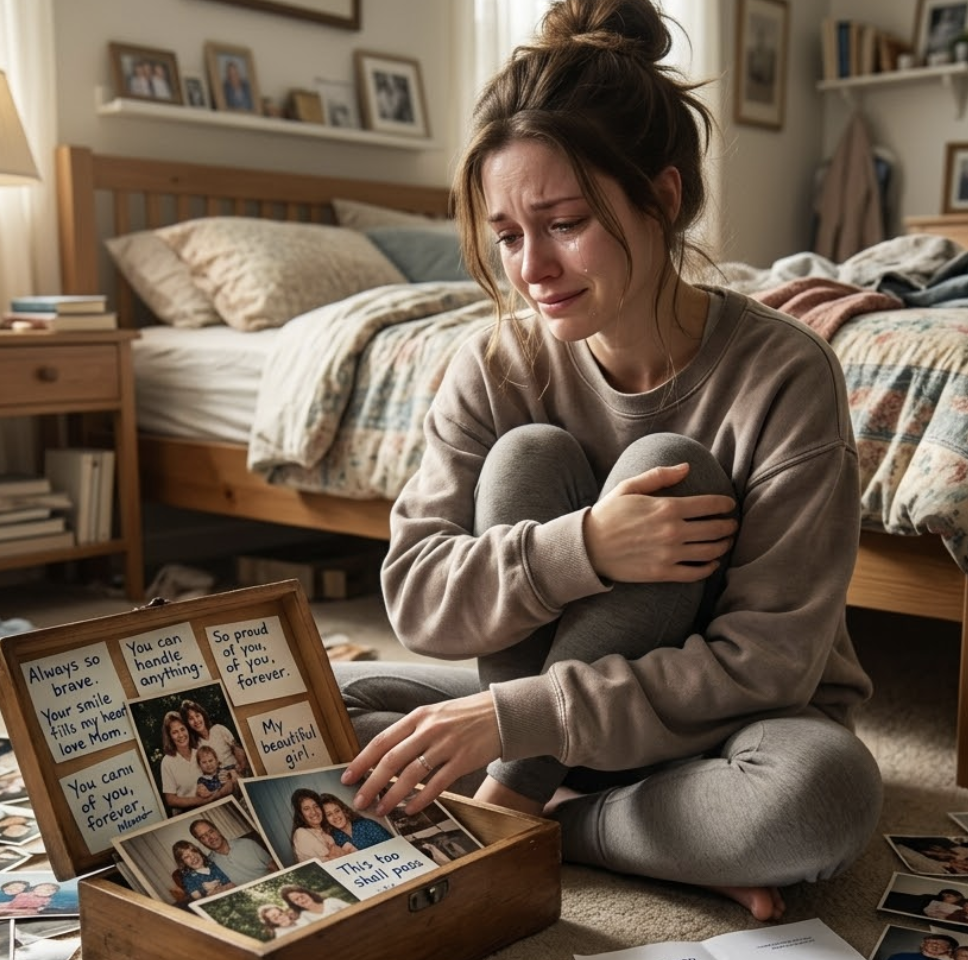
A small wooden box.
Dark brown.
Simple.
No lock.
No decoration.
Just a handwritten label attached to the top.
The moment I read the words, I stopped breathing.
The label said:
“Open when you feel you are not good enough.”
My mother’s handwriting.
I immediately sat down.
My hands began shaking.
Because suddenly I remembered.
The box.
The conversation.
The promise.
Years earlier, shortly before she died, my mother gave me several personal items.
Family photographs.
Letters.
Jewelry.
And this box.
I was twenty-three at the time.
Young.
Busy.
Certain I understood life.
When she handed it to me, I laughed.
“What is it?”
She smiled.
“You’ll know when to open it.”
I rolled my eyes.
“That sounds mysterious.”
“It isn’t.”
“Then why not tell me?”
She simply shook her head.
“Because if I explain it now, it won’t mean as much later.”
I never opened it.
Not after her funeral.
Not after moving cities.
Not after getting engaged.
Not after buying my first home.
The box followed me through eleven years of life.
Always sitting quietly on a shelf.
Always waiting.
Now, sitting alone on my apartment floor, I suddenly understood.
This was the moment she had prepared it for.
For the first time since her death, I reached for the lid.
Then stopped.
Fear washed over me.
What if opening it made everything worse?
What if there was nothing inside?
What if I expected comfort and found disappointment instead?
The box remained closed for another three weeks.
Three weeks during which my life continued unraveling.
More job rejections.
More self-doubt.
More sleepless nights.
Eventually, one particularly difficult evening pushed me over the edge.
I attended a gathering with former coworkers.
Everyone seemed to be thriving.
Promotions.
Marriages.
New homes.
New businesses.
New opportunities.
I smiled.
Congratulated them.
Pretended everything was fine.
Then I drove home and cried in my car for nearly an hour.
When I entered my apartment, I walked directly to the closet.
Retrieved the box.
Placed it on my kitchen table.
And opened it.
Inside were dozens of photographs.
Nothing else.
Just photographs.
At first, I felt confused.
Almost disappointed.
I had expected a letter.
Advice.
Instructions.
Some great revelation.
Instead, I found ordinary pictures.
A kindergarten photo.
A birthday party.
School plays.
Family vacations.
Graduation.
Soccer games.
Simple moments from my life.
I picked up the first photograph.
A picture of me at six years old standing beside a bicycle.
Then I noticed writing on the back.
My mother’s handwriting.
I turned the card over completely.
The message read:
“This was the day you fell off your bike six times and still got back on.”
My throat tightened.
I grabbed another photo.
A school recital.
The back read:
“You were terrified before walking onto that stage, but you did it anyway.”
Another.
A picture from middle school.
“This was the year you thought nobody liked you. You kept being kind anyway.”
Another.
A photo after a soccer game.
“You sat on the bench most of the season but never stopped showing up.”
I felt tears forming.
Because suddenly I understood.
My mother hadn’t collected photographs.
She had collected evidence.
Evidence against every cruel thing I would one day say about myself.
Every picture captured a moment I had forgotten.
A moment when I had been brave.
Persistent.
Kind.
Resilient.
Strong.
The box contained nearly fifty photographs.
And every single one carried a handwritten message.
Every single one documented a moment when I succeeded at something far more important than achievement.
I continued turning photographs over.
One after another.
And with every note, it felt as though my mother was sitting beside me again.
Then I reached a photograph that made me completely stop.
It was taken the year my father left.
I was twelve.
The hardest year of my childhood.
The picture showed me smiling awkwardly at a school event.
The note on the back read:
“Nobody knows how hard this year has been for you. But I do.”
My vision blurred.
And then came the next sentence.
A sentence that would change everything.
The second sentence on the back of the photograph read:
“You think you’re surviving. What you’re actually doing is becoming stronger.”
I stared at those words until the ink blurred through my tears.
For years, I had remembered that chapter of my life as proof that I was broken.
My mother had remembered it as proof that I was brave.
The difference between those two perspectives felt small.
It wasn’t.
It changed everything.
I wiped my eyes and reached for another photograph.
This one showed me at thirteen years old, sitting at a kitchen table covered with textbooks.
I remembered that year immediately.
It was the year my grades collapsed after my father left.
The year teachers started saying I wasn’t applying myself.
The year I secretly believed I was becoming a disappointment.
I turned the picture over.
My mother’s handwriting covered nearly the entire back.
“You cried every night while pretending everything was fine during the day.”
My chest tightened.
“Nobody saw how hard you were trying. But I did.”
I closed my eyes.
Because that was exactly how it had felt.
People often assume children don’t notice when families break apart.
They’re wrong.
Children notice everything.
The silence.
The tension.
The empty chair at dinner.
The way adults suddenly stop laughing.
The way nobody answers certain questions.
That year, I spent months feeling like I was drowning.
And yet somehow I had forgotten that part.
I remembered the bad grades.
I remembered feeling lonely.
I remembered my failures.
My mother remembered my effort.
I picked up another photograph.
I was sixteen.
Standing awkwardly beside a group of girls at school.
I almost laughed.
That had been one of the worst years of my life.
I never felt like I belonged.
I was too quiet.
Too insecure.
Too desperate to be liked.
The note on the back said:
“This was the year you were left out of parties and cried in your room.”
I swallowed hard.
Then I read the next line.
“You still treated people kindly.”
Another line.
“Many people become bitter when they are hurt. You didn’t.”
I sat completely still.
Because I had never once considered kindness an achievement.
I considered it normal.
Expected.
Ordinary.
Yet my mother had considered it something worth remembering.
Something worth documenting.
Something worth saving for the future.
A future version of me who would forget.
The photographs continued.
One after another.
Each one revealing a memory I had filed under failure while my mother had filed it under courage.
There was a picture from college.
I immediately recognized it.
The day I failed an important exam.
At the time, I was convinced my future was ruined.
I turned the photo over.
“You failed today.”
I laughed sadly.
Finally.
A photograph acknowledging failure.
Then I read the next sentence.
“And tomorrow you tried again.”
Another.
“That matters more.”
My mother had never been impressed by perfection.
She was impressed by persistence.
There is a difference.
A massive difference.
Most people celebrate success.
Few people celebrate resilience.
My mother apparently had.
For years.
Without telling me.
The deeper I dug into the box, the more I realized she had been collecting evidence for a case I didn’t even know existed.
A case against self-hatred.
A case against self-doubt.
A case against the cruel voice inside my head.
Then I found an envelope hidden beneath the photographs.
Unlike the pictures, I had never seen it before.
My hands froze.
Across the front, in familiar handwriting, were six words:
“For the day you finally open this.”
My heart started racing.
Slowly, carefully, I opened the envelope.
Inside was a letter.
Several pages long.
I immediately recognized the handwriting.
It was my mother’s.
And somehow, despite the years that had passed since her death, seeing those words felt like hearing her voice again.
The letter began simply.
“Hello sweetheart.”
Tears immediately filled my eyes.
“If you’re reading this, then two things are probably true.”
“First, I’m gone.”
“Second, you’re hurting.”
I stopped reading for a moment.
Because she was right.
Painfully right.
The letter continued.
“I don’t know what happened.”
“Maybe someone broke your heart.”
“Maybe you lost a job.”
“Maybe life didn’t turn out the way you hoped.”
“Maybe you’re simply tired.”
“But I know you.”
“And I know there will come a day when you forget who you are.”
I couldn’t breathe.
Because that was exactly what had happened.
Not just recently.
For most of my life.
I had spent years forgetting my own worth.
The letter went on.
“You have always been harder on yourself than anyone else.”
“Even as a little girl.”
“You thought mistakes made you unworthy.”
“You thought failure made you weak.”
“You thought being imperfect made you less lovable.”
“I spent years trying to convince you otherwise.”
“I’m not sure I succeeded.”
“So I made this box.”
At that point, I was openly crying.
Not elegant tears.
Not movie tears.
The kind of tears that leave your chest aching.
Because suddenly I understood.
The box had never been intended as a keepsake.
It was a rescue kit.
Prepared years in advance.
For a future emotional emergency.
A future my mother somehow knew would arrive.
The letter continued.
“Every photograph in this box contains a moment you survived.”
“Not because you were fearless.”
“Because you weren’t.”
“Not because life was easy.”
“Because it wasn’t.”
“They are here because you kept going anyway.”
I looked around at the photographs scattered across the floor.
My entire life lay in front of me.
Not my achievements.
My perseverance.
The distinction mattered.
More than I had ever realized.
Then I reached the paragraph that changed me forever.
“You spend too much time asking whether you’re enough.”
“You always have.”
“So let me answer.”
I stopped breathing.
“You were enough when you fell off your bicycle.”
“You were enough when your father left.”
“You were enough when your heart was broken.”
“You were enough when you failed.”
“You were enough when you succeeded.”
“You were enough on your best days.”
“And you were enough on your worst.”
By then I couldn’t see clearly through my tears.
But I kept reading.
“Nothing you achieve will make you worthy.”
“Nothing you lose will make you unworthy.”
“Your value was never dependent on performance.”
“It never will be.”
I must have read those sentences twenty times.
Because they directly contradicted everything I believed.
For years, I had measured myself like a report card.
Success meant value.
Failure meant shame.
Achievement meant worthiness.
Struggle meant weakness.
My mother spent years trying to teach me otherwise.
And apparently she had prepared one final lesson.
Years after her death.
The letter continued for several more pages.
She shared memories I had forgotten.
Stories from childhood.
Moments when I had shown courage without realizing it.
Times I had helped people.
Comforted friends.
Persevered through difficult circumstances.
None of them were dramatic.
None of them would make headlines.
That was precisely the point.
My mother wasn’t documenting greatness.
She was documenting character.
Near the end of the letter, she wrote:
“One day you may have children.”
“If that happens, watch how they see themselves.”
“Protect them from the lie that worth must be earned.”
“Because that lie steals joy from good people.”
“It stole too much from you.”
Then came the final paragraph.
The paragraph that still makes me emotional years later.
“I know there will be days when you don’t believe in yourself.”
“Borrow my belief until yours returns.”
“That’s what mothers do.”
“We carry faith for our children when they cannot carry it themselves.”
“And if you’re reading this, sweetheart, then I need you to know something.”
“I never once looked at you and wondered whether you were enough.”
“The answer was always yes.”
The letter ended there.
No grand conclusion.
No dramatic revelation.
Just love.
Pure, unwavering, unconditional love.
I sat on the floor for hours afterward.
Not thinking.
Not analyzing.
Just feeling.
For the first time in years, the voice inside my head was quiet.
Not gone.
But quieter.
Its accusations suddenly seemed less convincing.
Because now there was evidence.
Fifty photographs.
One letter.
A lifetime of proof.
The next morning, I woke up expecting the feeling to disappear.
I expected reality to return.
My problems were still there, after all.
I was still unemployed.
Still heartbroken.
Still uncertain about the future.
And yet something fundamental had shifted.
I no longer viewed those circumstances as a verdict on my worth.
That distinction changed everything.
Weeks later, I began applying for jobs again.
Months later, I started seeing friends more often.
Eventually, I found meaningful work.
Eventually, I fell in love again.
Eventually, life moved forward.
Not because the box magically fixed everything.
Because it helped me remember something I had forgotten.
That difficult seasons are chapters.
Not identities.
Years have passed since that night.
The photographs remain in the box.
The letter remains folded inside its envelope.
Every now and then, when life becomes overwhelming, I take them out again.
Not because I need advice.
Because I need perspective.
Because self-doubt has a short memory.
But love doesn’t.
And perhaps that’s the real twist.
I thought my mother left behind a box.
What she actually left behind was a way to find myself again.
Long after she was gone.
Long after I believed I was lost.
Whenever people ask me what was inside the box, I usually smile and give a simple answer.
Photographs.
That’s technically true.
But it isn’t the whole truth.
Inside that box was every moment my mother saw strength where I saw weakness.
Courage where I saw fear.
Growth where I saw failure.
Value where I saw flaws.
And perhaps the greatest gift any parent can leave behind is not money.
Not property.
Not possessions.
But evidence.
Evidence that someone knew you completely.
And loved you completely anyway.


