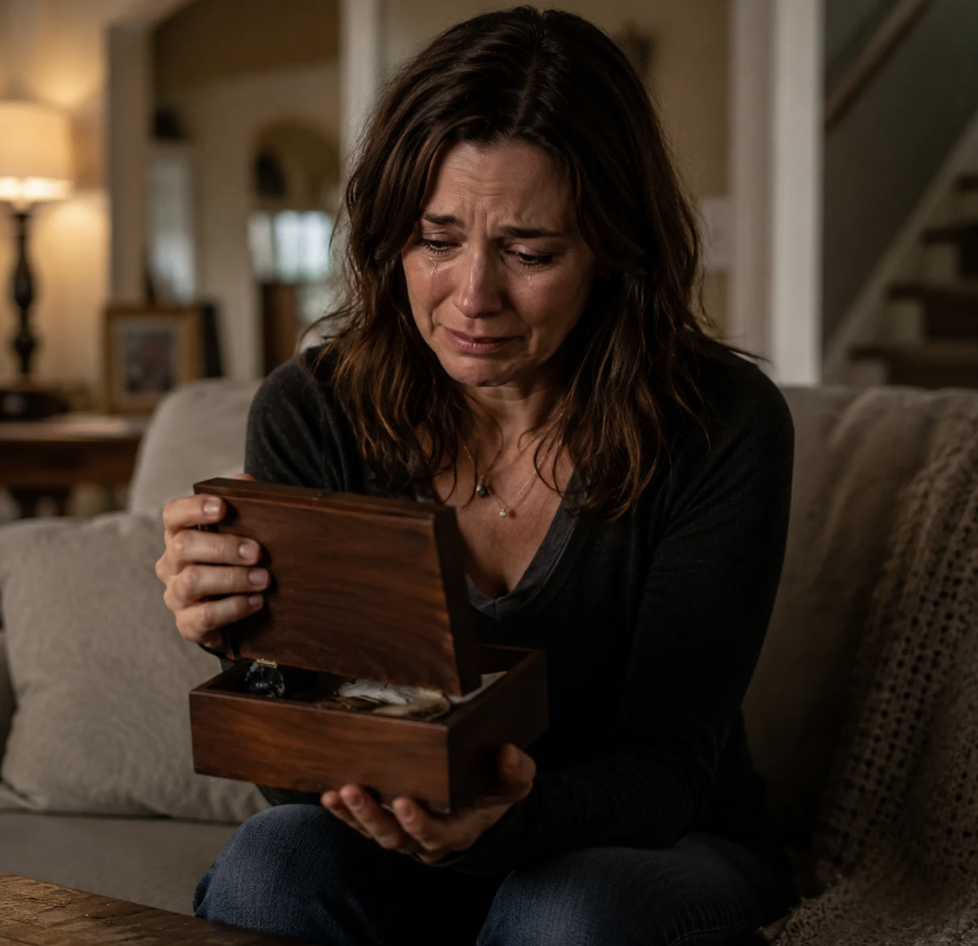
My mother left me a box with one warning written across the lid.
Do not open this when you are happy.
For years, I thought it was just another sad keepsake.
Then my marriage ended, my house went quiet, and that box became the only thing that made me feel less alone.
My mother, Grace Whitaker, was the kind of woman who prepared for everything.
She kept batteries in kitchen drawers.
Extra blankets in the hall closet.
Canned soup in the pantry.
Cash hidden inside an old recipe tin.
When storms came, neighbors called her first.
When someone got sick, she already had broth simmering.
When someone grieved, she knew whether to bring flowers, food, or silence.
But there was one thing she never prepared me for.
Living without her.
I was thirty-four when she died.
Too old to be called a child.
Too young to stop needing my mother.
Cancer took her slowly, then suddenly.
For months, we spoke about practical things because emotional things were too dangerous.
Hospital bills.
Medications.
House keys.
Insurance papers.
Where she kept important documents.
What dress she wanted buried in.
I hated those conversations.
She handled them with heartbreaking calm.
One afternoon, two weeks before she passed, she asked me to bring her a small wooden box from the top shelf of her bedroom closet.
It was plain.
Dark brown.
No decoration except a brass latch and a white label taped across the lid.
In her handwriting were seven words.
Do not open this when you are happy.
I tried to laugh.
“That sounds dramatic, Mom.”
She smiled, but her eyes looked tired.
“Good. Then you’ll remember it.”
I sat beside her hospital bed while she placed one thin hand on the box.
“This is for later.”
“Later when?”
“When life gets heavier than you think you can carry.”
I immediately shook my head.
“I don’t want it.”
“Yes, you do.”
“No, I want you.”
Her face changed.
Not with sadness exactly.
With the kind of pain mothers hide because their children are already breaking.
“I know, baby.”
That was the last time she called me baby.
She died thirteen days later.
After the funeral, everyone told me how strong I was.
People say that when they don’t know what else to say.
I didn’t feel strong.
I felt hollow.
But life continued in the cruel way it does.
Bills arrived.
Thank-you cards had to be written.
Her clothes had to be sorted.
Her house had to be emptied.
My husband, Mark, helped at first.
He carried boxes.
Spoke to the realtor.
Made phone calls I couldn’t handle.
Back then, I thought grief had brought us closer.
I was wrong.
It had only hidden the cracks.
The wooden box came home with me and sat on a shelf in our bedroom closet.
For years, I did not open it.
Sometimes I would see it while reaching for shoes or blankets.
That label always caught my eye.
Do not open this when you are happy.
At first, I avoided it because opening it felt like admitting my mother was gone.
Later, I avoided it because life became busy.
Work.
Marriage.
House repairs.
Birthdays.
Holidays.
All the ordinary noise of adulthood.
Then, gradually, I forgot about it.
Or told myself I had.
Ten years passed.
By then, I was forty-four.
My marriage looked respectable from the outside.
Nice house.
Decent jobs.
Holiday cards.
Couple photos.
Dinner with friends.
The kind of life other people looked at and assumed was stable.
Inside, it had been dying quietly for years.
Mark didn’t become cruel all at once.
That would have been easier to recognize.
He became absent.
Then impatient.
Then dismissive.
He stopped asking how my day was.
Stopped touching my shoulder when he passed behind me in the kitchen.
Stopped laughing at things we used to find funny.
When I tried talking about it, he blamed stress.
Work.
Money.
Exhaustion.
Anything except the truth.
Then one night I found the message.
It appeared on his phone while he was in the shower.
Just one sentence.
I miss waking up next to you.
There are moments in life when the body understands before the mind does.
My hands went cold.
My stomach tightened.
My ears began ringing.
I didn’t scream.
I didn’t throw the phone.
I simply sat on the edge of the bed staring at words that split my life into before and after.
When Mark came out, he knew.
His face gave him away before he spoke.
The affair had lasted eight months.
Eight months of hotel rooms.
Late meetings.
Fake business trips.
Eight months of me making dinners he barely ate, washing shirts that carried another woman’s perfume, and sleeping beside a man who was already leaving.
The divorce became final seven months later.
People expected me to be angry.
I was.
But anger was easier than the other feelings.
Humiliation.
Loneliness.
Fear.
The strange grief of mourning someone still alive.
The worse pain came from discovering how many people knew.
One friend suspected.
Another had seen them together.
Someone from Mark’s office had heard rumors.
No one told me.
After the divorce, I stayed in the house for three months.
Then I sold it.
Not because I wanted to.
Because every room had become evidence.
The kitchen where he lied.
The bedroom where I cried silently.
The dining room where we hosted friends who already knew.
I moved into a small apartment across town.
Second floor.
Thin walls.
No yard.
No memories.
For the first time in my adult life, I lived alone.
The silence frightened me.
During marriage, silence had felt like peace.
After divorce, silence felt like abandonment.
At night, the apartment made sounds I didn’t recognize.
Pipes.
Neighbors.
Cars outside.
My own refrigerator humming.
I slept with the television on just to hear human voices.
One Saturday afternoon, while unpacking the last boxes, I found the wooden box.
It had been wrapped in an old sweater.
The label was still there.
Slightly faded.
Do not open this when you are happy.
I sat on the floor holding it.
For several minutes, I couldn’t move.
Then I laughed.
Not because anything was funny.
Because my mother had known.
Not about Mark.
Not about the affair.
Not about the divorce.
But she had known life would eventually bring me to a place where happiness felt unreachable.
For the first time in ten years, I opened the latch.
Inside, there was no jewelry.
No cash.
No family heirloom.
No dramatic secret.
Just letters.
Dozens of them.
Each envelope labeled in my mother’s handwriting.
Open when you feel abandoned.
Open when someone betrays you.
Open when you blame yourself.
Open when the house is too quiet.
Open when you miss me.
Open when you think you are too old to start over.
Open when you need to remember who you are.
I covered my mouth with my hand.
The first envelope sat on top.
Its label read:
Open this one first.
I unfolded the letter with shaking hands.
My darling Anna,
If you are reading this, then life has hurt you in a way I cannot fix.
And that is the hardest part of being your mother.
I always wanted to protect you from pain, but I know now that no mother gets to do that forever.
So if this box has found you on a day when your heart feels broken, I need you to hear me clearly.
You are still here.
That means something.
You woke up.
You breathed.
You opened this box.
You reached for help, even if the help came from a woman who had to leave before you were ready.
I am proud of you for that.
I cried so hard the paper blurred.
Not delicate tears.
Not pretty grief.
The kind of crying that makes sound leave your body before you can stop it.
I hadn’t realized how long I had been waiting for my mother to say exactly that.
Not fix it.
Not judge it.
Not explain it.
Just tell me I was still here.
And that still mattered.
I read the letter three times.
Then I opened the next one.
Open when someone betrays you.
Inside, my mother wrote about betrayal as if she had known Mark personally.
She didn’t tell me to forgive.
She didn’t tell me to be graceful.
She didn’t tell me to take the high road.
She wrote:
Some people will hurt you and still expect you to protect their reputation.
Do not confuse silence with dignity.
Do not confuse anger with weakness.
You are allowed to feel the wound before you decide what to do with it.
That sentence changed something in me.
Because everyone around me had been encouraging peace.
Move on.
Don’t dwell.
Be mature.
Let it go.
My mother gave me permission to feel the truth first.
For the next several hours, I sat on the apartment floor opening letters.
Not all of them.
Only the ones I needed.
Open when you blame yourself.
Open when you feel replaced.
Open when you are afraid everyone else saw it coming.
Each letter met a pain I had not spoken aloud.
By evening, the room around me felt different.
Not healed.
Not fixed.
But less empty.
Then I found an envelope tucked beneath the others.
Unlike the rest, this one was sealed in red.
The label said:
Open when you think love has left your life for good.
I held that envelope for a long time.
Part of me wanted to open it immediately.
Another part was afraid.
Because I did think that.
I thought love had left.
Not only romantic love.
All of it.
My mother was gone.
My marriage was gone.
My old life was gone.
The woman I used to be felt gone too.
Finally, I opened it.
The first line made me stop breathing.
Anna, if you believe love has left your life, then I need to tell you something I should have told you years ago.
The letter continued.
And what my mother revealed next changed everything I thought I knew about her marriage, my childhood, and the quiet strength she had been carrying long before I was born.
I read the first line of that red-sealed letter again.
Anna, if you believe love has left your life, then I need to tell you something I should have told you years ago.
For a moment, I couldn’t continue.
The apartment was silent except for the refrigerator humming in the kitchen and the faint sound of traffic outside. I sat on the floor surrounded by cardboard boxes, divorce papers, and the kind of quiet that makes a person feel forgotten by the whole world. My mother’s handwriting seemed almost alive in my hands. Ten years after her death, she had reached into the loneliest night of my life and placed her voice exactly where I needed it.
I finally kept reading.
Your father left me once.
Not permanently.
Not legally.
Not in a way anyone at church or in town ever knew.
But he left me in every way that matters.
I stopped breathing.
My father, James Whitaker, had died when I was sixteen. In my memory, he was kind, patient, and steady. He worked at the hardware store, coached church softball, fixed neighbors’ lawnmowers, and kissed my mother every morning before leaving for work. Their marriage had always seemed safe to me, almost old-fashioned. They were the couple people pointed to and said, “That’s what love looks like.”
But according to my mother’s letter, that was not the whole truth.
When I was twenty-eight, years before you were born, your father fell in love with someone else. I discovered it because of a receipt in his coat pocket and a phone number written on the back. I remember standing in the kitchen holding that scrap of paper, feeling exactly what you may be feeling now. Like the floor had moved. Like the life I had trusted suddenly belonged to a stranger.
My hands tightened around the page.
For years, I had believed my mother’s strength came from never being broken. Now I realized it came from surviving something she had never described.
She wrote that my father had not been cruel afterward. That somehow made it worse. He cried. He apologized. He claimed he was confused. He claimed he still loved her. He claimed it meant nothing and then, in the same breath, admitted it had meant enough to risk everything. My mother wrote that betrayal is not only the act itself. It is the way it forces the innocent person to question every ordinary moment that came before it.
Was that dinner real?
Was that laugh real?
Was that anniversary card real?
Was I being loved, or merely managed?
I lowered the letter and stared across the room at the couch I had bought secondhand after moving into the apartment. I had asked myself those same questions about Mark. I had replayed vacations, dinners, birthdays, and quiet Sunday mornings, trying to determine when love had stopped being real. My mother had known that kind of pain before I was ever born.
The letter continued.
I did not leave immediately. People think they know what they would do. They don’t. Pain arrives, and suddenly your choices are not clean. I loved him. I hated him. I missed him while he sat across from me at the table. I wanted to punish him. I wanted him to hold me. I wanted my old life back, even though I knew it no longer existed.
I cried again, but softer this time.
My mother had never been the kind of woman who spoke dramatically. She did not decorate pain. She named it plainly, and because of that, it felt more honest than any advice I had received since my divorce began.
For months, she wrote, my father slept in the guest room. They attended church together and smiled at people who had no idea their home was divided by silence. My grandmother told my mother to stay because “men make mistakes.” My mother’s best friend told her to leave because “trust never comes back.” The pastor told them forgiveness was possible. My mother wrote that all three statements were partly true and partly useless.
Because nobody else has to live inside your marriage.
That sentence hit me so hard I had to set the letter down.
Nobody else has to live inside your marriage.
Not the friends telling me to be strong.
Not the relatives quietly choosing sides.
Not the people who thought divorce at forty-four was a fresh start.
Not Mark, who wanted forgiveness mostly because guilt made him uncomfortable.
Nobody else woke up in my body.
Nobody else had to rebuild my life from the ashes of his choices.
I picked up the letter again.
In the end, I stayed. I need you to know that clearly. Not because I was weak. Not because I had no choice. Not because the pain was small. I stayed because your father did something many people never do after causing harm. He changed without demanding applause for it.
For two years, my father answered every question. He gave up privacy he had once treated as a right. He went to counseling even though he hated discussing feelings. He accepted that my mother cried on days when nothing new had happened. He stopped asking when she would be “over it.” He carried the consequences of what he had done without rushing her healing.
My mother wrote that forgiveness did not arrive like sunlight.
It came in fragments.
A morning when she didn’t feel sick looking at him.
A dinner where they laughed without pretending.
A Sunday drive where she reached for his hand without thinking.
A quiet evening when she realized she no longer wanted revenge.
But she never called their marriage the same.
She called it rebuilt.
A rebuilt house may stand strong, but the people who live there remember the fire.
I sat there thinking of Mark.
He had apologized too.
But his apology came with impatience. He wanted the pain to end once he admitted it. He wanted me to stop asking questions because answers embarrassed him. He wanted peace without accountability. He wanted the appearance of healing because it made him look less guilty.
My mother’s next paragraph felt as if she had reached across time and put a hand under my chin.
If the person who hurt you wants forgiveness more than they want to understand your pain, be careful. They may only be asking you to clean up the mess they made inside themselves.
I whispered, “Oh, Mom.”
For months, I had wondered whether I failed by ending my marriage. People had said Mark made a mistake. People had said no marriage is perfect. People had said loneliness would be harder than forgiveness. But my mother, who had once stayed after betrayal, was not telling me to stay. She was telling me to look at the truth without fear.
The letter went on.
You may wonder why I never told you this. The answer is complicated and imperfect. Part of me wanted you to believe love could be steady. Part of me feared you would look at your father differently. And part of me, if I am honest, did not want my worst pain to become family history. Mothers are human too. Sometimes we hide wounds because we do not want our children touching them.
That made me cry harder than anything else.
All my life, I had seen my mother as a shelter. A place I could run to. A voice that steadied everything. But she had once been a young woman alone in a kitchen, holding evidence that her husband had betrayed her. She had once been someone whose future collapsed. She had once needed a mother of her own.
And yet she became mine.
The letter ended with this:
So if love has left your life, let me tell you the truth. Love has not left. A person may leave. A marriage may end. A dream may die. But love is bigger than the one who failed to protect it. Love is in the friend who answers at midnight. Love is in the stranger who is kind when you are barely holding together. Love is in your own decision to keep breathing. And love is here, in this box, waiting for you on the day you need me most.
I pressed the letter against my chest.
For the first time since the divorce, I did not feel foolish for being devastated. I did not feel behind. I did not feel like a failed wife or an aging woman starting over too late. I felt like a daughter. A hurt daughter being held by words her mother had saved for a pain she knew would someday come.
The next morning, I did something I had avoided for months.
I called my friend Rebecca.
Not texted.
Called.
When she answered, I said, “I need help.”
There was no hesitation.
“Tell me where you are.”
An hour later, she arrived with coffee, cinnamon rolls, and no judgment. I showed her the box. We sat on the floor reading some of the envelope labels aloud. Some made us cry. Some made us laugh because they were so specific they felt almost funny.
Open when you are tempted to cut your own bangs.
Open when someone says, “Everything happens for a reason,” and you want to scream.
Open when you realize grief made you forget to eat lunch.
Open when you need to remember that leaving the house counts as bravery.
That was my mother.
Tender and practical.
Sacred and funny.
Able to write about heartbreak, then remind me not to make permanent hair decisions during emotional emergencies.
Over the next year, the box became part of my recovery.
Not a cure.
Not magic.
A companion.
When Mark got engaged to the woman he had betrayed me with, I opened Open when you feel replaced.
My mother wrote:
No one replaces you. People may choose someone else. That is not the same thing. A chair can be replaced. A tire can be replaced. A person cannot. You are not an object that lost its position. You are a soul that was mishandled.
When I spent my first Christmas alone, I opened Open when the holidays feel cruel.
She wrote:
Make one beautiful thing for yourself. Not for guests. Not for tradition. For you. A candle in the window. Soup on the stove. A ridiculous movie. Proof that joy can be small and still real.
So I made soup.
I burned the first pot.
Then I made another.
And I watched a Christmas movie so predictable my mother would have guessed the ending in ten minutes.
When I signed the final sale documents for the house, I opened Open when goodbye feels like failure.
She wrote:
Leaving a place is not proof that love failed. Sometimes it is proof that you survived what happened there.
That letter gave me the strength to hand over the keys.
But the most important envelope remained unopened for a long time.
Open when you are ready to begin again.
I didn’t touch it for nearly two years.
Beginning again sounded too cheerful. Too neat. Too much like something people said when they wanted the broken person to become inspiring. I did not want to be inspiring. I wanted not to hurt.
Then one spring afternoon, I noticed something small.
I woke up before my alarm and did not immediately feel dread.
I made coffee.
Opened the window.
Listened to birds in the parking lot trees.
And for several minutes, I felt nothing dramatic.
Just peace.
It was not happiness exactly.
But it was close enough to make me afraid.
That evening, I opened the envelope.
My mother had written:
If you are reading this, then I hope something inside you has started turning toward the light again.
Do not rush it.
Do not announce it before you believe it.
Do not let anyone tell you what beginning again should look like.
Maybe it is dating.
Maybe it is not.
Maybe it is moving.
Maybe it is staying.
Maybe it is planting basil in a kitchen window.
Maybe it is taking a walk without crying.
Maybe it is laughing and then realizing you did not feel guilty afterward.
Beginning again does not mean the pain was small.
It means you are still becoming.
At the bottom of the page was a recipe.
Tomato basil soup.
My favorite.
Under it, she had written:
Make this when you want proof that warmth can return.
So I did.
The apartment smelled like garlic, tomatoes, and basil.
For the first time, it felt less like a waiting room for my sadness and more like a home.
Later that year, I began volunteering at a community center that hosted support groups for divorced women and widows. I did not go because I had answers. I went because I knew what it felt like to sit alone with too many questions. Sometimes I brought soup. Sometimes I brought tissues. Sometimes I brought nothing but the ability to listen.
One evening, a woman named Carol came in wearing sunglasses even though it was raining. Her husband of thirty-one years had left her for someone younger. She sat in the corner and said almost nothing. After the meeting, she whispered, “I feel like I disappeared.”
I thought of my mother’s letter.
A person cannot be replaced.
So I said, “You are still here.”
Carol started crying.
So did I.
That was when I understood the real purpose of the box.
It was not only my mother’s final gift to me.
It was training.
She had left me words so I could survive long enough to offer some of them to someone else.
Years passed.
I did eventually date again.
Slowly.
Cautiously.
Awkwardly.
I met a man named Thomas at a library fundraiser. He was gentle, widowed, and patient in a way that did not feel performative. On our third date, I told him I was not interested in being rescued. He smiled and said, “Good. I am not qualified to rescue anyone. I can bring dessert, though.”
My mother would have liked him.
But I did not open the box because of Thomas.
That surprised me.
The box had carried me through abandonment, betrayal, grief, and fear. But when happiness returned, I understood the instruction on the lid in a new way.
Do not open this when you are happy.
My mother had not meant happiness was forbidden.
She meant the box was not for days when life was easy.
It was emergency light.
Bread for famine.
A voice for silence.
Medicine for the hour when pain convinces you that you have been completely abandoned.
I kept it on a shelf in my bedroom, not hidden anymore. Sometimes I touched the lid the way she once touched my hair when I was little. Most days, I did not open it. I didn’t need to.
Then one day, my niece Lily called me from college.
Her voice sounded small.
A boy had broken her heart.
Not a husband.
Not a divorce.
Not the same pain.
But pain does not need to be identical to be real.
She said, “Aunt Anna, I know this sounds dramatic, but I feel like nobody will ever love me.”
I looked at the wooden box.
For a moment, I could almost hear my mother.
So I said, “Come over.”
That night, Lily sat on my couch wrapped in a blanket while I made tomato basil soup. I did not give her the whole box. Not yet. Some inheritances are too heavy before their time. But I copied one sentence onto a small card and handed it to her.
You are still here. That means something.
She read it.
Then she asked, “Who wrote this?”
I smiled.
“Your grandmother.”
Lily pressed the card to her chest.
Just like I once had.
And in that moment, I realized my mother had not really left.
Not completely.
She was in the letters.
In the soup.
In the sentence that kept traveling from one wounded woman to another.
In the courage to say, “I need help.”
In the refusal to confuse betrayal with worthlessness.
In the understanding that happiness may return quietly, without asking permission.
The wooden box remains in my room now.
The label is still there.
Do not open this when you are happy.
But I added another line beneath it, written in my own handwriting.
Open when you need to remember you are loved.
Because that is what the box was all along.
Not a container of sadness.
A container of love prepared in advance.
A mother knowing she could not stay.
A daughter discovering that comfort can arrive years late and still be on time.
And a reminder that sometimes the people who love us most leave behind exactly what we will need on the day we finally break.
Do you think Grace was right to hide her own heartbreak from her daughter until after her death, or should mothers share their painful truths while they are still alive?


