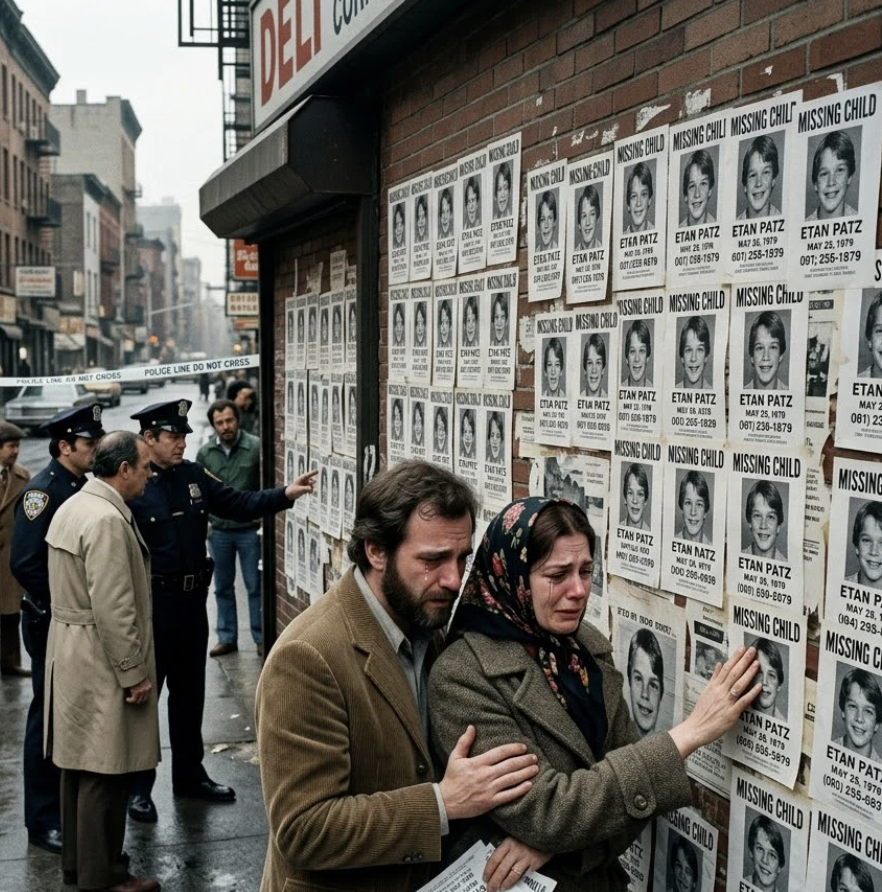
A six-year-old boy was allowed to walk to his school bus stop alone for the first time.
It was only a short walk.
Just a few blocks through a familiar New York neighborhood.
But Etan Patz never made it to the bus.
And after that morning, American parents would never look at childhood freedom the same way again.
On the morning of May 25, 1979, New York City looked like any other city waking up to another ordinary day.
Parents were making breakfast.
Children were getting ready for school.
Shopkeepers were opening doors.
Traffic was beginning to move through the streets.
In one apartment in SoHo, six-year-old Etan Patz was preparing for a small but exciting milestone.
He was going to walk to the school bus stop by himself.
To families today, that detail may sound frightening.
But in 1979, many parents saw it differently.
Children walked to school.
They rode bikes through neighborhoods.
They played outside until dinner.
They went to corner stores with coins in their pockets.
The world was not necessarily safer.
But many families believed it was.
Etan’s route was short.
The bus stop was close.
The neighborhood was familiar.
And to a little boy, being allowed to walk alone probably felt like a sign that he was growing up.
That morning, he left home.
He wore clothes that would later be described again and again in reports, articles, and missing posters.
He stepped into the city.
Then he vanished.
At first, no one understood what had happened.
Etan did not get on the school bus.
He did not arrive at school.
But his absence was not immediately reported in the way many parents today would expect.
Hours passed.
His family did not learn something was wrong until later that day, when he failed to come home.
That delay would become one of the most painful details of the case.
Because in missing-child cases, time matters.
Minutes matter.
The earlier someone realizes a child is missing, the faster the search can begin.
But on that day, Etan had already been gone for hours before the alarm truly spread.
When his parents realized he was missing, ordinary life ended.
Police were called.
Neighbors searched.
Flyers were made.
People walked streets, checked alleys, looked inside buildings, asked questions, and tried to imagine where a small boy could have gone.
At first, some still hoped there was a simple explanation.
Maybe he had gone to the wrong bus stop.
Maybe he had wandered.
Maybe someone had taken him in temporarily.
Maybe he would be found frightened but alive.
That hope did not last.
As hours became days, fear grew.
New York began paying attention.
Then the country began paying attention.
Etan Patz was not the first missing child in America.
But his disappearance arrived at a moment when media, photography, and public anxiety combined in a powerful way.
His father, Stanley Patz, was a photographer.
The images of Etan were clear, intimate, and unforgettable.
He was not just a name on a police report.
He was a little boy with bright eyes and a face America could recognize.
Those photographs spread widely.
They appeared on posters.
They appeared in public spaces.
They became part of one of the earliest and most memorable national efforts to make a missing child visible.
For parents across the United States, Etan’s disappearance felt terrifying because of how ordinary it was.
He did not vanish from a remote highway.
He did not disappear during a camping trip.
He did not go missing from an obviously dangerous place.
He disappeared near home.
During the morning routine.
On the way to school.
That was what made the case so haunting.
Every parent could imagine it.
A child asking for independence.
A mother allowing one small step toward growing up.
A bus stop just a few blocks away.
Then silence.
The search continued.
Police interviewed people.
Tips came in.
Leads appeared.
Many went nowhere.
Families in the neighborhood looked at familiar streets differently.
Parents who once let children walk alone began hesitating.
The idea of “stranger danger” began entering American family conversations more strongly.
For many, Etan’s disappearance became a before-and-after moment.
Before Etan, some parents believed a neighborhood was safe because it was familiar.
After Etan, familiarity was no longer enough.
The case also changed how missing children were presented to the public.
Etan became one of the children whose image helped shape the missing-children awareness movement. In the years that followed, missing children began appearing on milk cartons and in mass-distributed alerts. The goal was simple but urgent: make sure the public saw the faces, remembered the names, and understood that a missing child could not be treated as a private family tragedy alone.
It had to become everyone’s concern.
The emotional burden on the Patz family was impossible to measure.
When a child dies and a body is found, grief has a terrible finality.
But when a child disappears, grief becomes something else.
It becomes waiting.
It becomes checking the door.
It becomes answering the phone with your heart racing.
It becomes seeing strangers who resemble your child and wondering for one impossible second.
It becomes birthdays without answers.
Holidays without closure.
Years passing while one question remains alive.
Where is he?
Etan’s parents endured that kind of pain publicly.
Their son’s face became a symbol.
But behind that symbol was a family.
A mother and father who had to live every day with the last morning.
Every parent knows the cruelty of “what if.”
What if I had walked with him?
What if I had waited by the window?
What if someone had noticed sooner?
What if the bus driver had asked?
What if the school had called immediately?
Those questions can destroy people.
And yet, Etan’s case also pushed America toward change.
In 1983, President Ronald Reagan proclaimed May 25, the date Etan disappeared, as National Missing Children’s Day. The purpose was not only to remember one boy. It was to remind the country that missing children needed urgent attention, coordinated searches, public awareness, and systems stronger than a few posters on a wall.
The date mattered.
May 25 was no longer only the day Etan vanished.
It became a day for every missing child.
Every family still waiting.
Every case that needed attention.
Every community that needed to act faster.
But even as public awareness grew, Etan’s own case remained unresolved for years.
Then decades.
The boy on the posters became frozen in time.
America aged.
New technologies appeared.
Police methods improved.
The world changed.
But Etan remained six years old in the public memory.
That is one of the cruelest things about missing-child cases.
The child does not grow older in the photograph.
The family does.
Parents become elderly.
Siblings become adults.
Investigators retire.
Witnesses forget.
Buildings change.
Neighborhoods transform.
But the image stays the same.
A child smiling from the past.
As the years passed, theories emerged.
Suspects were examined.
Leads were followed.
Some names became familiar to those who studied the case.
Some possibilities looked promising.
Others collapsed.
For the public, the case became one of America’s most painful mysteries.
For the family, it was never just a mystery.
It was their son.
Then, many years later, the case took a dramatic turn.
A man named Pedro Hernandez, who had worked near the area where Etan disappeared, became connected to the investigation. He confessed, faced charges, and was later convicted in 2017. But even that did not end every debate. Years later, legal questions continued, and in 2025 a federal appeals court overturned the conviction over jury-instruction issues. A judge later declined to dismiss the case, setting up the possibility of another trial.
That complicated legal history matters.
Because Etan’s story is not only about one morning in 1979.
It is about how difficult justice can be when time has passed, evidence is limited, memories have faded, and a child’s body has never been found.
And that is why the case remains so emotionally powerful.
It changed national awareness.
It changed parenting conversations.
It changed the way missing children were shown to the public.
But for the family at the center of it, the deepest question was always personal.
What happened to Etan?
PART 2
In the years after Etan Patz disappeared, America slowly became a different country for children.
Not overnight.
Not because of one law.
Not because one case could explain every danger.
But because Etan’s disappearance made something visible that many families had not wanted to confront.
A child could vanish in an ordinary place.
A familiar neighborhood did not guarantee safety.
A short walk could change a family forever.
Before cases like Etan’s became part of national conversation, many missing-child searches depended heavily on local efforts.
Police reports.
Neighborhood flyers.
Word of mouth.
Local news.
Families often had to fight to keep attention on their children.
But Etan’s face showed the country the power of visibility.
When a missing child’s photograph is seen by millions, strangers become part of the search.
Someone in another city might recognize a face.
Someone in another state might remember a child.
Someone who knows nothing about the family might still become the person who provides a lead.
This idea helped shape a broader movement.
In the 1980s, missing children’s faces began appearing in places Americans saw every day.
Milk cartons became one of the most famous symbols of that era.
A breakfast table could suddenly become a reminder that somewhere, a family was waiting.
Children saw those faces.
Parents saw those faces.
The country saw those faces.
It was imperfect.
It was heartbreaking.
But it changed awareness.
Etan’s case helped push missing children from the margins of local tragedy into the center of national concern. The National Center for Missing & Exploited Children, created in the 1980s, became part of that larger shift, helping coordinate public attention and resources for missing-child cases. NCMEC later reflected on the “milk carton kids” era as part of the movement that placed missing children’s faces and hotline information before the public.
For parents, the emotional change was enormous.
The late 1970s and early 1980s marked the beginning of a new kind of caution.
Parents who had once allowed children to walk several blocks alone began walking with them.
Schools became more aware of attendance procedures.
Communities discussed safety rules more openly.
Children were taught not to go with strangers.
Families created check-in habits.
Some people later criticized the fear as excessive.
Others saw it as necessary.
But almost everyone understood why the fear existed.
It had a face.
Etan’s face.
That is what made the case different.
A photograph can do what statistics cannot.
Numbers may tell us how many children are missing.
But a photograph asks us to imagine one child.
One room left untouched.
One family meal with an empty chair.
One mother replaying the last goodbye.
One father printing photo after photo because it is the only way to keep searching.
For years, Etan’s parents continued living with that reality.
The rest of the country could move on between headlines.
They could not.
Their son’s disappearance became part of public history, but their private grief remained daily.
Imagine answering questions about the worst day of your life for decades.
Imagine strangers knowing your child’s face but not knowing his laugh.
Imagine seeing his image used as a symbol while remembering the real boy behind it.
The case carried that painful duality.
Etan was both a child and an icon.
A son and a national symbol.
A missing boy and a turning point in American awareness.
Over time, the legal story became even more complicated.
For decades, no one was convicted.
Etan was declared legally dead in 2001.
The case was reopened more than once.
Investigators searched locations connected to old leads.
Then Pedro Hernandez entered the case after making statements to authorities. He was convicted in 2017 of kidnapping and murder, but the conviction did not bring a simple final chapter. In 2025, a federal appeals court overturned that conviction, citing problems with how jurors were instructed regarding his confessions. In 2026, a judge refused to dismiss the charges, keeping the possibility of another trial alive.
That legal uncertainty keeps the story emotionally difficult.
For some, the confession and conviction once felt like long-delayed justice.
For others, questions about evidence, confession reliability, and the absence of physical remains kept doubt alive.
This is the burden of old cases.
Time damages everything.
Witness memories fade.
Evidence disappears.
Publicity shapes perception.
Families endure years of hope and disappointment.
Even when courts act, emotional closure does not always follow.
And yet, no matter how complex the legal history becomes, Etan’s broader impact remains undeniable.
May 25 is observed as National Missing Children’s Day in the United States because of him. The Department of Justice describes the day as beginning in memory of Etan Patz, who disappeared from a New York City street corner on May 25, 1979.
That fact alone shows how deeply one child’s disappearance changed the nation.
His story became part of how America talks about child safety.
Part of how schools respond.
Part of how parents teach caution.
Part of how missing children are publicized.
Part of how communities understand urgency.
But the most haunting truth is still the simplest.
Etan did not disappear from somewhere obviously dangerous.
He disappeared during a normal morning routine.
A child walking to a bus stop.
That detail is why the story still unsettles people decades later.
Because the most frightening tragedies are sometimes not the ones that happen in strange places.
They are the ones that happen inside ordinary life.
A mother lets her son take a small step toward independence.
A boy walks out the door.
A bus stop waits nearby.
And then everything changes.
The story of Etan Patz asks painful questions that every generation of parents understands differently.
How much freedom should children have?
How much protection is enough?
Can parents ever remove all danger?
What do we lose when fear changes childhood?
What do we risk when we ignore that fear?
There is no easy answer.
The world of 1979 was not perfect.
The world today is not perfectly safe.
But Etan’s disappearance forced families to acknowledge that love requires attention, systems, and community responsibility.
It is not enough to assume a child will be fine because the route is short.
It is not enough to assume someone else will notice.
It is not enough to wait until the end of the school day.
A missing child demands urgency.
That lesson became part of Etan’s legacy.
Not the legacy any family would choose.
Not the legacy any child should have to carry.
But one that changed America.
Today, Etan Patz remains frozen in public memory as a six-year-old boy on his way to school.
The city changed.
The neighborhood changed.
The country changed.
But the image remains.
A little boy who stepped into an ordinary morning and never came home.
And perhaps that is why his story still hurts.
Because it reminds every parent that childhood is fragile.
That routines can hide risk.
That time matters.
That a photograph can move a nation.
And that behind every missing-child poster is not a symbol, but a family waiting for answers.
Do you think Etan Patz’s case made parents more realistically careful, or did it also change childhood freedom in a way America never fully recovered from?


