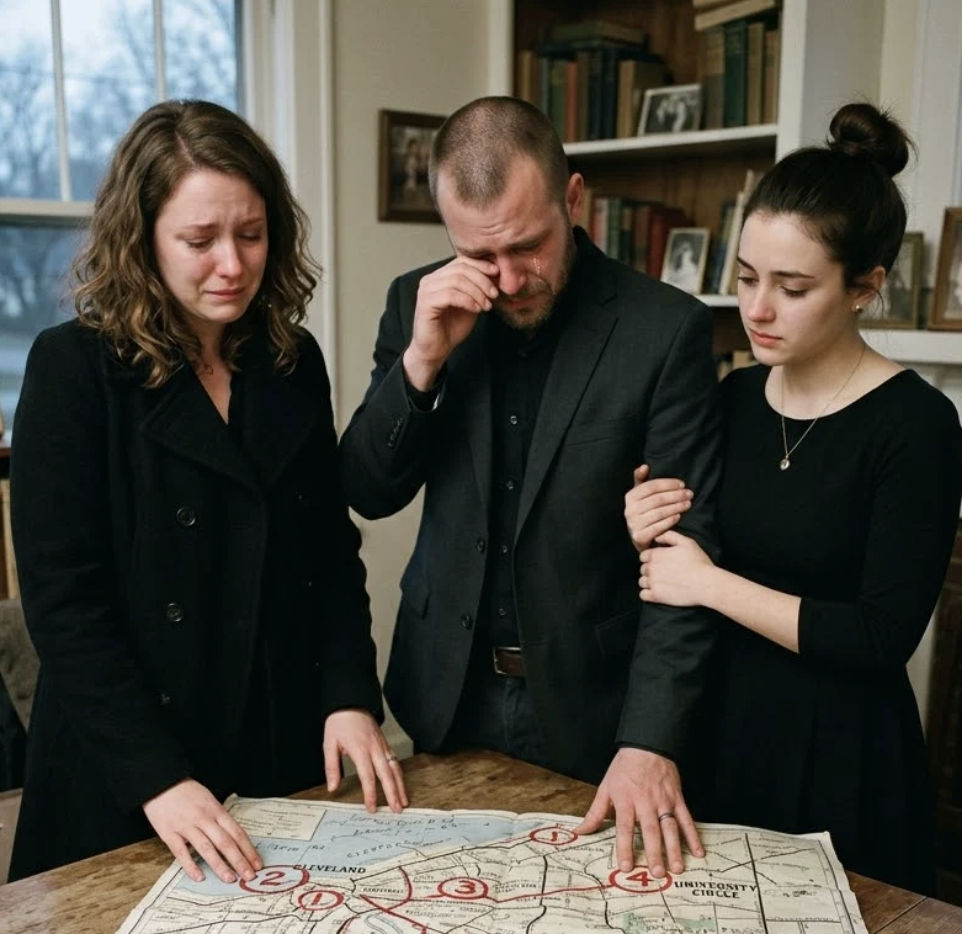
Seven red circles on an old city map were all the proof the Whitmore children needed.
Their father had hidden something.
Something valuable.
Maybe cash.
Maybe gold.
Maybe property deeds nobody knew existed.
After all, a man doesn’t leave behind a secret map unless he wants someone to find a treasure.
At least that’s what they believed.
They were wrong.
And by the time they reached the seventh location, every one of them would be crying.
The funeral of Harold Whitmore brought together four adult children who had barely been in the same room for years.
Michael, the oldest, ran a construction company.
Susan lived three states away and rarely visited.
Daniel worked in finance and measured life through spreadsheets.
Emily, the youngest, had spent more time with their father than anyone else during his final years.
The tension between them began before the service even ended.
Not because they hated each other.
Because grief has a way of dragging old resentments into the light.
Who visited Dad the most?
Who helped financially?
Who stayed away?
Who cared enough?
Everyone had their own version of history.
Harold had been a widower for nearly twenty years.
After their mother died, the family slowly drifted apart.
Life happened.
Jobs.
Marriage.
Children.
Distance.
The phone calls became less frequent.
The holidays became shorter.
The excuses became easier.
Yet Harold never complained.
At least not out loud.
Three days after the funeral, the attorney handling Harold’s estate invited the family back to his office.
Most expected routine paperwork.
Bank accounts.
Property transfers.
Insurance documents.
Instead, the attorney placed an envelope on the table.
“This was left specifically for all four of you.”
Michael opened it.
Inside was a folded city map.
Seven red circles marked seven locations.
Nothing else.
No explanation.
No letter.
No instructions.
Just seven places scattered throughout the city.
The attorney looked confused.
“That’s all he left regarding this.”
Daniel immediately leaned forward.
“Did Dad own any property we don’t know about?”
The attorney shook his head.
“Not that I’m aware of.”
Susan studied the map.
“Maybe he hid something.”
Emily frowned.
“Like what?”
Michael laughed.
“Dad grew up during the Depression. He never trusted banks. For all we know, he buried money somewhere.”
The idea sounded ridiculous.
Then again, their father had always been full of surprises.
The first location sat on the edge of downtown.
An old building near the river.
The next morning, all four siblings met there.
Excitement replaced grief.
For the first time in years, they shared a common goal.
The building turned out to be St. Catherine’s Hospital.
A modern structure now stood where the older building once existed.
The red circle landed directly on the maternity wing.
Emily looked around.
“What exactly are we looking for?”
Michael shrugged.
“No idea.”
Then a nurse exiting the building overheard their conversation.
When she learned Harold Whitmore’s name, she smiled.
“Oh my goodness. Harold.”
The siblings exchanged surprised looks.
“You knew our father?”
The nurse laughed.
“Not personally. But his name is on a plaque in the lobby.”
They followed her inside.
Mounted on a wall sat a small brass plaque.
DONATED IN HONOR OF THE BIRTH OF MICHAEL WHITMORE — 1974
Michael stared silently.
The nurse explained.
“Your father donated money to help renovate part of the maternity ward after you were born.”
Michael looked genuinely confused.
“Dad never told me that.”
The siblings left with more questions than answers.
The second location proved even stranger.
A small neighborhood park.
Nothing special.
Just swings, benches, and a baseball field.
Again they searched.
Again they found nothing.
Until an elderly groundskeeper approached.
“You Harold’s kids?”
The question startled them.
Apparently everyone knew their father.
The groundskeeper pointed toward an old oak tree.
“Your dad used to bring all of you here every Saturday.”
The siblings walked toward the tree.
A small metal marker had been attached years earlier.
Family Picnic Area Renovation Sponsored By Harold Whitmore
Susan felt tears forming.
She remembered now.
The park.
The lunches.
Their mother laughing.
Things she hadn’t thought about in decades.
Still, none of it explained the map.
Nor did it explain why their father sent them here.
The third location brought them to a small diner.
A place called Betty’s Grill.
Shockingly, it still operated.
The owner immediately recognized Harold’s photograph when Emily showed it.
“That man practically kept us open in 1987.”
“What do you mean?”
The owner told a story none of them had ever heard.
When the diner nearly went bankrupt, Harold organized fundraisers and volunteer repairs.
He recruited neighbors.
Bought supplies.
Worked weekends.
Saved the business.
The owner pointed to a framed picture behind the counter.
There stood their father.
Smiling.
Covered in paint.
Surrounded by grateful employees.
Again, none of the children had known.
Three locations.
Three discoveries.
No treasure.
No money.
No hidden fortune.
Only memories.
And somehow that felt more mysterious.
By the fourth location, frustration started growing.
Daniel finally voiced what everyone was thinking.
“What if this is all there is?”
Michael shook his head.
“No. Dad wouldn’t do that.”
Wouldn’t he?
The fourth location led to a small apartment complex.
An elderly woman answered when they knocked.
The moment she heard Harold’s name, she began crying.
For several minutes she couldn’t speak.
Finally she explained.
Thirty years earlier, her husband died unexpectedly.
She had three children.
No savings.
No family nearby.
The bank prepared foreclosure papers.
Then Harold stepped in.
He secretly paid six months of her mortgage.
Enough time for her to get back on her feet.
The siblings sat stunned.
Another story.
Another act of kindness.
Another piece of a father they never fully knew.
That evening they gathered at Emily’s house.
Nobody talked about treasure anymore.
Instead they talked about Harold.
Really talked.
For the first time in years.
Stories surfaced.
Memories resurfaced.
Regrets surfaced.
Then Emily noticed something.
The locations formed a pattern.
Each represented a moment of love.
A birth.
A childhood memory.
Someone he helped.
Someone he saved.
Someone he stood beside.
The realization unsettled her.
Because there were still three locations left.
And she suddenly suspected none of them contained money.
The fifth location proved her right.
The sixth nearly broke their hearts.
And the seventh…
The seventh would reveal why Harold created the map at all.
The fifth location sat outside a modest brick church.
The Whitmore children arrived expecting another story.
They received something far more personal.
Father Reynolds still served there despite being nearly eighty years old.
The moment he heard Harold’s name, he smiled.
“Your father came here every Thursday for seventeen years.”
Susan looked confused.
“We weren’t church people.”
Father Reynolds nodded.
“I know.”
“Then why was he here?”
The old priest opened a filing cabinet.
From inside, he removed a folder.
“Because your mother was.”
Silence filled the room.
Their mother, Margaret, had died nineteen years earlier.
Even now, speaking her name felt strange.
Father Reynolds continued.
“After she died, your father came every week.”
Emily’s eyes filled with tears.
“What did he do here?”
The priest smiled sadly.
“He sat in the last pew and talked to her.”
Nobody laughed.
Nobody questioned him.
Because somehow they all understood.
The priest handed Emily a note written years earlier by Harold.
The handwriting was unmistakable.
I don’t come because I need answers.
I come because this is the last place she sat beside me.
Susan covered her mouth.
Daniel looked away.
Michael stared at the floor.
Another piece of their father emerged.
A man grieving quietly.
A man carrying loneliness without burdening his children.
A man none of them had fully seen.
The sixth location proved even more devastating.
It led them to a modest house near the edge of town.
The homeowner greeted them warmly.
Then she invited them inside.
Photos covered the walls.
Family pictures.
Graduations.
Birthdays.
Weddings.
The woman pointed toward one photo.
Standing beside her teenage son was Harold.
Emily frowned.
“Who are you?”
The woman smiled.
“My name is Linda.”
The story she told left everyone speechless.
Twenty-two years earlier, her husband abandoned the family.
She worked two jobs.
Her son nearly dropped out of school.
One day Harold met the boy while volunteering at a community center.
Over the next decade, Harold became a mentor.
Tutor.
Coach.
Father figure.
He attended graduations.
Helped with college applications.
Even contributed money toward tuition.
The boy—now a successful engineer—joined them later that afternoon.
The first thing he said was:
“Your dad changed my life.”
Not helped.
Changed.
The distinction mattered.
As they left the house, nobody spoke.
The map felt different now.
The red circles were no longer clues.
They were evidence.
Evidence of a life lived quietly.
Generously.
Without recognition.
That evening they spread the map across Emily’s dining table.
Only one location remained.
A cemetery.
The realization hit all of them at once.
The final destination was where Harold rested.
The next morning they drove there together.
For the first time since childhood.
No arguments.
No competition.
No discussions about inheritance.
Just four siblings following their father’s final instructions.
The cemetery sat beneath a gray sky.
Harold’s grave was simple.
No elaborate monument.
Just a polished stone bearing his name beside their mother’s.
Michael noticed something immediately.
A small metal box had been attached behind the headstone.
Inside waited an envelope.
Susan’s hands trembled as she opened it.
The paper inside contained only a few paragraphs.
But every word landed like a hammer.
My children,
If you found this, then you followed the map.
Which means you probably spent the first few days believing I hid money somewhere.
I know you too well.
Despite their tears, all four laughed.
The letter continued.
The truth is simple.
I never had a fortune.
No secret account.
No buried treasure.
No surprise inheritance.
For a moment the cemetery became silent again.
Then came the next paragraph.
What I did have was a life.
And the older I became, the more I realized that life happened in places.
A hospital where I first held my son.
A park where your mother laughed.
A diner where neighbors became family.
A church where grief became bearable.
A house where kindness mattered.
And many others.
Susan began crying openly.
Emily squeezed her hand.
Harold’s words continued.
You spent years worrying about success.
Money.
Careers.
Mistakes.
Arguments.
Distance.
I did too.
Then your mother died.
And suddenly none of those things seemed important.
What mattered were the places where love happened.
The final page contained one last message.
The siblings read it together.
I don’t have treasure to leave behind.
I only wanted you to remember that you were loved in more places than you realize.
And if you ever feel poor, forgotten, or alone, go back to those places.
You may discover your real inheritance was never money.
It was being loved.
On the back of the page was a single handwritten sentence.
For several seconds nobody could speak.
Because every one of them recognized it as their father’s final lesson.
The sentence read:
The richest thing I ever owned was my family.
Michael finally broke down.
Not the controlled tears he’d shown at the funeral.
Real tears.
The kind that come from regret.
“I should’ve visited him more.”
Nobody disagreed.
Because all four felt the same.
The map had accomplished exactly what Harold intended.
It brought them together.
It forced them to remember.
It made them see their father as something more than an aging widower living alone.
He had been a husband.
A friend.
A helper.
A protector.
A man who quietly left pieces of himself in places most people would never notice.
Over the following months, something unexpected happened.
The siblings stayed connected.
They created a group chat.
Started Sunday dinners.
Visited one another.
Shared family photos.
When disagreements appeared, they remembered the map.
Remembered the hospital.
The park.
The diner.
The church.
The cemetery.
And gradually they stopped measuring inheritance in dollars.
Years later, when Emily’s daughter asked why a framed city map hung above the fireplace, Emily smiled.
Then she told the story.
Not about hidden treasure.
About hidden love.
Because sometimes the greatest inheritance is not what someone leaves behind.
It’s what they spent their entire life giving away.
Do you think most families wait until it’s too late to realize that memories and love are worth more than money, or do people only understand that lesson after losing someone they love?


