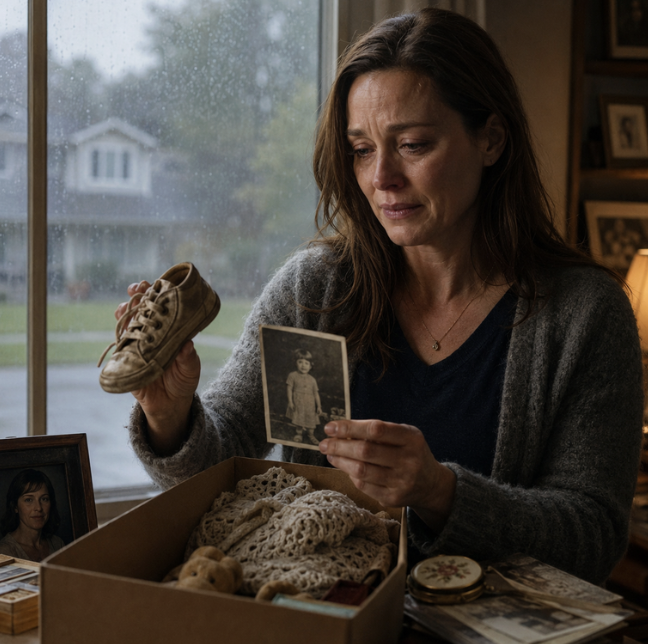
For as long as I can remember, my mother carried the same small object inside her purse.
A worn-out child’s shoe.
The shoe was tiny.
Blue.
Faded by time.
Its laces had long disappeared.
The rubber sole was cracked.
The fabric looked so old that touching it seemed dangerous.
Yet my mother treated it like treasure.
She never left home without it.
Not once.
As a child, I thought it was strange.
As a teenager, I thought it was embarrassing.
As an adult, I stopped noticing it altogether.
Like many mysteries inside a family, it became part of the background.
Something always there.
Something nobody talked about.
Something everyone accepted without understanding.
My mother never explained the shoe.
And we never asked for long.
Because every time the subject came up, a shadow crossed her face.
Not anger.
Not annoyance.
Sadness.
The kind of sadness that makes people immediately change topics.
So eventually we did.
Life continued.
The shoe remained.
Year after year.
Decade after decade.
My name is Rachel Morgan.
I was forty-two years old when my mother died.
Cancer.
Fast.
Aggressive.
The kind that turns months into weeks and weeks into days.
Until the diagnosis, she had always seemed indestructible.
The center of every family gathering.
The first person to volunteer.
The first person to help.
The first person to comfort someone else.
Then suddenly she was gone.
After the funeral, my sister and I began sorting through her belongings.
The task felt impossible.
Every drawer contained memories.
Every closet contained pieces of a life we thought we understood.
We laughed.
We cried.
We told stories.
Sometimes all three happened within the same minute.
Late one evening, while organizing her bedroom, I found her purse hanging inside the closet.
The same brown leather purse she had carried for years.
Without thinking, I opened it.
Inside were ordinary things.
A wallet.
Reading glasses.
Receipts.
A handkerchief.
And at the bottom…
The shoe.
Still there.
Still protected inside a small cloth pouch.
Still carried every day.
Even during chemotherapy.
Even during her final weeks.
Something about that realization broke my heart.
Because whatever the shoe meant, it had remained important until the end.
I carefully removed it.
For the first time in my life, I truly examined it.
The shoe couldn’t have belonged to me.
Or my younger sister.
It was too old.
Far older than either of us.
As I turned it over, something slipped from inside.
A photograph.
Old.
Yellowed.
Fragile.
I stared at it.
Then stared again.
Because the child in the photograph wasn’t me.
And it wasn’t my sister.
The picture showed a little boy.
Perhaps four years old.
Dark hair.
Bright smile.
Standing beside a wooden fence.
The image looked decades old.
On the back, written in faded ink, was a single name.
Daniel.
Nothing else.
No date.
No explanation.
No surname.
Just Daniel.
My sister walked into the room.
“What is that?”
I handed her the photograph.
Within seconds, confusion spread across her face.
“Who is he?”
“I don’t know.”
Neither of us recognized the child.
Neither of us had ever heard the name.
Neither of us understood why our mother had carried his shoe for nearly forty years.
That night neither of us slept well.
The mystery felt too personal.
Too important.
The next morning we searched through old family albums.
Thousands of photographs.
Birthdays.
Vacations.
Christmas mornings.
School graduations.
Wedding anniversaries.
Nothing.
No Daniel.
No little boy.
No explanation.
It was as if he had never existed.
Yet clearly he had.
Someone had taken his photograph.
Someone had kept his shoe.
Someone had remembered him long enough for the object to survive decades.
The question was why.
Three days later, while cleaning my mother’s attic, I found another clue.
A cardboard box hidden behind several storage containers.
Unlike everything else in the attic, the box had no label.
Inside were newspaper clippings.
Hospital paperwork.
Several letters.
And one small notebook.
The notebook belonged to my mother.
The first page was dated thirty-eight years earlier.
My hands trembled as I began reading.
The entries started normally.
Descriptions of daily life.
Weather.
Family events.
Ordinary observations.
Then everything changed.
One entry read:
“Daniel laughed today when the rain started.”
I froze.
Daniel.
The little boy from the photograph.
My pulse quickened.
I continued reading.
“He wanted to jump in every puddle he saw.”
“I told him we’d both get soaked.”
“He said that’s what made it fun.”
I read the paragraph three times.
Then looked at my sister.
Neither of us spoke.
Because the implication was becoming impossible to ignore.
Daniel wasn’t a neighbor.
Wasn’t a cousin.
Wasn’t a family friend.
The way my mother wrote about him sounded different.
Intimate.
Protective.
Maternal.
The next entry confirmed it.
“Daniel starts school next month.”
“I don’t know how he’s already old enough.”
The room became silent.
My sister sat down slowly.
“No.”
I knew exactly what she meant.
No.
It couldn’t be.
Could it?
Our mother had only ever spoken about two children.
Us.
There had never been a third.
Never a brother.
Never a loss.
Never a secret child.
Nothing.
Yet the evidence was sitting directly in front of us.
Page after page.
Entry after entry.
A little boy named Daniel.
A child our mother clearly loved.
A child she wrote about constantly.
A child who disappeared from the notebook abruptly.
One moment he was there.
Then suddenly he wasn’t.
The final entry mentioning him was dated October 17.
It contained only two sentences.
“The rain won’t stop.”
“Please let him be okay.”
The next page was blank.
Then another.
Then another.
Nearly twenty pages remained empty.
When the writing resumed months later, everything had changed.
The cheerful tone was gone.
The detailed stories were gone.
The joy was gone.
Even the handwriting looked different.
Older.
Heavier.
Sadder.
My mother never mentioned Daniel again.
Not once.
That frightened me more than anything.
People don’t erase someone from their writing unless the pain is unbearable.
That evening, my sister and I drove to visit our aunt Margaret, my mother’s older sister.
If anyone knew the truth, it would be her.
At first she refused to talk.
The moment we placed the photograph on her table, tears filled her eyes.
Then she saw the shoe.
And everything changed.
For nearly a minute she simply stared at it.
Finally she whispered:
“I wondered what happened to that.”
My heart pounded.
“You know whose shoe this is?”
She nodded.
Slowly.
Painfully.
Then came the sentence that shattered everything we thought we knew about our family.
“That belonged to your brother.”
For several seconds, neither my sister nor I spoke.
The room seemed to shrink around us.
Our brother.
The words felt impossible.
We had spent our entire lives believing there were only two children in our family.
Two daughters.
No sons.
No missing sibling.
No tragedy hidden in the past.
Yet our aunt had spoken with complete certainty.
The little boy in the photograph was not a cousin.
Not a neighbor.
Not a family friend.
He was our brother.
My sister was the first to find her voice.
“What do you mean… our brother?”
Aunt Margaret looked exhausted.
As if she had been carrying the same secret for decades.
Then she quietly stood, walked to a cabinet, and removed a small tin box.
Inside were old photographs.
Dozens of them.
And in nearly every picture, there he was.
The same little boy.
Daniel.
Laughing.
Running.
Playing.
Being held by our mother.
Being carried by our father.
Opening Christmas presents.
Standing in front of birthday cakes.
Existing.
Living.
Belonging.
Every photograph proved the same thing.
We had once been a family of five.
And somehow we had never known.
I felt physically sick.
“Why didn’t anyone tell us?”
Aunt Margaret lowered her eyes.
“Because your mother couldn’t.”
That answer only created more questions.
Couldn’t?
Or wouldn’t?
The difference mattered.
Our aunt took a deep breath.
Then she began telling a story she had not spoken aloud in nearly four decades.
Daniel was my parents’ first child.
Born six years before me.
Three years before my sister.
According to everyone who knew him, he was the center of my mother’s world.
Energetic.
Curious.
Fearless.
The type of child who turned ordinary errands into adventures.
He loved trains.
Loved dogs.
Loved puddles.
Especially puddles.
At this point Aunt Margaret stopped and looked toward the rain falling outside her kitchen window.
Then she continued.
Daniel loved rain.
My stomach tightened.
Because suddenly I remembered something.
My mother hated rain.
Not disliked.
Hated.
Whenever storms arrived, her mood changed.
She became quieter.
More distant.
Sometimes emotional.
As children, we never understood why.
Now I was beginning to.
The day everything changed occurred during a severe autumn storm.
Daniel was four years old.
The rain had fallen for hours.
Roads flooded.
Visibility was poor.
Most people stayed home.
My mother and Daniel had been returning from a grocery trip.
A routine day.
A routine drive.
Nothing unusual.
Nothing memorable.
Until a single moment changed everything.
According to the police report, my mother stopped the car near their home.
She exited briefly to retrieve something that had fallen near the curb.
Just seconds.
Perhaps less.
Daniel somehow managed to open the passenger-side door.
Nobody knows exactly why.
Perhaps he wanted to follow her.
Perhaps he saw something.
Perhaps he was simply curious.
Children often are.
The details remain unclear.
What happened next did not.
A flooded drainage channel ran beside the road.
The current was stronger than it appeared.
By the time my mother realized Daniel was no longer in the vehicle, he had already disappeared.
The search lasted hours.
Then days.
Then weeks.
Volunteers.
Police.
Rescue workers.
Neighbors.
Entire sections of the community joined the effort.
Everyone hoped.
Everyone prayed.
Everyone searched.
The outcome never changed.
Daniel was gone.
When Aunt Margaret finished speaking, nobody in the room moved.
I could barely breathe.
The tragedy alone was devastating.
But another question remained.
Why hide him?
Why erase him?
Why allow us to grow up without ever knowing?
My aunt began crying.
Then she answered.
“Because your mother thought speaking his name would destroy her.”
Those words stayed with me.
Destroy her.
Not hurt her.
Destroy her.
The difference revealed everything.
Many people imagine grief as something that gradually disappears.
It doesn’t.
Sometimes it simply changes shape.
My mother survived Daniel’s death.
But according to Aunt Margaret, part of her never recovered.
For years afterward she blamed herself.
Obsessively.
Relentlessly.
No matter what anyone said.
No matter what investigators concluded.
No matter how many people reminded her it had been an accident.
She carried the guilt anyway.
She replayed those seconds endlessly.
What if she hadn’t stopped the car?
What if she had held his hand?
What if she had checked the door?
What if?
What if?
What if?
The questions never ended.
Then something unexpected happened.
Several years later, my sister and I were born.
Family members hoped our arrival would heal her.
In some ways it did.
She loved us fiercely.
Completely.
Unconditionally.
Yet Daniel never disappeared from her heart.
He simply moved into a place nobody could see.
Our aunt explained that shortly before I was born, my mother made a decision.
She packed away the photographs.
Stored the toys.
Closed the boxes.
And stopped speaking about him.
Not because she stopped loving him.
Because she loved him too much.
Every conversation reopened the wound.
Every memory felt unbearable.
Silence became survival.
And eventually that silence became permanent.
As children, my sister and I occasionally sensed something hidden beneath the surface.
We just didn’t understand what it was.
Now countless memories suddenly made sense.
The way Mom always seemed distant during storms.
The way she sometimes stared at children in parks.
The way she became emotional at certain birthdays.
The way she never threw away old toys.
The way she occasionally looked at us with an expression that felt strangely sad despite her smile.
At the time, we interpreted those moments incorrectly.
Now we finally understood.
She wasn’t only seeing us.
She was seeing three children.
Not two.
Three.
Over the following weeks, my sister and I continued exploring the attic boxes.
The deeper we looked, the more evidence we found.
Drawings.
School enrollment forms.
Medical records.
Birthday cards.
Photographs.
An entire childhood preserved in secret.
One evening, I found a sealed envelope tucked inside a notebook.
Across the front, written in my mother’s handwriting, were the words:
“For my daughters, if you ever find this.”
My hands trembled.
I opened it immediately.
Inside was a letter.
The longest letter she had ever written.
It began with an apology.
“I am sorry I never told you about Daniel.”
The next sentence shattered me.
“Not because I wanted to hide your brother, but because I never learned how to speak about losing him without falling apart.”
I cried before reaching the second page.
For years I had assumed silence meant shame.
The truth was far different.
Silence meant grief.
The letter continued.
My mother described the day Daniel died.
Not in detail.
Not dramatically.
Simply honestly.
She described waking every morning hoping it had been a nightmare.
She described hearing his voice in empty rooms.
She described setting an extra plate at dinner by accident.
She described buying gifts for birthdays that would never arrive.
Most heartbreaking of all, she described carrying the shoe.
The very shoe sitting beside me.
Daniel had worn it the week before he died.
After the accident, it was the only item she could bring herself to keep close.
Everything else felt too painful.
The shoe was different.
Small enough to carry.
Small enough to hide.
Small enough to keep him near.
For thirty-eight years, she carried it everywhere.
Every grocery trip.
Every doctor’s appointment.
Every holiday.
Every family gathering.
Every ordinary day.
The shoe became a connection to a child time never allowed to grow older.
Then came the paragraph that broke me completely.
“People say grief gets smaller.”
“That wasn’t true for me.”
“Life simply grew around it.”
I read the sentence again.
And again.
And again.
Because it perfectly explained everything.
My mother wasn’t trapped in grief.
She built a life around it.
She laughed.
Worked.
Raised daughters.
Made friends.
Celebrated holidays.
Created memories.
Yet beneath all of it remained the love of a mother whose first child never came home.
The letter ended with a request.
“Please don’t remember me as sad.”
“Remember me as a mother of three.”
“Because that is what I always was.”
After reading those words, my sister and I sat in silence for a long time.
The rain tapped softly against the windows.
Neither of us spoke.
Neither of us needed to.
For the first time, our family finally made sense.
The sadness.
The storms.
The shoe.
The photograph.
The hidden boxes.
All of it.
Months later, we visited Daniel’s memorial site together.
Not because we remembered him.
Because we finally knew him.
We brought flowers.
Shared stories from the journals.
Read parts of my mother’s letter aloud.
And for the first time in nearly forty years, Daniel’s name was spoken openly within our family.
Not as a secret.
Not as a wound.
As a son.
As a brother.
As someone who mattered.
Today, the little shoe sits in a glass display case in my home.
Visitors occasionally ask about it.
I always tell them the truth.
It belonged to my brother.
Then I tell them something else.
For most of my life, I believed the shoe represented loss.
Now I understand it represented love.
Because the real story was never about a child who died.
It was about a mother who never stopped being his mother.
Not for one day.
Not for one storm.
Not for one year.
Not for nearly four decades.
The world moved forward.
Time passed.
Children grew up.
Seasons changed.
But somewhere inside her heart, a little boy named Daniel remained four years old forever.
And every morning when she placed that tiny shoe into her purse, she carried more than a memory.
She carried motherhood itself.
A love so powerful that even time could not convince it to let go.


