
THE BLIND TRAIL


The snow outside the cracked second-story window of Davenport Thorne’s office did not fall in gentle, poetic flakes. It fell like pulverized gray ash, heavy and wet, driven across the Chicago skyline by a punishing, sub-zero wind howling off Lake Michigan. Inside, the ancient cast-iron radiator hissed a rhythmic, dying breath, doing pitifully little to cut the damp chill that seeped through the worn oak floorboards.
Davenport sat behind a scarred wooden desk, his calloused fingers wrapped around a lowball glass filled with two fingers of cheap bourbon. He didn’t drink it. He just held it, using the ice to anchor himself to the present. His coat—a heavy, waterlogged charcoal trench coat—hung on a bent brass rack near the door, reeking of wet wool, stale tobacco, and urban meltwater.
At forty-two, Davenport’s face was a brutal topography of grief and sleepless nights. Deep, bruised shadows carved darkness beneath his steel-gray eyes, and a rough stubble dusted a jawline perpetually set in a guarded clench. Four years ago, he had been the rising star of the Chicago Police Department’s Behavioral Analysis Unit. He was the man who could look at a blood-splattered carpet and read the killer’s childhood trauma like an open book. Then came the phone call on a rainy November midnight. The hit-and-run. The crumpled bicycle. The small, cold hand he held in the morgue. Since the death of his seven-year-old daughter, Lily, Davenport had buried his badge, traded his pension for a private investigator’s license, and retired into the rust and shadows of West Fulton Market.
A sharp, hesitant knock cut through the hiss of the radiator and the howl of the wind outside. Three distinct raps. Light, yet desperate.
Davenport didn’t reach for a weapon, but his right hand dropped casually beneath the desk frame, resting near the cold steel handle of a modified Glock 19 mounted under the drawer.
“It’s open,” he grunted, his voice raspy from cold coffee, cheap tobacco, and hours of silence.
The door creaked inward on rusted hinges, bringing with it a violent gust of freezing air and the faint, unmistakable scent of expensive French perfume—jasmine, cardamom, and white musk cutting sharply through the stench of damp wool and old paper.
She stepped inside, pulling back the hood of a dark mink coat. She was breathtaking in a way that felt entirely alien to this dilapidated industrial district. Pale, porcelain skin, sculpted cheekbones, and dark hazel eyes that darted frantically across the peeling wallpaper, the dust-covered filing cabinets, and the shadows pooling in the corners of the room. Her diamond rings caught the dull, yellow flickers of the neon pawnshop sign buzzing outside his window.
Davenport leaned back, his eyes narrowing into cold slits. He recognized her instantly from the society pages of the Chicago Tribune.
“There are two types of people who come looking for me: those who want to find the truth, and those who want to buy a perfect lie to bury someone alive.”
Davenport’s voice was flat, utterly devoid of professional warmth or hospitality. He made no movement to offer her a chair.
The woman didn’t flinch at the icy reception, though her lower lip quivered slightly. She closed the door behind her, throwing the deadbolt with a quick, practiced flick of her wrist. Her gloved hands trembled as she pulled a sleek, encrypted smartphone from her alligator-skin handbag.
“My name is Sienna Vance,” she said, her voice a brittle blend of high-society composure and raw, suffocating terror. “And I’m not here to buy a lie, Mr. Thorne. I’m here because I’ve spent the last forty-eight hours realizing I have no one left to trust.”
“The Vance family doesn’t hire bottom-feeder PIs,” Davenport replied, taking a slow sip of the bourbon. “Your father-in-law built half the shipping docks along the river. Your husband sits on the board of three private equity firms. You have security teams composed of former Delta Force contractors. If you have a problem, you press a panic button.”
“This isn’t a problem my husband’s security detail can fix,” she said, stepping closer to the desk. The floorboards groaned beneath her designer boots. She placed the smartphone on the desk and slid it toward him. “Because the threat isn’t coming from the street, Mr. Thorne. It’s coming from inside my life.”
Davenport looked down at the illuminated screen. He didn’t touch it with his bare hands; he used the cap of a pen to tap through the interface. A series of encrypted, auto-deleting text messages flashed across the screen, accompanied by heavily redacted attachments: high-resolution scans of offshore shell-company ledgers, wire transfers routed through Panama, and blurred, intimate video stills captured from hidden security cameras.
“Two million dollars,” Sienna whispered, leaning over the desk until Davenport could smell the panic in her breath. “Payable in Bitcoin to a blind wallet by midnight tomorrow. If the deadline passes, these financial ledgers are emailed directly to the Chief Prosecutor at the Northern District Illinois Federal Court. The videos will be uploaded to every media server in the Midwest. It will demolish the Vance empire. It will destroy my life, my reputation… everything.”
Davenport tapped the metadata header on the latest text. “The encryption algorithm on these messages is military-grade. 256-bit AES wrapped in a multi-node proxy chain. Whoever is sending these isn’t a street-level hacker demanding beer money. This is corporate warfare.” He looked up, locking eyes with her. “Why come to me? Why not the FBI’s Cyber Division?”
Sienna swallowed hard. Tears welled in her hazel eyes, threatening to break her pristine mascara. “I’m not afraid of losing this two million dollars, Mr. Thorne. I’m just afraid that when I wake up tomorrow morning, the person lying next to me won’t be breathing anymore… and he’s the one holding the knife.”
The silence that followed hung heavy in the cold air, punctuated only by the relentless hammering of the snow against the glass.
“You think Garrison is blackmailing you,” Davenport stated bluntly.
Sienna gripped the edge of the desk, her knuckles turning chalk-white. “Garrison controls the corporate operations, but my family’s trust fund holds sixty percent of the voting stock in the parent company. Over the past six months, he’s changed. He’s become paranoid, aggressive. He spends hours locked in the sub-basement server room beneath our estate in Lincoln Park, claiming he’s managing international market trades. But I’ve seen the way he looks at me, Davenport. He looks at me like I’m an obstacle standing between him and complete financial autonomy.”
Davenport stared at her face, applying every lesson from his decade in behavioral analysis. Micro-expressions of fear: dilated pupils, rapid shallow breathing, muscle tension along the jawline. Everything signaled a woman living in a pressure cooker of dread. Yet, deep in the back of his mind, a faint alarm bell rang—an instinct honed by years of dealing with sociopaths. But the mention of the Vance family name hit a raw nerve. The Vance logistics empire had political protection so thick that even the CPD couldn’t touch them—a protection that had conveniently stifled several traffic fatality investigations over the years.
“If I take this,” Davenport said slowly, “I do it my way. No police. No security guards. And if I find out your husband is clean and you’re just looking for leverage in a divorce settlement, I hand everything over to his legal team.”
“Find the truth,” Sienna said, her voice dropping to a fierce whisper. “That’s all I’m paying you for.”
“Give me three hours,” Davenport said, reaching for his coat.
Ninety minutes later, Davenport was crouched in the sub-zero darkness of Lake Shore Drive, blending into the shadow of a massive oak tree. The blizzard had transformed the affluent neighborhood of Lincoln Park into a ghost town. The Vance estate was a monolithic limestone mansion, surrounded by a ten-foot wrought-iron fence, motion-tracking floodlights, and a high-definition infrared security mesh.
Davenport pulled a high-frequency signal cloner from his tactical vest. He knew that high-end estates in Chicago relied on automated perimeter sensors linked to private security dispatchers. He attached an RF-jamming node to the junction box near the northern gate, looping the camera feed for a tight seven-minute window.
Moving like a ghost, Davenport scaled the stone pillar, cleared the iron spikes, and dropped silently into three feet of fresh powder on the interior lawn.
He moved along the perimeter of the mansion, avoiding the main courtyard, and reached the rear terrace facing Lake Michigan. Pulling a set of custom tension wrenches from his pocket, he picked the mechanical lock on the conservatory door in less than forty-five seconds. He slipped inside, closing the door behind him to block out the howling wind.
The interior of the Vance estate smelled of floor wax, polished mahogany, and money. Davenport pulled a thermal imaging monocular from his coat and swept the grand hallway. The primary security guards were stationed near the front entrance foyer and the second-floor master suite. The path down to the sub-basement was clear.
Davenport descended a narrow spiral staircase behind the butler’s pantry, stepping onto the cold concrete floor of the lower level. He passed the wine cellar and approached a reinforced steel door equipped with a biometric fingerprint scanner and a digital keypad.
He pulled a handheld diagnostic bypass module from his kit and spliced its copper leads directly into the maintenance port beneath the keypad. A line of green code scrolled across his diagnostic screen as the module executed a brute-force dictionary attack against the door’s firmware.
Clack. The magnetic lock disengaged with a dull metallic thud.
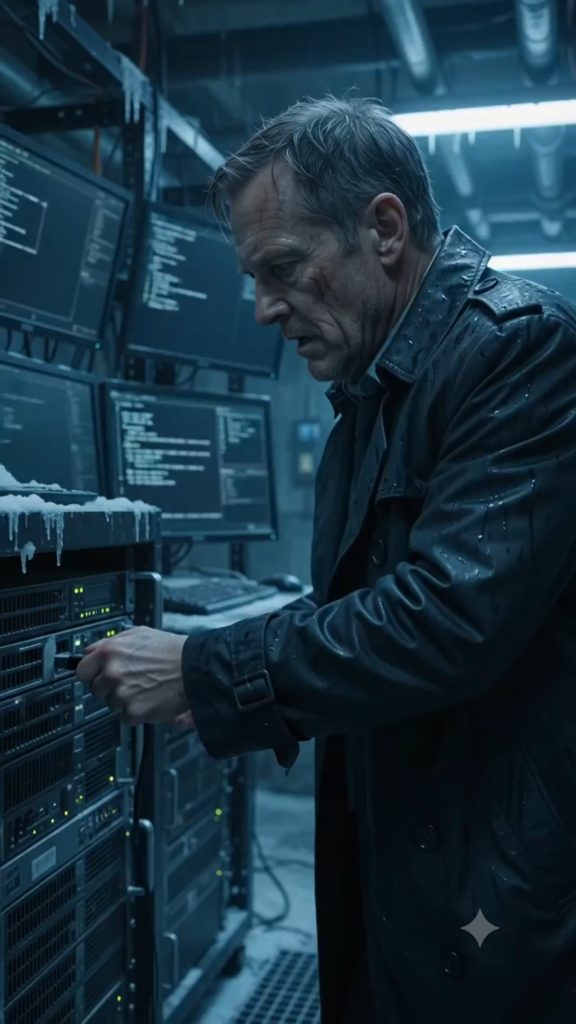
Davenport gently eased the steel door open, stepping into a room that felt like a stark contrast to the opulence above. The sub-basement server room was freezing, cooled by high-capacity industrial air handlers humming in a monotonous, deafening drone. Racks of black blade servers lined the walls, their blue and green LED lights pulsing in the dim room.
At the far end of the room, seated at a curved glass console beneath a bank of monitor screens, was Garrison Vance.
Davenport melted into the deep shadows between two massive backup power units, pulling his suppressed Glock from his holster, keeping it low at his side. He adjusted his thermal monocular and pulled a high-resolution telephoto camera lens from his pocket, aiming it at the glass wall behind Garrison’s desk. The glass was reflective enough to mirror the contents of Garrison’s primary monitor.
Garrison was a sharp-featured man in his late forties, wearing a crisp white dress shirt with the sleeves rolled up and his silk tie loosened. He was sweating profusely despite the freezing room air, his fingers clacking furiously against a mechanical keyboard.
Davenport adjusted the optical zoom on his camera, capturing frame-by-frame images of the data streaming across Garrison’s screen.
What Davenport saw made his blood run cold. Garrison wasn’t setting up a defense against an external blackmailer. He was actively running an automated liquidity draining script. He was executing unauthorized transfers out of the Vance Family Charitable Trust—Sienna’s trust—and routing millions of dollars through a complex web of shell companies registered in the Cayman Islands, ultimate landing in an un-traceable, blind Swiss crypto-custody account.
Davenport’s mind pieced the puzzle together instantly. Garrison wasn’t being extorted. He was orchestrating the entire blackmail scheme himself. By fabricating a high-profile extortion crisis, Garrison could claim the drained funds were paid out as ransom to an anonymous cyber-criminal, allowing him to strip his wife’s inheritance completely bare before fleeing the country.
Suddenly, Garrison’s personal satellite phone buzzed loudly on the desk. He snatched it up, listened for five seconds, and uttered a single, furious curse. He slammed his fist against the glass desk, locked his workstation console with a quick keyboard shortcut, grabbed his heavy wool overcoat from a nearby chair, and rushed out of the server room. The heavy steel door swung shut behind him, the magnetic lock re-engaging with a sharp click.
Davenport waited ten seconds, listening to the fading echo of Garrison’s footsteps on the concrete stairs. Then he stepped out from the shadows.
He approached the glass console, pulling a specialized hardware hacking dongle from his pocket—an encrypted flash drive loaded with a custom kernel bypass script. He plugged the drive directly into the server console’s primary USB-C port and initiated an administrative override.
The monitor flickered back to life. Davenport’s bypass script tore through the local security protocols, dumping the terminal’s recent network traffic logs, IP routing tables, and outgoing message histories onto his flash drive.
The progress bar filled rapidly: 35%… 68%… 91%… 100%. Download Complete.
Davenport leaned closer to the screen, reading the raw network logs. The IP address that had sent the blackmail texts to Sienna’s phone forty-eight hours ago originated from this exact terminal. Garrison Vance was the blackmailer, the thief, and the architect of his wife’s terror.
“Got you, you cold-blooded bastard,” Davenport muttered under his breath.
He reached out and yanked his flash drive from the USB port, preparing to retreat back into the storm.
The moment the physical connection was broken, the console’s monitors instantly flashed from dark blue to a blinding, high-contrast blood red.

A piercing, high-pitched digital chime echoed through the silent server room, followed by the rapid, automated execution of a hidden background command script.
Davenport froze. His heart hammered against his ribs as he watched lines of automated code execute across the screen at breakneck speed. This wasn’t a physical security alarm—it didn’t sound sirens in the house or alert the guards upstairs. It was a silent, stealth trojan script embedded deep within the server’s firmware, designed to trigger the exact microsecond an unauthorized external storage device was uncoupled from the system.
On the central screen, an automated mail-routing protocol initialized.
Davenport lunged forward to rip the server’s main power cables directly out of the wall socket, but he was two seconds too late.
The trojan script had already scraped the contents of his connected flash drive—harvesting Davenport’s personal PGP encryption keys, his private digital signature, his IP credentials, and his agency’s registered email server protocols.
Before his eyes, the automated system compiled a massive data packet. Inside the packet were the stolen corporate ledgers, the offshore wire logs, the blackmail messages, and a master file containing the decrypted access codes to the Vance family accounts.
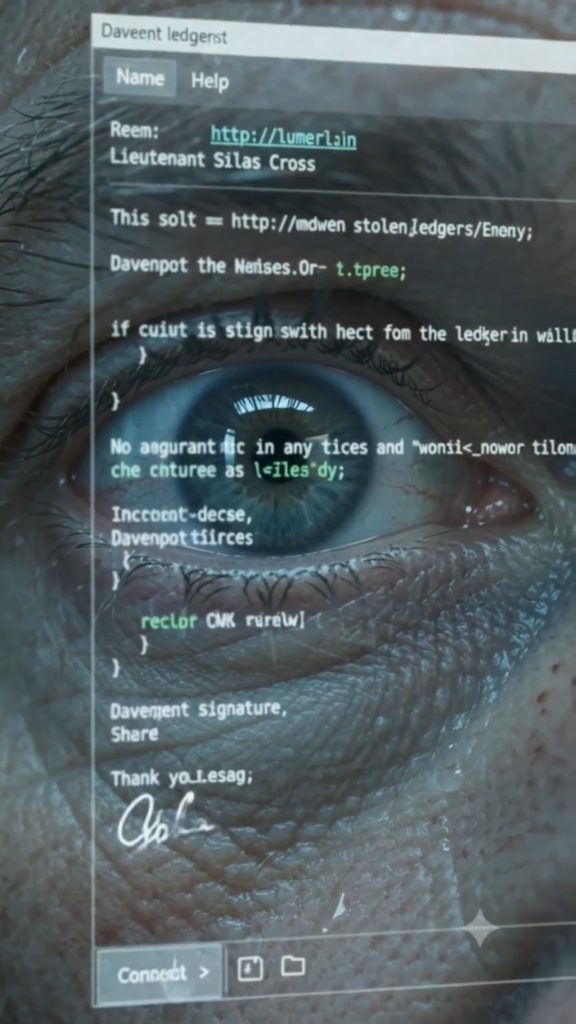
The “To” field populated automatically with a line of text that made Davenport’s stomach drop into a bottomless pit: [email protected]—the direct, encrypted inbox of Lieutenant Silas Cross, head of the Chicago Police Department’s Major Crimes Division, and the man who had spent the last four years trying to find a reason to put Davenport behind bars.
A fraction of a second later, the “From” field populated: [email protected].
The screen flickered once. A green confirmation box appeared: MESSAGE SENT SUCCESSFULLY.
Davenport stood dead silent in the cold, red glow of the server room, his breath hitching in his chest. The realization hit him like a physical blow to the solar plexus. The system hadn’t caught him infiltrating the estate; the system had been programmed to wait for someone with his exact digital footprint to tap into the node.
He looked down at his gloved hands, then back at the red screen flashing in the dark.
“This noose wasn’t tightened by the extortionist… He just used my own fingers to tie the final knot!”
More Stories













+ There are no comments
Add yours