
My Cult Leader Boss Thought I Was a Broke Temp Medic Until My Sleeve Slipped in the Infirmary Tent




Part 1
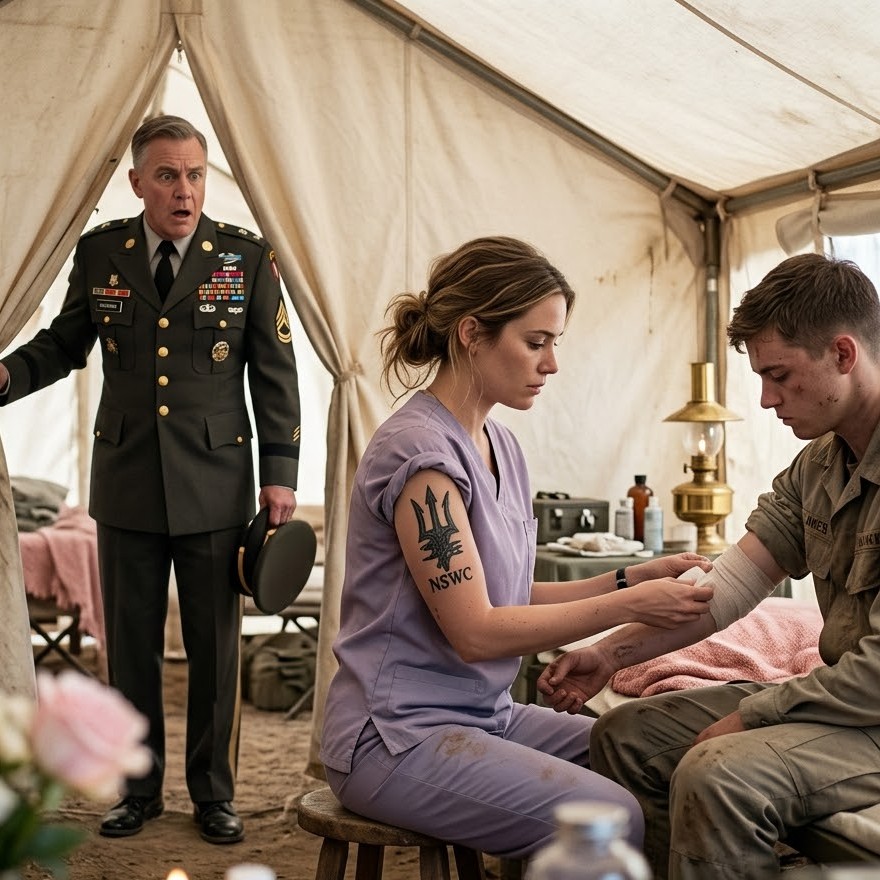
Two minutes earlier, I was cutting open a nineteen-year-old boy’s soaked shirt to treat his hypothermia in the medical tent.
When my scrub jacket sleeve hitched up past my shoulder, the room went dead silent.
Etched into my upper arm was a deep ink trident—the emblem of the Navy Special Warfare Medical Element.
My boss, Prophet Elias Crain, froze in the doorway of the compound tent, staring at the mark on the woman he thought was a broke civilian helper.
The flimsy medical tent, pitched behind the main compound lodge, always felt colder than the Idaho winter outside. This afternoon, it was practically an icebox. The air was thick with the faint smell of rubbing alcohol and damp wool.
I worked quickly, my fingers precise despite the biting chill. Caleb Wright, a nineteen-year-old recruit, lay shivering violently on the cot. His lips were blue, his skin unnaturally pale.
His work clothes, soaked through from what must have been hours exposed to the elements, clung to his fragile frame. Frost dusted the collar of his denim shirt.
“Stay with me, Caleb,” I murmured, my voice low and steady.
He mumbled something, a choked whimper, his eyes fluttering. His teeth chattered so hard I could hear it over the low hum of the portable electric heater struggling in the corner.
“Almost done,” I promised, reaching for the heavy-duty shears. The fabric was stiff with ice and dirt.
With a swift, practiced motion, I began to cut his shirt open, starting from the collar. The rusty scissors grated through the thick denim. Each snip brought me closer to his chest, to the urgent task of warming his core.
My movements were economical, honed by years of emergency care in far worse conditions. I didn’t think about anything but the boy in front of me. His breathing was shallow, hitched.
As I pulled the heavy, sodden shirt away from his body, the sleeve of my own scrub jacket snagged on the rough fabric. It slid upward, past my elbow, past my shoulder.
The room, already quiet save for Caleb’s shivers and the heater’s whine, went absolutely still.
A few younger recruits, who had been nervously watching from the tent’s perimeter, froze mid-whisper. The two compound nurses, usually bustling with quiet efficiency, stopped moving entirely.
Their eyes weren’t on Caleb. They were on my arm.
The deep ink trident, a symbol burned into my skin more than a decade ago, was fully exposed. It sat starkly against my pale skin, a silent testament to a life I had tried desperately to bury.
A muffled gasp rippled through the small group. No one spoke. No one dared.
Then, a shadow filled the tent entrance. Prophet Elias Crain, his imposing figure framed by the flapping canvas, stood there. His eyes, usually gleaming with self-importance, were wide with a raw, unadulterated shock.
He had been in the middle of a sermon, or so I’d overheard from the main lodge. His voice had carried across the compound courtyard, a booming echo against the Idaho hills.
Now, he was silent.
His gaze dropped to my arm, specifically to the unmistakable emblem. The trident. The mark of the Navy Special Warfare Medical Element. It was not merely a tattoo; it was a brand, impossible to misinterpret.
His face, usually so composed and arrogant, contorted into something tight and furious. A vein throbbed visibly in his temple.
He walked slowly, deliberately, into the tent, his boots crunching on the thin layer of straw spread over the frozen earth. Every eye in the tent followed him, then flicked to me, then to the tattoo, then back to him.
The temperature in the tent seemed to drop even further, suddenly colder than the outside air. Elias stopped mere feet from my cot. He didn’t look at Caleb. He only looked at me.
His chest rose and fell rapidly, like a bellows.
“What is that?” he demanded, his voice a low growl that still managed to echo in the sudden vacuum of sound. He pointed a trembling finger directly at my arm.
I said nothing. My hand, still holding the shears, was frozen above Caleb’s chest. Caleb whimpered again, oblivious.
Elias’s eyes narrowed, sweeping over my face, then back to the trident. His face darkened, a storm brewing behind his usually placid facade. The initial shock gave way to something far more sinister.
He took another step closer, invading my personal space. The scent of his expensive cologne, so out of place in the sterile tent, suddenly filled my nostrils.
“You,” he spat, his voice rising, gaining momentum, “You are no ordinary temp worker, are you?”
He looked around at the petrified faces of the recruits and the nurses, his gaze flicking between them, as if gauging their understanding.
“This woman,” he roared, his voice shaking the canvas walls, “is not here for fifteen dollars an hour. She is a federal infiltrator! A government spy!”
Part 2
Elias gestured wildly. “Jonas! Her bag! Lock her in the timber supply barn. Now!”
Jonas Lawson, the compound quartermaster, moved with frightening efficiency. He ripped my medic bag from my shoulder.
His grip tightened on my arm, yanking me toward the tent flap.
“Get out!” Elias screamed, his face purple. “And take that federal filth with you!”
I stumbled backward, shoved hard through the tent entrance. The cold air hit my face.
As Jonas dragged me past the cots, I managed one quick glance at Caleb.
His shivering had worsened. But it wasn’t just hypothermia. The irregular spasms, the dilated pupils, the faint, metallic scent I’d dismissed earlier…
He wasn’t just exhausted and cold. Caleb was showing signs of chemical poisoning.
More Stories





+ There are no comments
Add yours