The Bleeding Canvas Mystery: Why My Father Is Threatening Legal Action Over a $28,500 Portrait


Part 1
The morning after I hung it in my study, the figure in the painting had subtly shifted her seated posture toward the edge of the frame.
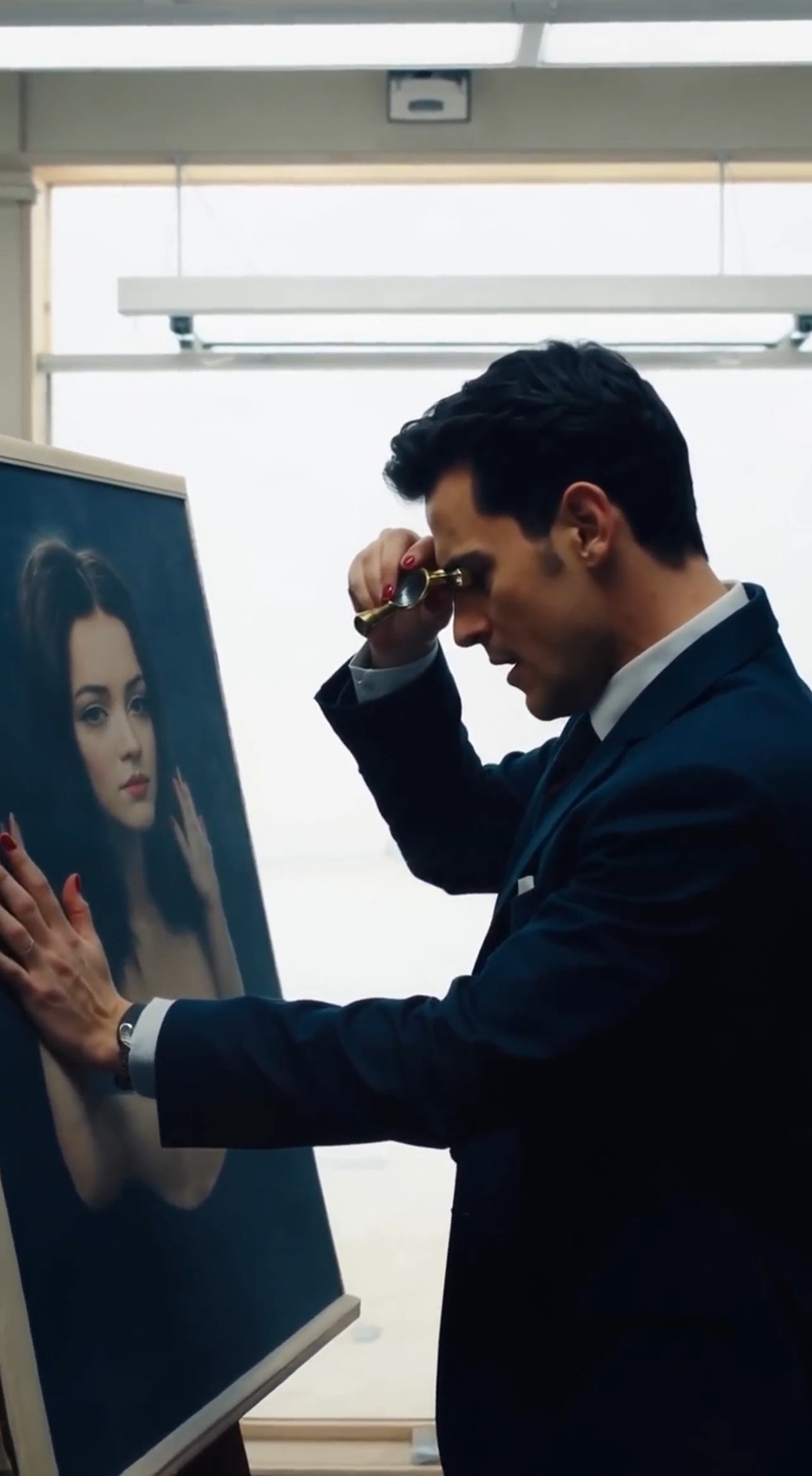
By this morning, her fingers were pressed against the inside of the canvas, and faint red pigment resembling fresh blood was blooming under her fingernails.
My estranged father, Arthur Craine, immediately sent a team of lawyers threatening a federal court injunction if I do not surrender the painting to his estate by midnight.
Something dark is locked inside this frame, and my father is terrified I am about to expose it.
Julian Craine stood in the hushed morning light of his Boston townhouse, the brass magnifying glass clutched tightly in his hand. Sunlight, filtering through the leaded-glass windows of his study, cast long, dusty shafts across the worn Persian rug and illuminated the enigmatic oil painting on the far wall.
It was a 1994 portrait, purchased for $28,500 just three days prior at a quiet Beacon Hill estate auction. He had been drawn to its melancholic beauty, the way the artist had captured a fleeting expression in the subject’s eyes.
Yesterday, the woman in the portrait had been seated serenely, her hands folded neatly in her lap, a picture of quiet contemplation.
This morning, however, was different.
His breath caught in his throat, a cold knot tightening in his stomach. The figure had undeniably shifted.
Her posture was no longer relaxed and central. Instead, she leaned distinctly to the right, her painted shoulders angled towards the very edge of the frame, as if straining against an unseen barrier.
His art restorer’s eye, trained over decades to spot the slightest anomaly, registered the impossible change. His rational mind, however, struggled to process it.
He raised the magnifying glass, bringing the canvas into sharp, unnerving focus. The details, already exquisite, now held a sinister edge.
Her hands, once demurely folded, were now raised. They were pressed flat against the inside of the canvas, fingers splayed wide as if pushing against the surface of the painting itself.
It looked like an attempt to escape.
A shiver traced its way down Julian’s spine. He leaned closer, his nose almost touching the aged varnish, the faint scent of linseed oil and dust filling his nostrils.
There, beneath each fingernail, a faint, deep red pigment had bloomed. It looked terrifyingly fresh, a moist crimson stain that hadn’t been there yesterday.
It was exactly as if she had been trying to claw her way out, scraping her fingers raw against the very fabric of her painted prison.
He tentatively reached out, his own finger trembling slightly as it met the cool, smooth surface of the canvas. He traced the outline of one of the painted fingers.
When he pulled his hand back, a minute speck of the red pigment clung to the pad of his index finger. It was soft, almost viscous.
Julian stared at it, then at the painting. His mind raced, grappling with the impossible. This wasn’t just an optical illusion. This was a physical alteration.
He needed an expert. He needed answers. His first thought was to call Dr. Aris Thorne, his old professor and mentor, a man who had seen every conceivable oddity in the art world.
He was reaching for his phone, his thumb hovering over Thorne’s contact, when an urgent chime startled him. It wasn’t a call. It was an email notification.
The sender’s name flashed across the screen: “Morrison & Kitteridge LLC.”
Julian’s hand froze. The law firm. His father’s law firm.
A fresh wave of dread, cold and professional, washed over him, completely eclipsing the eerie mystery of the painting. He knew that name, and he knew what it meant.
His estranged father, Arthur Craine, rarely communicated directly. He preferred to operate through layers of legal counsel, a characteristic Julian had grown to despise over their long years of silence.
He tapped the screen, opening the message. The subject line was stark: “URGENT: Cease and Desist – Unlawful Possession of Craine Family Trust Property.”
The legal jargon that followed was dense, but the core message was brutally clear.
“This communication serves as formal notice to Julian Craine regarding the unauthorized possession of an oil painting, purported to be a 1994 portrait of a young woman, recently acquired at the Beacon Hill Estate Sale on [Date of Sale].”
Julian’s eyes scanned the next paragraph, his heart hammering against his ribs.
“Our client, Arthur Craine, unequivocally asserts ownership of this artwork as a designated asset of the Craine Family Trust.”
The words blurred together, but the specific demands crystallized into a chilling threat.
“We hereby demand the immediate surrender of the aforementioned artwork to authorized representatives of the Craine Family Trust no later than midnight this evening, [Current Date].”
“Failure to comply with this demand will result in the immediate initiation of legal proceedings, including but not limited to, a federal court injunction for recovery of stolen property and a lawsuit seeking damages in the amount of one hundred thousand dollars ($100,000.00).”
Julian felt a profound chill, entirely unrelated to the spectral painting before him. His father wasn’t just making a claim; he was issuing an ultimatum.
The painting, with its bleeding fingers and impossible shifts, suddenly felt less like a mysterious artifact and more like a battleground.
Part 2
The sun dropped below the Boston skyline, painting my workshop window in hues of deep violet and orange. I locked the heavy steel door behind me, sealing myself inside with the painting and the unsettling silence. Overhead, the fluorescent lights hummed, casting a stark, shadowless glow on every tool and canvas.
I stared at the portrait, the figure’s painted hands now visibly further forward, pressing hard against the inner frame. By 2:00 AM, the quiet hum of the workshop was the only sound. My eyes burned from hours of relentless observation.
The moist crimson pigment under her fingernails glistened, catching the light. I leaned in close, inhaling deeply. A faint, metallic tang mixed with the familiar, earthy scent of old linseed oil and iron. It wasn’t organic blood, not in the way I first thought. This was something manufactured.
Then, a cold jolt shot through me. This wasn’t supernatural. It was a cunning mechanism. The painting wasn’t static. It was alive with dynamic thermo-hygrometric pigments, formulated to react to ambient moisture and temperature. Designed to move, to shift, to *bleed* over decades. A slow, deliberate countdown, orchestrated by someone from the past.
Thirty years, perhaps, since it was first constructed. A hidden message, timing its revelation for this exact moment. The canvas now seemed to pulse faintly under the harsh lights, its slow, inexorable shift a chilling, premeditated act.
You are Julian Craine. The canvas before you feels less like an artwork and more like a ticking device. What do you do?
A) Use a utility lighter to ignite the canvas in the workshop fireplace immediately.
B) Mount the canvas under the stereo microscope to inspect the pigment layers.
More Stories











+ There are no comments
Add yours