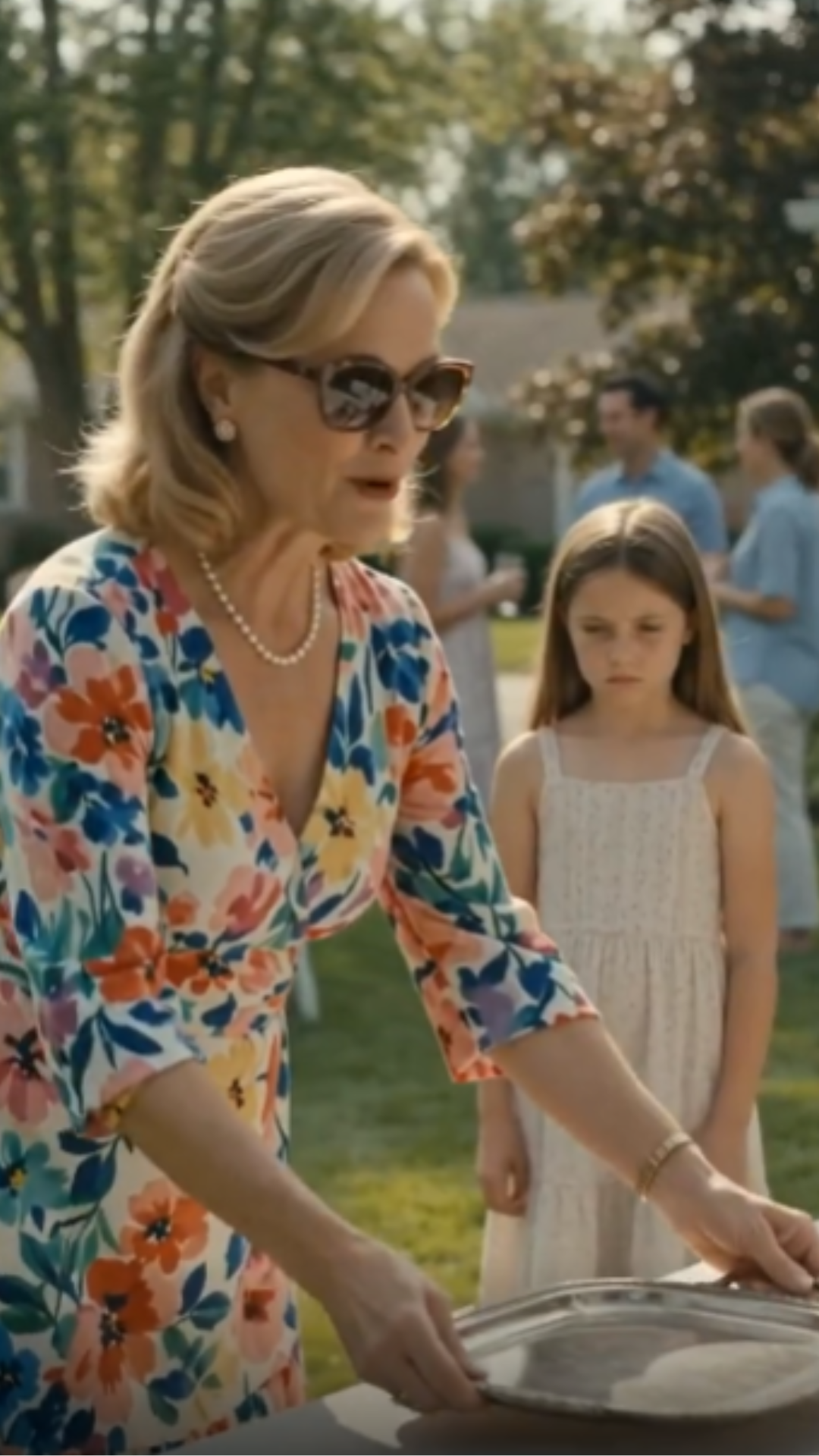
At our cul-de-sac summer barbecue, my next-door neighbor Brenda Gable publicly refused to give my ten-year-old granddaughter Maya a plate of food.


Part 1
Brenda announced to the entire neighborhood that freeloading kids without fathers who do not pay into the block association fund should eat at home.
I silently took Maya’s hand, walked her back across our lawn, and began digging through old records to prove Maya’s father had not simply abandoned us.
What I uncovered was $187,000 sent over eight years—and a terrifying secret hidden behind the quiet houses on our street.
The scent of grilled hot dogs and hickory smoke hung heavy in the warm Pennsylvania air, mixing with the sweet perfume of Mrs. Davison’s honeysuckle bushes. Children’s laughter echoed between the neatly manicured lawns of Pine Creek cul-de-sac, punctuated by the occasional splash from a kiddie pool.
It was the annual Fourth of July barbecue, a tradition for as long as 68-year-old Clara Higgins could remember.
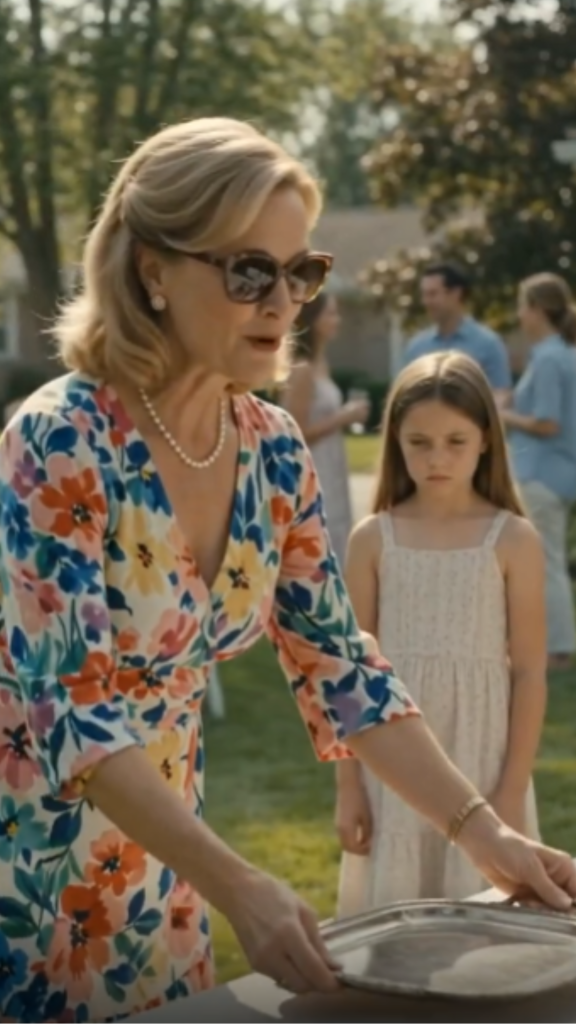
Clara watched her ten-year-old granddaughter, Maya, skip toward the long folding table set up in Brenda Gable’s backyard. Maya’s eyes were wide with innocent excitement. A stack of paper plates sat at one end, and Brenda Gable, Clara’s next-door neighbor and the self-appointed queen of the block association, stood proudly behind the serving trays, a white apron tied over her floral dress.
Brenda’s smile, usually as tight and starched as her linen tablecloths, was broader today as she scooped potato salad onto plates for Mr. and Mrs. Peterson.
Maya reached the table, her small hand hovering over the stack of plates. She looked up at Brenda with a hopeful gaze.
“Please, Ms. Gable?” Maya asked, her voice soft but clear. “Could I have some chicken?”
Brenda’s smile flickered, then vanished. Her eyes, usually darting around to catch every neighborhood detail, fixed on Maya with an icy stare. She didn’t move.
Then, slowly, deliberately, Brenda reached down and pulled the large aluminum tray of grilled chicken thighs, still steaming, a good two feet further down the table, away from Maya’s grasp. The clatter of metal against plastic was surprisingly loud in the momentary silence that fell over the nearest group of neighbors.
“Oh, Maya,” Brenda said, her voice dropping its earlier cheerfulness to a sharp, patronizing tone. “You know how these things work, sweetie.”
A few conversations died down around them. Heads turned.
“Unfunded children whose parents don’t pay block association dues don’t get plates.”
The words hung in the air, heavy and blunt. They were meant for Maya, but they sliced through Clara’s heart. Maya froze, her hand still outstretched, her face crumpling in confusion. She looked from the chicken tray, now out of reach, to Brenda’s unyielding face, then back at Clara across the lawn, her eyes wide and wet.
A stifled gasp swept across the yard. Someone dropped a plastic cup. It bounced harmlessly, but the sound felt violent. The cheerful hum of the barbecue had vanished, replaced by an awkward, suffocating quiet. Neighbors, who moments before had been laughing, now stared at their feet or pretended to be engrossed in their conversations. No one spoke up.
Clara felt a hot flush creep up her neck, but she forced herself to keep her expression neutral for Maya’s sake. She walked slowly, deliberately, across the soft grass. Each step felt like a pilgrimage.
She reached Maya, whose chin was trembling. Clara gently took her granddaughter’s small, trusting hand in her own. Maya’s fingers were cold.
“Come on, sweet pea,” Clara murmured, her voice steady despite the tremor in her chest. “Let’s go home. Grammie will make you something special.”
She felt Brenda Gable’s eyes burning into her back as they turned. She felt the silent, unspoken judgment from every neighbor present, not just Brenda’s. The walk back across their manicured lawn, only twenty paces, felt like miles. Maya didn’t say a word, her small hand clutching Clara’s tightly, her head bowed. The humiliation was a raw wound.
Back in the quiet refuge of their own kitchen, Clara tried to distract Maya with a grilled cheese sandwich, but the girl barely touched it. Later, as Clara tucked Maya into bed, the ten-year-old asked, her voice small and muffled by her pillow, “Does my dad not paying mean I don’t belong, Grammie?”
Clara’s throat tightened. She smoothed Maya’s dark hair, kissing her forehead.
“Of course not, darling. You belong everywhere. And your dad… he was a good man. He loved you very much.”
But the words felt hollow even to Clara. For eight long years, everyone on Pine Creek Lane, including Brenda, had whispered about Julian Higgins abandoning his young family without a trace, leaving Clara to raise Maya on her meager widow’s pension.
After Maya finally drifted off to sleep, Clara descended into the cool, slightly musty air of her basement. It was a space filled with forgotten memories, the remnants of her late husband’s life. His old oak desk stood against the far wall, a monument to a past that felt increasingly distant.
Clara turned on a bare bulb hanging from the ceiling. Dust motes danced in the weak light. She ran her hand over the smooth, worn surface of the desk, a faint smell of old paper and cedar in the air. Her husband had been meticulous, keeping all their financial records in order.
She pulled open the bottom drawer, which groaned in protest. Inside, nestled beneath a stack of faded photographs and old tax returns, was a rusted metal strongbox. It was heavier than she remembered. She found the small, tarnished key on a ring with her husband’s old fishing lure, tucked in a velvet pouch.
The lock clicked open with a faint metallic protest. Inside, neatly stacked, were various documents. She found their marriage certificate, old savings bonds, and then, a slim, leather-bound book. It was a bank ledger, its pages yellowed at the edges.
Clara opened it. The handwriting was her husband’s, neat and precise, dating back years. She flipped past entries for utility bills, mortgage payments, and grocery expenses. Then, her breath hitched.
Her eyes landed on a series of entries that began in August 2016. Each one was for the exact same amount: $1,947.00. And next to it, under the “memo” column, clearly written in her husband’s familiar hand: “For Maya Higgins.”
Month after month. For eight years. Every single month, without fail, since Julian had supposedly vanished.
Clara’s hands began to tremble. She grabbed a small calculator from the desk, her fingers fumbling with the buttons. $1,947 multiplied by 12 months, multiplied by 8 years.
The number glowed starkly on the small screen: $187,000.
One hundred eighty-seven thousand dollars. Money for Maya. Money that Clara had never seen a single cent of. Money that contradicted everything she had been told, everything she had believed, about Julian simply walking away and leaving them with nothing. The pain of the barbecue snub was instantly overshadowed by a tidal wave of shock and disbelief.
Who had been sending this money? And where had it gone?
Her eyes darted back to the ledger, searching for any additional information. On the very last page, taped securely, was a small, white slip of paper—a local bank Routing slip.
It was faded, but the details were still legible. It named the beneficiary account for these consistent monthly transfers.
Pine Creek Neighborhood Beautification Fund.
And below that, in smaller print, the name of the account manager.
Brenda Gable.
Clara stared at the slip, the words blurring, then sharpening into horrifying focus. The money, meant for her granddaughter, had been flowing directly into her next-door neighbor’s hands for nearly a decade.
Part 2
The morning sun was barely over the tree line, casting long shadows across Pine Creek cul-de-sac. It was 7:00 AM. I had barely slept, the image of that routing slip seared into my mind.
The strongbox sat open on my kitchen counter, the ledger and slip still laid out. I looked at Maya’s untouched grilled cheese from last night, a cold lump in my stomach.
I walked across our lawn to Brenda Gable’s house. She was already out, a green watering can in hand, methodically tending to her hanging ferns on the porch. The air was cool and crisp, a stark contrast to the heat in my chest.
Brenda looked up, a bright, cold smile already on her face.
“Clara, dear! Up with the birds, I see,” she chirped, her voice falsely cheerful. “Lovely morning, isn’t it?”
I stopped at the edge of her porch, the ledger printout clutched in my hand.
“Brenda, we need to talk about this,” I said, holding out the paper. “$1,947 a month, every month, for eight years. Paid into the Pine Creek Neighborhood Beautification Fund.”
Her smile didn’t waver. She poured a slow stream of water onto a fern.
“Oh, that old thing?” she said dismissively. “That was a community benefit, Clara. Your late husband signed over those rights years ago. A local grant for property upkeep, not… child support. You must be confusing things in your head.”
My grip tightened on the paper. “I want to see the bank statements, Brenda. All of them.”
Brenda set down the watering can. She stepped closer, her eyes losing their cold cheer and hardening. The sweet scent of wet earth and ferns suddenly felt menacing.
“Clara, I’m going to give you a friendly warning,” she said, her voice dropping to a low, firm tone. “If you start making wild accusations around the neighborhood, the committee will have no choice.”
She paused, letting the words hang.
“We’d have to vote to cite that overgrown oak tree of yours. You know the one. That would be a $4,000 removal fee you simply can’t afford, dear.”
My mouth went dry. I stared at her, then at the sprawling oak that shaded my house, its branches reaching over my roof. Brenda was actively hiding the money stream, using my own home as leverage.
I turned and walked away, shaken to my core. The air felt suffocating.
Back in my kitchen, I pulled out my phone. I needed to talk to my sister. Evelyn always knew what to do.
She answered on the third ring, her voice tight.
“Evelyn, it’s me,” I began, my voice trembling. “I found something incredible about Julian, and Brenda is…”
“Clara, listen to me,” Evelyn cut me off, her voice hushed. “Brenda called me late last night, in tears. She told me you’ve been having these… dementia episodes. About missing fortunes.”
More Stories






+ There are no comments
Add yours