
Union Army Auditor Returns Home in 1864 to Rescue His Abused Seven-Year-Old Son, Uncovering an In-Law Betrayal over a $150,000 War Estate That Ends in Permanent Family Tragedy


The momentum had swung decisively. With Cordelia’s scathing testimony, Clara’s letter was no longer a disputed piece of evidence, but a cornerstone of the prosecution. The military tribunal moved swiftly, now seeing through Silas’s thinly veiled facade.
I took the stand once more, presenting the physical evidence Thaddeus Finch had surrendered: the falsified probate appraisals, the manipulated financial ledgers, and the legal petitions bearing Silas’s personal seal alongside Julian’s signature. I meticulously detailed how these documents sought to strip Thomas of his $150,000 federal land trust, all under the guise of my alleged combat mania.
“These documents,” I stated, holding up the stack of papers, “are not merely instruments of probate; they are instruments of war-time fraud, orchestrated by Judge Silas Pembroke to enrich himself at the expense of a child and a serving Union officer.”
I presented my own auditor’s notes, cross-referencing Finch’s forged records with official War Department receipts that detailed the true valuations of properties, proving the deliberate undervaluation of Clara’s mother’s estate and the fraudulent claims on Thomas’s trust. The numbers, stark and undeniable, laid bare the extent of Silas’s greed.
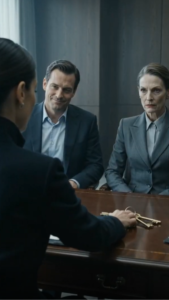
The magistrate, after reviewing the comprehensive evidence, slammed his gavel down. “The court finds sufficient evidence to nullify all land seizure petitions filed by Judge Silas Pembroke regarding the Hallowell estate and Captain Samuel Hallowell’s son, Thomas. Furthermore, the court issues immediate arrest warrants for Julian Hallowell and Thaddeus Finch for their documented involvement in this conspiracy.”
A wave of relief washed over me. Julian and Finch would face justice. But then, the magistrate continued, his voice heavy.
“However,” he said, looking directly at Silas, “due to Judge Pembroke’s standing, his long-term political connections, and the complex nature of the civil and military probate laws during this time of war, direct criminal charges against Judge Silas Pembroke himself will require further, extensive investigation.”
Silas, ever the master manipulator, had anticipated this. His lawyers immediately invoked a series of complex legal loopholes, citing jurisdictional ambiguities between military and civil law, and leveraging high-ranking connections within the D.C. legal establishment. They argued for the case to be moved to civilian courts, where Silas’s influence was even stronger.
The military tribunal, focused on immediate wartime justice, could not easily untangle Silas’s web of connections and legal stratagems. They had struck a blow, but not a killing one.
The final ruling was a bitter, partial victory. The land seizure petitions were voided. My guardianship of Thomas was affirmed. Julian and Finch were to be arrested for their direct, undeniable roles in the fraud. But Judge Silas Pembroke, the architect of it all, walked free from the tribunal.
He merely smiled, a thin, cold twist of his lips, as he exited the courtroom. His face held no remorse, only a chilling promise of continued resistance.
“He’s tying it up in endless court appeals, Captain,” Bradstreet explained, shaking his head. “He’ll bleed you dry in the civil courts, drawing it out until you have nothing left to fight with. This is not over.”
The $150,000 trust, while protected from immediate seizure, was now embroiled in a seemingly endless legal battle. Silas would continue to file petty land disputes, challenge every decision, and use his vast network to delay, complicate, and obstruct. It was a war of attrition, fought with legal papers instead of bullets, but no less devastating.
I looked down at Thomas’s small, still hand, nestled in mine. He had remained silent, withdrawn, throughout the entire proceedings, his eyes vacant. The immediate legal threat was gone, but the true battle, the one for my son’s spirit, had only just begun. The legal victory felt hollow in the face of his unbroken silence.
More Stories










+ There are no comments
Add yours