
Union Army Auditor Returns Home in 1864 to Rescue His Abused Seven-Year-Old Son, Uncovering an In-Law Betrayal over a $150,000 War Estate That Ends in Permanent Family Tragedy


The reprieve at Cordelia’s cottage was short-lived. The deputies, though they stood down, were obligated to report the situation. Within days, my allegations and Cordelia’s account, combined with the explosive contents of Clara’s letter and Finch’s forged documents, reached the Union Military District magistrate. An emergency tribunal was convened in Washington D.C.
It was a small, somber courtroom, tucked into a government building, filled with the stern faces of military officials. The Civil War was still raging, and any hint of fraud or instability among its officers was taken seriously.
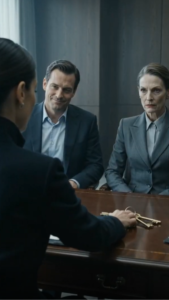
Judge Silas Pembroke, however, was not one to be easily defeated. He arrived in the courtroom with a phalanx of well-connected lawyers, his demeanor radiating an air of injured innocence. He played the part of the grieving father-in-law, concerned for his daughter’s legacy and his unstable son-in-law.
His lawyers immediately launched a blistering smear campaign. They painted me as a war-crazed whistleblower, driven to paranoia by the horrors of the front lines and the loss of my wife. They claimed my accusations were the delusions of a man suffering from “combat-induced hysteria,” fabricating evidence to justify my erratic behavior.
“Captain Hallowell’s mental state is clearly compromised,” Silas’s lead counsel argued, gesturing dramatically. “His claims of conspiracy are baseless, fueled by an unstable mind. He has even dragged his elderly aunt into his delusions, coercing her to support his fabricated narrative.”
They dismissed Clara’s letter as a forgery, or, at best, the ramblings of a woman weakened by consumption and prone to “feminine hysterics” under the influence of her unstable husband. They produced expert witnesses – doctors I’d never seen – who testified to the supposed symptoms of combat mania, all aligning suspiciously with my current predicament.
Julian, my own brother, took the stand for Silas. His testimony was a cruel twist of the knife. He spoke of my “obsessive tendencies” with auditing, my “unusual detachment” after Clara’s death, and my “sudden, violent outburst” against Evelyn. He painted me as a man unraveling, confirming every one of Silas’s claims.
He even claimed I had attempted to extort him, offering a split of the trust money if he would support my “fanciful notions of conspiracy.” My blood ran cold at the audacity of his lies.
I watched, grim-faced, as Silas sat at his table, a faint, triumphant smirk playing on his lips. His political influence, his carefully cultivated reputation, were powerful weapons. The military tribunal, while impartial in principle, was still susceptible to such a carefully orchestrated attack.
The magistrate, a stern-faced colonel, listened impassively to the mounting accusations. He occasionally cast a glance in my direction, his expression unreadable.
During a recess, my own appointed military counsel, a young but sharp lieutenant named Bradstreet, approached me. “Captain, they’re attempting to invalidate your character entirely. The letter alone, without a corroborating witness, is vulnerable. Especially given the circumstances of your return, and the emotional trauma you’ve undeniably experienced.”
He was right. A dead woman’s letter, even one so damning, could be dismissed as fantasy if I was painted as insane. I needed more. I needed a living, breathing testament to Clara’s character, to Silas’s long history of manipulation, and to the clear authenticity of the letter itself.
Bradstreet looked at me expectantly. “Who else can speak to Clara’s state of mind? To her past knowledge of her father? Someone unimpeachable, who can withstand their attacks.”
My mind immediately went to Cordelia. She had known Clara since birth. She had known Silas even longer. She was the matriarch, the keeper of family secrets. She was the key.
“Great-Aunt Cordelia Pembroke,” I stated, my voice firm. “She will testify. She knows everything. She was Clara’s confidante.”
Bradstreet’s eyes lit up. “Excellent. A witness of such standing, a Pembroke herself… that could turn the tide. She can validate the letter, and speak to Judge Pembroke’s true nature.”
The next phase of this battle would be in Cordelia’s hands.
More Stories










+ There are no comments
Add yours