
At a post-war formal gathering, Silas Caldwell publicly assaulted his wife Elara after she claimed her inheritance, then his family threatened her into silence — but she had a secret ally.


The fall of Percival Finch was merely the first crack in the Caldwell family’s crumbling empire. With Finch gone, the gazette’s articles grew bolder, more direct, linking the named properties and the methods of fraud unequivocally to the Caldwell name. The whispers turned to outright condemnation.
Silas Caldwell, stripped of his family’s wealth, his credit revoked, and his reputation in tatters, became a ghost in his own grand house. His once-haughty demeanor had completely vanished, replaced by a visible, desperate panic. I observed him from my window, a silent, grim spectator to his downfall.
He was seen frantically trying to sell off family heirlooms. A carriage loaded with ornate silverware and antique furniture, once displayed with pride, pulled away from the estate, presumably bound for a pawnbroker in a distant town. The sale was for pennies on the dollar, a humiliating fire sale of what was once untouchable wealth. The casual disposal of their cherished possessions, forced by desperation, was a specific cruelty, a visible sign of their rapid descent.
Later, I saw him trying to speak with a local farmer, gesturing wildly at a section of the Caldwell land. The farmer, who had once bowed and scraped to Silas, now merely shook his head and walked away, his back stiff with newfound defiance. Silas was utterly alone, his influence evaporated. His face, once so proud, was now etched with a profound, public despair.
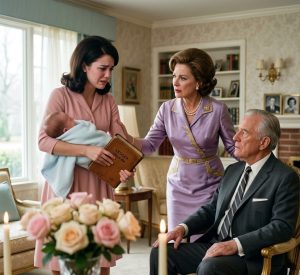
Beatrice Caldwell, however, proved herself to be a master of cruel pragmatism. She had always prioritized appearances above all else, and in their moment of ruin, her resolve hardened. She began to publicly disavow her son’s actions, claiming complete ignorance of his “unfortunate business dealings.” I heard her speaking to a visiting cousin, her voice clear and precise.
“Silas has always been somewhat… impetuous,” Beatrice said, her tone icy. “His father’s business was complex, of course, but I assure you, I was never privy to the details of his more… speculative ventures.”
She maintained a carefully constructed facade of aristocratic innocence, throwing Silas under the carriage to save her own skin. It was a cold, calculated act of abandonment, a profound betrayal that left Silas completely isolated. The petty cruelty of her disavowal, separating herself from her son as if he were a stranger, was breathtaking to witness.
Martha, utterly bewildered by the rapid disintegration of her world, clung desperately to Beatrice, her usual gossipy demeanor replaced by a fearful silence. She watched Silas with wide, frightened eyes, as if he were a stranger, a pariah.
Silas, now ostracized by his own mother, ignored by the remaining servants, and universally scorned by the community, was a shattered man. His power, his status, his very identity, had dissolved into nothing. The grand Caldwell name, once synonymous with wealth and influence, was now a byword for fraud and ruin. The ironic reversal was complete. My aunt’s silent retribution had ensured that the Caldwells’ legacy, built on stolen land and lies, would finally collapse under its own weight.
More Stories










+ There are no comments
Add yours