
At a post-war formal gathering, Silas Caldwell publicly assaulted his wife Elara after she claimed her inheritance, then his family threatened her into silence — but she had a secret ally.


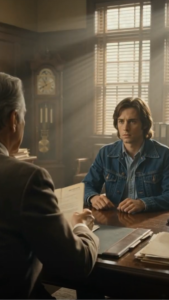
Finn walked away from the newspaper office, the scent of ink still clinging to his clothes, a bitter reminder of his failed attempt to secure help. Nathaniel Croft’s polite refusal echoed in his ears, a frustrating loop of “domestic matter” and “lack of broader public impact.” But one detail, small and seemingly insignificant at the time, continued to nag at him.
He was halfway down the dusty street when he replayed their conversation. Nathaniel had briefly lifted his head from his maps, his eyes momentarily connecting with Finn’s.
“Finch? Yes, his name appears in several of my files, connected to those questionable transfers,” Nathaniel had said, almost as an aside.
It was a throwaway line, a casual observation from a man consumed by his research. Yet, it pulsed in Finn’s memory, a tiny spark in the pervasive darkness. He stopped by the general store, grabbing a cup of coffee, the cheap porcelain warm in his hands. He leaned against a rain-slicked barrel outside, trying to piece together the fragments.
Nathaniel had then recounted a pattern, spoken casually, almost as if explaining a tedious ledger entry. He described “dubious land transfers from vulnerable post-war families,” often involving “low-value sales and quick resales.” The journalist had been dismissive of my immediate plight, but this description of Finch’s activities, this *pattern*, was undeniably concrete. It hinted at systemic fraud, a methodical predation on the unsuspecting.
Finn drained his coffee, his mind whirring. He had known Percival Finch was a crooked notary, but he’d always viewed it as petty corruption, an opportunistic man taking advantage where he could. Nathaniel’s words painted a picture of something larger, more organized. Finch wasn’t just a one-off charlatan; he was part of a broader, more insidious operation.
The physical description Nathaniel had given resonated with Finn. He’d spoken of “families left destitute,” their land taken for a pittance, then swiftly flipped for a significant profit. Finn imagined the desperation of those families, the same desperation that Silas was now trying to inflict upon me. The casual cruelty of it, the systematic nature of the exploitation, made his stomach clench.
“These are not isolated incidents, Mr. Beaumont,” Nathaniel had said, tapping a section of his map. “This is a web.”
Finn had been too focused on my immediate crisis to grasp the full implication then. But now, away from the immediate pressure of the conversation, the connection began to form, hazy and incomplete. Finch was involved with my case, yes, but he was also involved in this larger, darker scheme. What if the two were not entirely separate? What if my family’s situation, my inheritance, was somehow entangled in this grander pattern of fraud?
He thought of the urgency in Silas’s voice, the depth of the Caldwells’ hidden financial struggles I had overheard. That desperation, combined with Finch’s shadowy activities, suddenly felt less like random events and more like pieces of a puzzle. It was still a loose thread, a connection without a clear knot, but it was a thread nonetheless.
Finn knew he couldn’t force Nathaniel to abandon his major investigation for my personal drama. But perhaps, just perhaps, if he could find a way to link my specific case to Nathaniel’s broader inquiry, the journalist would be compelled to act. The trick was finding that link. He needed something concrete, something that transcended a “domestic dispute.” He needed evidence that spoke to the systematic nature of the Caldwells’ and Finch’s wrongdoing, evidence that fit into Nathaniel’s “web.”
He started walking back towards the Caldwell estate, a new resolve hardening his features. The sheriff might ignore him, and the journalist might be preoccupied, but Finn wasn’t giving up. He understood now that my fight wasn’t just against Silas and Beatrice; it was against a system, and sometimes, to fight a system, you needed to find its weak points, its hidden connections. The mention of Percival Finch and his “dubious land transfers” felt like one such point, a crack in the wall.
More Stories









+ There are no comments
Add yours