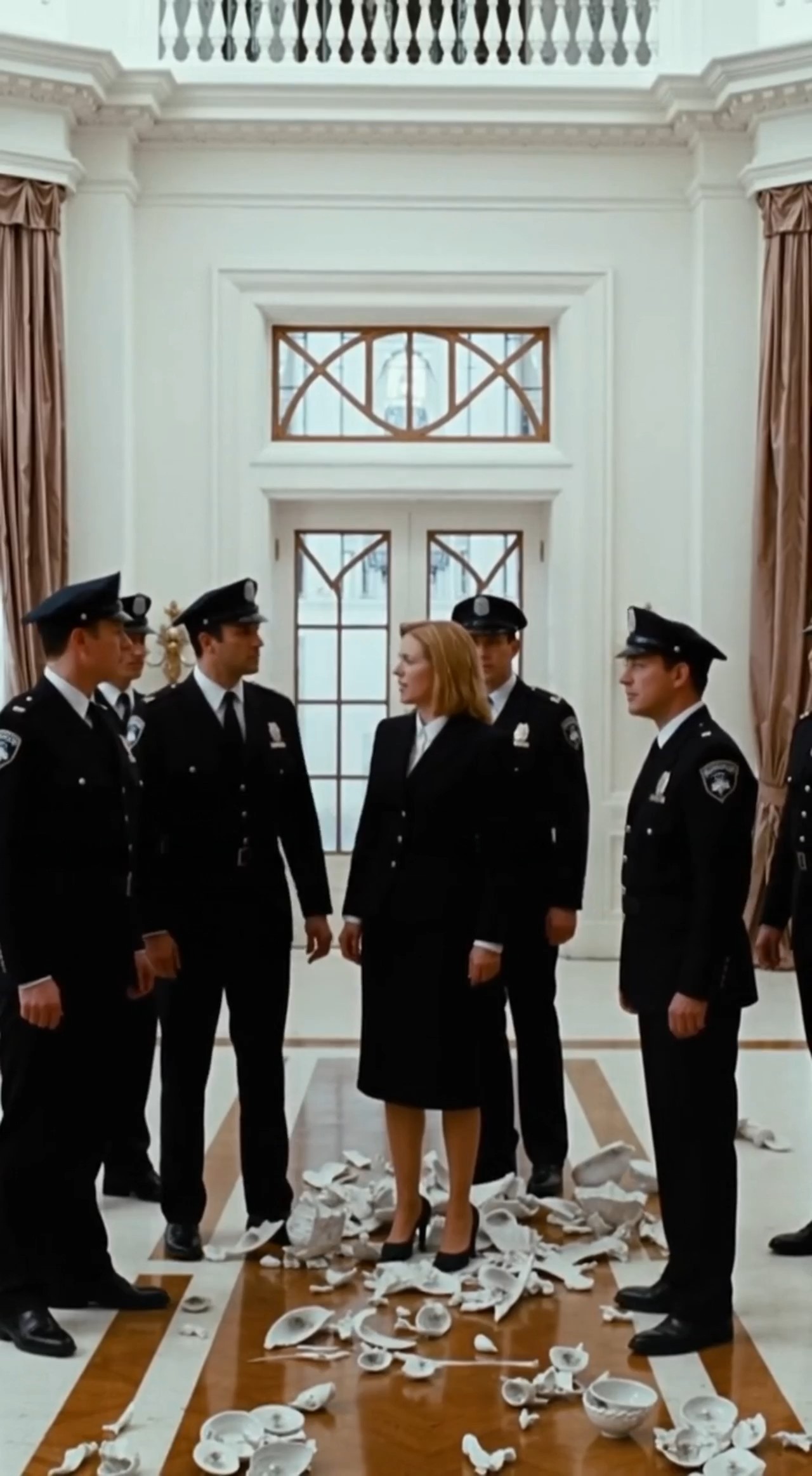
When a 66-Year-Old Estate Curator Is Framed by His Step-Mother Boss for Destroying $4 Million in Antiques, a Single Cashmere Fiber Exposes the Truth and Reshapes Their Family Legacy


The drive to Newport was a blur of early autumn foliage, the vibrant reds and golds a jarring contrast to the grim purpose of my visit. Beatrix’s estate, ‘The Anchorage,’ sat perched on a cliff overlooking the churning Atlantic, a grand old dame of shingle and stone, filled with the scent of sea salt and old money.
I found Great-Aunt Beatrix in her sunroom, a shawl draped over her thin shoulders, reading a first edition of Edith Wharton. At eighty-nine, her mind was still sharper than many half her age, and her eyes, though clouded by cataracts, missed nothing.
“Arthur, dear boy,” she greeted, her voice a reedy whisper that nonetheless carried authority. “To what do I owe this somber visit? You look as though you’ve seen a ghost. Or worse, Evelyn.”
I settled into a floral armchair opposite her, the leather briefcase containing the lab report heavy on my lap. The irony of seeking solace among such opulence, given the recent destruction of my own, was not lost on me.
“Aunt Beatrix, it’s about the collection,” I began, choosing my words carefully. “About the porcelain. I have proof.”
I opened the briefcase and slid the sealed envelope with the lab report across the polished mahogany table. She picked it up with surprisingly steady hands, her reading glasses perched on the end of her nose. The silence stretched as she read, her lips moving almost imperceptibly with each line.
Her expression remained impassive, a mask perfected over decades of high-society scrutiny. Only a slight clenching of her jaw, a faint tremor in her hand, betrayed any reaction. When she finished, she laid the report down, her gaze fixed on the turbulent grey sea outside.
“So,” she said, her voice softer than before, “Evelyn. My, my. A cashmere sweater worth more than my first automobile. How very… Evelyn.”
“But *why*, Aunt Beatrix?” I pressed, leaning forward. “Why would she do this? She accused me of trying to sabotage her plans, yet this act destroys the very assets she claims to want to sell. It doesn’t make any sense.”
Beatrix turned her gaze from the window to me, and for the first time, I saw a flicker of genuine sadness, and perhaps a touch of pity, in her ancient eyes.
“It makes perfect sense, Arthur, if you understand Evelyn’s deep well of resentment. A resentment that has been festering for decades.”
She reached for a small, ornate silver box on a nearby table, extracting a perfectly preserved, yellowed letter. “Your father was a kind man, but he was a Lansdale. And the Lansdales, for all their supposed ‘grace,’ could be extraordinarily cruel when it came to their pedigree.”
She handed me the letter. It was dated from just after my father, George Lansdale, married Evelyn, nearly thirty years ago. It was addressed to Evelyn, from my grandfather, the patriarch of the Lansdale Trust.
The words were cold, formal, and devastating. They informed Evelyn that while she was now part of the family by marriage, she would “never hold a material stake in the original Lansdale Trust, nor would her descendants, given her… humble origins.” My grandfather had deemed her “unsuitable” to manage the family’s core assets, fearing her “new money” influence would corrupt the old-money traditions.
“He cut her out, Arthur,” Beatrix explained, her voice low. “Completely. Discreetly. The trustees, bound by your grandfather’s will, could never allow her a say in the core estate management, only in the ancillary foundation he set up for her ‘charitable’ endeavors—the one she now runs. He humiliated her, publicly, in the subtle, brutal way only the Lansdales could manage.”
My mind reeled. Evelyn, always so poised, so aggressively modernizing. I had always assumed her ambition stemmed from a desire to make her own mark, not from such a deep, unhealed wound.
“She wanted control, Arthur,” Beatrix continued, “desperately. Not just for money, but for validation. To prove your grandfather, and by extension, the entire family, wrong. To show she was worthy. When your father died, and she became the Managing Executive Director, she saw her chance. But the core trust, the *real* money, the heart of the legacy, remained beyond her grasp as long as you, the true blood heir, stood in her way, devoted to preserving every last artifact.”
“So, she didn’t just smash the porcelain for the insurance or to block a sale,” I clarified, the pieces clicking into place. “She smashed it to frame me. To remove me. To destroy the *symbol* of the old-money legacy she was denied, and then blame the direct heir to that legacy.”
“Precisely,” Beatrix affirmed. “She wanted to erase the past that had rejected her, and she wanted to do it by making *you* the villain. The porcelain wasn’t just old art; it was a physical manifestation of everything she was denied. She shattered it as an act of decades-long, festering rage, aimed at your father’s memory and, by extension, you.”
The revelation was a chill down my spine. This wasn’t just a corporate squabble or a simple crime. It was a tragedy steeped in family history, ambition, and a festering humiliation.
“We cannot let this continue, Arthur,” Beatrix said, her gaze firm. “The trust, the name, it’s more than just money. It’s family. And sometimes, family needs a reckoning. But it also needs understanding.”
More Stories

















+ There are no comments
Add yours