
New Commander Humiliated and Arrested by Her Stepparent Sergeant on Arrival — Then Her Vengeance Began


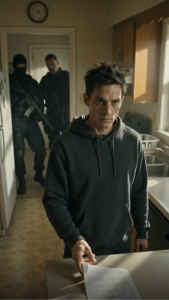
The sterile quiet of my temporary office was interrupted by the delivery of a thick, official envelope. The base seal was prominently embossed on its front, lending it an air of unquestionable authority. My name was typed precisely on the label.
My stomach churned with a familiar unease. I knew, instinctively, what it contained. Rourke’s next move.
I tore open the seal, the paper making a crisp, tearing sound. Inside, a formal notification letter informed me that Sergeant First Class Elias Rourke had filed a detailed complaint against me.
I scanned the charges: “unauthorized access,” “insubordination,” and “conduct unbecoming of an officer.” Each word felt like a deliberate slap.
He cited my incognito inspection as “reckless endangerment,” claiming my presence on the hangar floor had compromised base security protocols and created a dangerous distraction for the maintenance crew.
The accusation twisted the facts with infuriating expertise. I had been observing, not interfering.
The document listed several anonymous statements from junior officers and enlisted personnel. They echoed Rourke’s narrative, questioning my judgment and suitability for command.
One statement, attributed to “A. Smith,” detailed how I had “disrupted a critical maintenance operation” and “challenged established procedure without proper authorization.” The language was generic, yet pointed.
Another, from “J. Miller,” spoke of my “arrogance” and a “disregard for the established chain of command,” citing my refusal to immediately identify myself during the arrest.
The anonymity of the statements was a specific, petty cruelty. It prevented me from directly confronting my accusers, forcing me to contend with an invisible tide of manufactured resentment.
Rourke had clearly leveraged his network, twisting casual observations into formal accusations, making his social isolation campaign official.
The complaint was meticulously crafted, each charge designed to paint me as unfit for command, a rogue element.
It was designed to block my appointment, to create enough doubt within the command structure to delay, or even revoke, my assignment as the new Base Commander.
I read the final paragraph, my jaw clenching. An internal review board would convene in seventy-two hours.
The board would consider delaying my appointment, pending a full investigation into Rourke’s allegations. Seventy-two hours.
My command ceremony was only days away. This was a direct attempt to derail everything, to ensure I never took the podium.
The timing was impeccable, clearly calculated to cause maximum disruption and embarrassment. Rourke wasn’t just playing games; he was going for the kill.
I slammed the document down on the desk, the paper rattling. My hands trembled with a mix of fury and frustration.
This wasn’t just a procedural hurdle; it was a character assassination, weaponized to destroy my career before it even began.
I thought of Owen’s warnings about Rourke’s political savvy, his entrenched network. This document was the embodiment of that power.
He had used the system, the very procedures designed to ensure military order, to fight against it. He had twisted truth into a weapon.
I took a deep, shaky breath, forcing myself to regain composure. Panic would do no good.
I picked up the phone, my fingers dialing General Finch’s direct line. He needed to know this immediately.
The line rang once, twice, before a weary voice answered. “Finch.”
“General,” I said, my voice tight. “I just received Rourke’s formal complaint.”
There was a moment of silence on the other end, then a heavy sigh. “I was expecting it, Major.”
“Seventy-two hours, General,” I pressed. “The review board will convene in seventy-two hours.”
“Yes,” he confirmed, his voice sounding resigned. “I saw the notice. It’s a standard procedure for these kinds of allegations.”
“Standard procedure, General,” I stated, my voice sharper than I intended, “or a deliberate obstruction?”
Finch didn’t answer directly. “It puts us in a difficult position, Major. Especially with your ceremony so close.”
“He’s trying to stop me,” I said, stating the obvious truth. “He’s making sure I never get to that podium.”
“It would appear so,” Finch conceded. His voice held no comfort, only the stark reality of the challenge ahead.
The phone clicked as he hung up. I was left alone again, the thick complaint document lying open on my desk, a direct challenge to my authority.
Rourke had opened a new front in his war against me. And this time, he was using the military’s own rules as his weapon.
More Stories








+ There are no comments
Add yours