
Her Landlord Evicted My Sick Tenant, But He Didn't Know My Elderly Aunt Held the Keys to His Past


The office building where Bethany Quinn worked was a modern glass and steel structure, a stark contrast to my aging cafe. Her name, “Bethany Quinn, Certified Real Estate Appraiser,” was discreetly engraved on a polished brass plaque next to her office door on the tenth floor.
I pushed open the door, a small bell chiming softly. The waiting area was tastefully decorated, with abstract art on the walls and a faint scent of lemon polish. A young receptionist looked up from her computer, surprised.
“I’d like to speak with Ms. Quinn, please,” I said, trying to project a calm confidence I didn’t feel.
The receptionist looked hesitant. “Do you have an appointment?”
“No, but it’s important,” I insisted. “It’s about Marcus Kincaid.”
At the mention of Kincaid’s name, the receptionist’s eyes flickered to a closed door down the hall. After a moment, she picked up her phone, spoke in a low voice, then hung up.
“Ms. Quinn will see you,” she said, her voice oddly subdued. “Just a moment.”
Bethany Quinn emerged from the office, a forced smile on her face. She was impeccably dressed, her blonde hair pulled back in a severe ponytail. But her eyes, though quick to offer a professional greeting, were visibly jumpy, darting around the room. There was a faint tremor in her hands as she gestured for me to follow her.
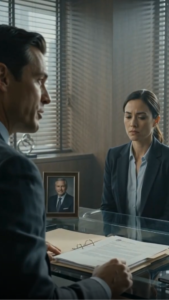
Her office was neat, almost sterile. A large window overlooked the city, but she kept the blinds drawn halfway. On her desk, amid stacks of organized papers, sat a framed photograph. It was partially obscured by a file, but I could make out two young children, a boy and a girl, smiling brightly.
“How can I help you, Mrs. Novak?” Bethany asked, her voice tight, formal. She sat down quickly, her hands clasped on the desk, betraying her nervousness.
“It’s about Marcus Kincaid,” I said, getting straight to the point. “And the appraisals you’ve done for him. Specifically, for properties where tenants were illegally evicted.”
Bethany’s forced smile vanished. Her face tightened, and a faint flush rose on her cheeks. “I’m a certified appraiser, Mrs. Novak. All my assessments are fair and in accordance with professional standards.” Her voice was defensive, a little too sharp.
“Are they?” I challenged, my gaze unwavering. “Because I’ve seen the online forum. Dozens of complaints. Your name appears repeatedly, linked to highly suspicious valuations that always seem to benefit Kincaid’s predatory schemes.”
She flinched, visibly. Her eyes darted to the door, then back to me. “I don’t know what you’re talking about. I appraise properties based on market value, not on tenant disputes.”
“What about Lily Maxwell’s property?” I pressed. “The valuation you signed off on was a fraction of its true worth. Just enough for Kincaid to claim squatters’ rights, but not enough to trigger proper legal protections for inherited land.”
Bethany’s jaw clenched. She remained silent, her gaze fixed on the corner of her desk. She wouldn’t meet my eyes. The silence stretched, heavy and uncomfortable. It was the silence of someone caught, someone terrified.
My eyes drifted back to the framed photo. The boy in the picture had a gap-toothed smile, his arm around a smaller girl with bright, curious eyes. They were young, perhaps seven and five. The image was jarring, a burst of innocence in this tense, sterile office.
“You have children, Ms. Quinn?” I asked, my voice softening slightly.
She stiffened, her gaze snapping up, a flicker of something raw and protective in her eyes. “My family is not relevant to this conversation.”
“Kincaid preys on the vulnerable,” I continued, ignoring her protest. “The sick, the elderly, families struggling to make ends meet. He uses their weaknesses against them. And you’ve been helping him.”
“I am a professional,” she repeated, her voice thin. “I simply provide valuations.” It was a weak defense, hollow and unconvincing. Her hands were now gripping each other so tightly her knuckles were white.
“Did you know about Lily’s severe bone infection?” I asked. “Did Kincaid tell you he was evicting her while she was hospitalized, unable to defend herself?”
Bethany swallowed hard. Her gaze dropped again, this time to the photograph. A faint sheen of sweat appeared on her forehead. She looked like she was teetering on the edge of a precipice, desperate to hold on but slowly losing her grip.
She said nothing, but her silence spoke volumes. It wasn’t defiance; it was fear. Deep, profound fear. The kind of fear that makes people do things they know are wrong. The petty cruelty of Kincaid’s actions extended to Bethany too, trapping her in a web of complicity. He wasn’t just a landlord; he was a silent oppressor, using fear to control those around him.
I stood up, pushing my chair back gently. “I think you know exactly what I’m talking about, Ms. Quinn. And I think you know Kincaid isn’t just a landlord. We both know what he’s capable of.”
I left her sitting there, surrounded by her meticulously organized papers, her professional facade crumbling, her gaze fixed on the smiling faces of her children. The encounter had not yielded a confession, but it had yielded a truth: Bethany Quinn was not a willing accomplice. She was a woman trapped, visibly terrified, her family a potential target. And Kincaid held the key to her fear.
More Stories







+ There are no comments
Add yours