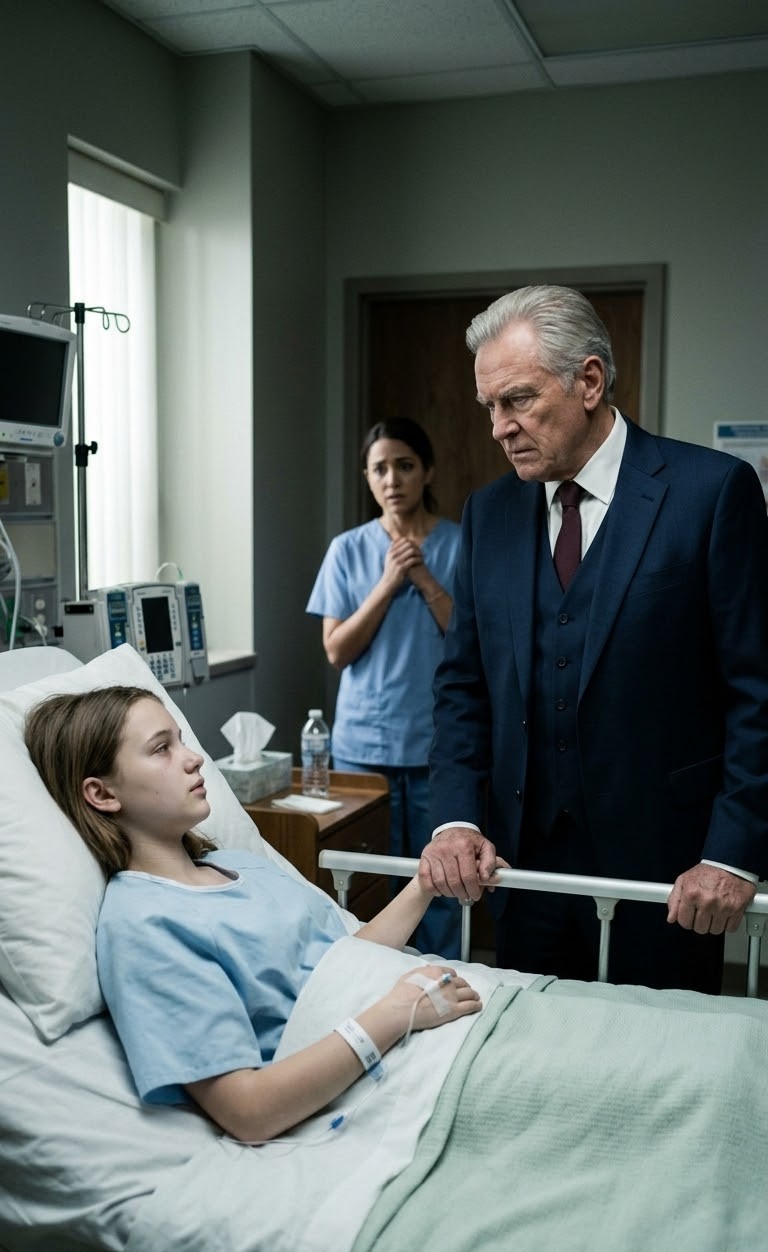
Abandoned at 14 after my stepmother's lie, I found my missing mother's letter, then a renowned judge appeared, claiming to be my dead grandfather.


The raw shock of Eleanor’s final entries left us all reeling. Elias, his grief now mingled with a cold, righteous fury, moved with a quiet intensity. He had loved his daughter deeply, and the revelation of Robert’s perfidy, and Cassandra’s chilling cruelty, cut him to the bone.
“We will not let this stand,” he declared, his voice low and firm, echoing with decades of judicial authority. He spoke with a resolve that brooked no argument.
His first action was to retreat to his study, pulling out every legal document he possessed concerning Eleanor’s estate. He spent days poring over them, often with Leo assisting, cross-referencing dates, signatures, and clauses. I watched him, a quiet gratitude swelling in my chest. He was broken, but he was fighting for us.
And then, he found it. Buried deep within Eleanor’s original, meticulously drafted will, dated years before her diagnosis, was a small, almost invisible codicil. It was handwritten, personally signed and witnessed by a trusted family lawyer and dated to the same period as her earlier cryptolinguistic work.
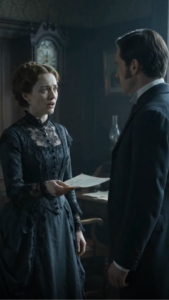
He called Leo and me into his study, his eyes tired but alight with a grim satisfaction. He held a faded, legal-sized paper.
“Eleanor,” he said, his voice thick with emotion, “she anticipated something like this. She knew the nature of her work, the risks. And she knew Robert.”
He pointed to a specific paragraph. “This codicil states that if she became incapacitated, or if her ‘disappearance’ was ever manipulated for personal gain by Robert Thorne, her entire substantial trust, designated for Elara’s education and future, would revert immediately.”
My breath hitched. “Revert to whom?”
“To an independent legal fund,” Elias stated, his finger tracing the words, “controlled by Bartholomew Finch, a trusted family lawyer. Bypassing Robert entirely. And Cassandra.”
A wave of relief, potent and disorienting, washed over me. It was a lifeline. It wouldn’t bring my mother back, but it would ensure her legacy, and my future, were protected from the very people who had tried to steal them.
The news was a quiet triumph. There was no dramatic confrontation with Robert and Cassandra. Judge Vance, true to his nature and the outline of Eleanor’s will, moved with silent precision. Bartholomew Finch, a man as honorable and discreet as Elias, was informed. The legal process was initiated swiftly, ensuring the fraudulent will was nullified and Elara’s true inheritance secured.
Robert and Cassandra, however, began to feel the subtle, yet undeniable, shift in their social standing. Elias, a figure of immense respect in their circles, didn’t issue public accusations. Instead, his quiet withdrawal from their company, his deliberate coolness, spoke volumes.
Aunt Carol, once easily swayed by Cassandra’s gossip, suddenly stopped calling. I heard through hushed whispers that Robert and Cassandra’s once-vibrant social calendar had noticeably thinned. Invitations were no longer extended. Their once-impressive philanthropic endeavors quietly ceased, the financial flow from Eleanor’s stolen trust now redirected.
One afternoon, I answered the phone to a surprisingly contrite Aunt Carol.
“Elara, dear,” she began, her voice tentative. “I… I’ve been doing some thinking. And Elias… well, he’s a very discerning man.”
She paused, as if gathering courage. “I just wanted to say… I’m sorry if I ever said anything that caused you pain. Robert and Cassandra… they can be very persuasive. But sometimes, when things go too quiet, you start to hear other stories.”
It wasn’t an apology for believing their lies, but it was an acknowledgement. It was enough. It signaled the erosion of their carefully constructed narrative, not through a public scandal, but through the quiet weight of truth in private circles. Their influence, built on a foundation of deceit, was crumbling.
Robert and Cassandra became increasingly isolated, their power diminished, their lies exposed not by shouts, but by the quiet absence of those who once sought their company. They didn’t face legal prosecution for their moral crimes, but their social landscape became a barren wasteland of their own making. Their once-grand home, a symbol of their ill-gotten gains, began to feel hollow, its walls echoing with the silence of their diminishing circle.
Through it all, Leo remained my constant. We shared the burden of Eleanor’s tragic truth, the anger, the grief, and the quiet satisfaction of the justice Elias had secured. Our relationship, forged in the crucible of shared pain and unwavering support, deepened into something unbreakable.
One evening, as the sun dipped below the horizon, painting Elias’s study in hues of orange and purple, Leo sat beside me, his hand resting on mine.
“It’s not the ending we hoped for,” he said softly, “for Eleanor. But it’s an ending where you are safe, and her wishes, her legacy, are finally honored.”
I leaned my head against his shoulder. “She didn’t get to live, not truly. But her words, her strength… they guided us. And you, Leo. You found me in the middle of it all.”
He squeezed my hand. “We found each other. And we built something real, Elara. Out of the wreckage.”
The grief for my mother, and the profound, unredeemable loss of my father, would always be a part of me. But with Elias’s quiet strength, Leo’s unwavering love, and the knowledge that my mother’s spirit had prevailed against their darkness, I was no longer alone. We had built a new, honest family, bound by truth, not by blood or legal ties, but by genuine affection and a shared commitment to each other. The quiet reckoning had come, not with a bang, but with the subtle shifting of loyalties and the silent collapse of a house of cards.
More Stories






+ There are no comments
Add yours