
Abandoned at 14 after my stepmother's lie, I found my missing mother's letter, then a renowned judge appeared, claiming to be my dead grandfather.


Our collaboration intensified, fueled by the electrifying discovery of the “lost family cipher.” The university library became our second home, its quiet hum a constant backdrop to our whispered discussions and late-night breakthroughs. Leo’s unwavering enthusiasm was a stark contrast to my own cautious nature, but it was precisely what I needed.
He had a way of cutting through my ingrained distrust, a gentle patience that slowly chipped away at the walls I’d built after my father’s betrayal. Our shared passion for obscure languages and forgotten histories was a bridge, and soon, our intellectual partnership began to deepen into something more.
We’d spend hours bent over old texts, fingers brushing as we pointed out a subtle variation in a script, or shared a moment of triumph over a particularly stubborn inscription. Late nights turned into shared takeout meals, then into longer conversations about our lives, our hopes, our pasts.
One rainy evening, as we packed up our research materials, he reached across the table and gently took my hand. His touch was warm, steady.
“Elara,” he began, his voice soft, “I know you’ve been through a lot. I see it, in the way you guard yourself. But I also see your incredible strength, your brilliance.”
My breath caught. I pulled my hand away slightly, my old fears resurfacing. Could I trust this? Was this another trap, another fleeting connection that would end in abandonment?
He didn’t push. He simply watched me, his expression open and honest. “I’m not going anywhere,” he said, as if he could read my thoughts. “I want to be here, for all of it. The research, the discoveries, whatever comes next.”
His sincerity chipped away at my defenses. I found myself leaning in, allowing myself to feel the warmth of his presence. That night, a new chapter began, one not just of shared intellectual pursuit, but of genuine, tentative affection.
As our bond deepened, so did the opposition from my past. The “lost family cipher” became our obsession. We meticulously combed through Eleanor’s academic notes, her personal letters to Elias from before her disappearance, and even her early artistic sketches. We were searching for any hint of its structure, its key, its intended recipient.
But as our progress gained momentum, so did the whispers. Cassandra and Robert, once distant shadows, began to cast long, unpleasant ones across my burgeoning life.
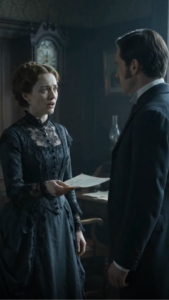
One afternoon, a letter arrived from the university, emblazoned with the departmental seal. My heart sank as I read it. My application for a prestigious research grant, crucial for my work on ancient Mediterranean languages, had been denied. The rejection letter was vague, citing “concerns regarding the proposed methodology and the applicant’s research stability.”
I crumpled the letter in my hand. “Research stability?” I muttered, a cold dread creeping in.
Elias, who had been observing my reaction, took the letter from me. His eyes scanned the formal language, then hardened.
“This isn’t about your methodology, Elara,” he said, his voice clipped. “This is Cassandra. Or Robert. Or both.”
He was right. The following week, during a casual visit, Aunt Carol Simmons, a distant relative of Robert’s who had always been prone to gossip, arrived with a thinly veiled air of concern. She sat in Elias’s living room, sipping tea, her gaze darting uncomfortably in my direction.
“Elara, dear,” she began, her voice sickly sweet. “I heard about that grant. Such a shame. You really are so bright, just like your mother.”
A chill went down my spine. The comparison felt like a poison.
“But you know,” she continued, lowering her voice conspiratorially, “your mother, Eleanor, she had such a… vivid imagination. And sometimes, her intellectual pursuits could become quite… intense. Robert always worried about her. About her grasp on reality, bless her heart.”
My hands clenched under the table. She was repeating Cassandra’s insidious narrative, word for word.
“And you, Elara,” Aunt Carol said, her eyes fixed on me with a pitying expression, “you seem to have inherited some of that brilliance. And perhaps some of that… intensity. Robert and Cassandra are quite concerned, you know. About you ‘fabricating’ some of these historical connections. They say it’s a ‘delusional imagination,’ like Eleanor’s.”
My face burned. I wanted to scream, to lash out at her for echoing such vile lies. But I remembered Elias’s earlier advice: “Silence can be more potent than anger against such small-mindedness.”
“Aunt Carol,” Elias interjected, his voice calm but with an edge of steel. “Elara’s academic achievements are well-documented and highly respected by her professors. Unlike certain individuals, her work is grounded in verifiable scholarship, not fabricated narratives.”
Aunt Carol visibly flinched, her teacup rattling slightly. She quickly changed the subject, but the damage was done. The seed of doubt, planted by Cassandra, was now taking root in the family circle.
Later that week, another blow. A professor I deeply respected, someone I had hoped would supervise my doctoral research, suddenly became distant. When I pressed him for feedback on a research proposal, he offered vague platitudes and then, almost reluctantly, admitted to “hearing some concerns.”
“About your… focus, Elara,” he mumbled, avoiding my eyes. “And the unconventional nature of your previous research. It’s just not quite aligning with the department’s core objectives at the moment.”
I knew exactly what that meant. Cassandra and Robert’s smear campaign was working. They were not just whispering in the family; they were actively trying to sabotage my academic future, painting me as mentally unstable, delusional, just like they had painted my mother. They wanted to isolate me, to cut off my access to the very tools I needed to uncover their truth.
The attacks, however, only solidified my resolve, and Leo’s commitment. He saw the injustice, the deliberate cruelty.
“This is precisely why we need to find the truth, Elara,” he said, holding me close one night as I wept with frustration. “They’re terrified of what you might uncover. And that tells us we’re on the right track.”
His unwavering support was a balm to my wounded spirit. He didn’t question my sanity; he validated my quest. He helped me reframe the grant rejection, to see it not as a failure, but as proof of their fear.
We doubled down on the “lost family cipher,” convinced that its secrets held the key to both Eleanor’s fate and our vindication. We traced every obscure symbol, every linguistic anomaly, every personal reference in Eleanor’s papers. The cipher, we realized, was not just a language; it was a map, etched into the very fabric of her memory, waiting for me, her true descendant, to read its hidden coordinates. The pressure mounted, both from the outside and within, but with Leo by my side, I felt a strength I hadn’t known I possessed.
More Stories











+ There are no comments
Add yours