
Four-year-old in cult exposes greedy leader's lies after he starves her and mom, sparking subtle shift that costs everything.


In the immediate aftermath of Elder Croft’s “Restructuring of Abundance,” Sarah and Elara found their physical needs consistently met. The portions were ample, the pantry well-stocked, and the children’s quarters genuinely received nourishing meals. No longer did Elara go to bed with a rumbling stomach, or Sarah lie awake, consumed by the gnawing worry of impending hunger.
Yet, their position within “The Way” was irrevocably altered. Croft, though publicly making concessions and maintaining an air of benevolent reform, privately ensured their lives were subtly difficult. The federal investigation into his finances had stalled, bogged down in legal complexities, and while his external reputation was damaged, his power within the community remained largely intact.
The loyalty of his remaining followers, though fractured, was still potent. They saw Sarah as the instrument of the external “persecution,” the reason for their community’s scrutiny. Whispers followed her wherever she went. Looks of suspicion, thinly veiled resentment, and outright hostility met her in the communal kitchens and fields.
“Sister Sarah always gets the best cuts of meat now, doesn’t she?” one woman would murmur loud enough for Sarah to hear, glancing pointedly at her plate.
“A sudden promotion for someone who brought us such trouble,” another would comment, eyes narrowed, as Sarah efficiently managed the new provisions.
Sarah felt it acutely. The genuine fellowship, the spiritual peace she had once sought within “The Way,” was gone. Replaced by a pervasive sense of being watched, judged, and fundamentally alienated. She was still physically present, still performing her duties, but she was an outsider looking in, an appointed leader without true belonging. The silence of her neighbors was louder than any accusation.
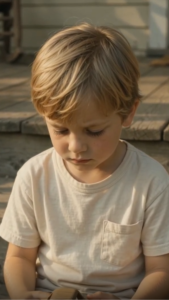
Elara, too, felt the shift. Though she ate well and her energy returned, she often found herself playing alone in the communal yard. The other children, once her companions, now kept a wary distance. Their parents, loyal to Croft, subtly instructed them to avoid “trouble.”
One afternoon, Elara sat under the shade of a wilting tree, tracing patterns in the dust with a stick. A group of children played a spirited game of chase nearby. Elara watched them, a faint sadness in her eyes, but she didn’t try to join. She knew the invisible barrier that now separated her.
Sarah, observing from a distance as she sorted freshly harvested beans, felt a pang of profound sorrow. She had sacrificed her sense of community, her spiritual home, for Elara’s material security. And Elara, in turn, had sacrificed her innocent friendships. It was a heavy price.
That evening, as Sarah tucked Elara into their now slightly more comfortable bed, Elara spoke in a small voice.
“Mama,” she began, “the other children don’t play with me anymore.”
Sarah smoothed Elara’s hair, her throat tight. “They will, my love. Perhaps not now, but one day.”
“Why?” Elara pressed, her brow furrowed. “Is it because of the stars?”
Sarah hesitated, weighing her words carefully. “No, my star. It’s because some people don’t understand that telling the truth, even when it’s hard, is important.”
She knew the answer was incomplete, simplified for a child, but it was the best she could offer. Elara might not fully grasp the intricate web of resentment and political maneuvering, but she understood the sting of isolation.
The nights were quieter now, free from the gnawing hunger. But they were filled with a different kind of ache. Sarah often found herself sitting by the window, long after Elara had fallen asleep, gazing out at the compound. The same buildings, the same fields, but they no longer felt like home. They felt like a cage, albeit a gilded one.
She had fought for justice, and in a way, she had won. Elara was safe, fed, protected. But the victory felt hollow, tinged with a deep, pervasive loneliness. The truth had set them free from hunger, but it had also exiled them from the only world they had ever known. The silence of the other members, the wary distance in their eyes, was a constant, unspoken reminder of the cost of their freedom. Sarah knew that this new normal, this state of material security coupled with social ostracism, would be their enduring reality within “The Way.”
More Stories







+ There are no comments
Add yours