
A Post-War Mother’s Desperate Act Reveals Her Eldest Son’s True Identity, Forcing Her to Confront Decades of Lies


The atmosphere in our home shifted, growing colder, more oppressive, with Abigail Caldwell’s continued presence in town. Silas, usually so adept at projecting an air of casual indifference, was becoming increasingly agitated. He sensed the unspoken questions, the lingering gazes from villagers, and the subtle change in my demeanor.
He began to shadow me, his presence a constant, unsettling pressure. Every time I tried to speak to Thomas, even just to offer a glass of water, Silas would appear. He would stand just within earshot, his eyes on me, then on Thomas, a silent, menacing presence.
One afternoon, I found Thomas sketching in his small, worn notebook, a rare moment of peace for him. He was drawing a field of wildflowers, his young face intent on the paper. Silas walked into the room, his eyes immediately falling on Thomas.
“Still drawing those foolish flowers?” Silas scoffed, his voice dripping with disdain.
“You should be helping Mama, not wasting time with childish things.”
Thomas flinched, his hand freezing on the page. He immediately tried to hide the notebook, his face paling. It was another small, specific wound, a casual dismissal of Thomas’s only solace.
“He’s not bothering anyone, Silas,” I interjected, my voice sharper than I intended.
Silas turned his dark gaze on me, his smile fading into a thin, tight line.
“Oh, but Mama, he is. He wastes your precious paper. Paper we barely have. While you entertain grand ladies in our parlor, he fiddles.”
He played on my guilt, on the scarcity that defined our lives. It was a familiar manipulation, a way to reassert his control. He always knew how to make me feel inadequate, how to remind me of the burdens I carried.
“It’s not your concern,” I said, trying to hold my ground.
Silas took a step closer, his eyes hard.
“Everything here is my concern, Mama. Who do you think keeps this place running? Who works the fields while you fret over a bruised boy and a woman who brings nothing but trouble?”
He knew about Abigail. He hadn’t seen her, but the whispers had reached him. His words were laced with a resentment that felt cold and deep, a resentment that now had a clear target: Abigail, and by extension, me.
I remembered a day, years ago, when Thomas had brought me a small, shiny pebble he’d found by the creek, convinced it was a precious gem. Silas, then ten, had taken it, declared it “just a rock,” and then thrown it as hard as he could into the deepest part of the creek, watching Thomas’s face crumple. It was a deliberate act to crush joy, to diminish the small, precious finds of another.
“I do what I must for this family,” I retorted, my voice trembling with suppressed anger.
Silas chuckled, a low, humorless sound.
“Of course, you do. You always have. Just as you took me in, a poor, lost orphan. You sacrificed for me, Mama. Don’t forget that.”
His words were a poisoned arrow, designed to strike at my deepest sense of duty and guilt. He used my past compassion against me, twisting it into a weapon. He knew the burden I felt, the decades I had spent trying to make him feel loved, part of our family.
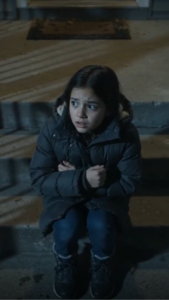
Thomas, witnessing this exchange, had shrunk back into his chair, his small body almost disappearing behind the table. His fear was a palpable thing in the room.
Silas glanced at Thomas, a fleeting, cruel smirk on his face. He knew his power over the younger boy. He enjoyed it. It was another small wound, another chipping away at Thomas’s fragile spirit.
“Perhaps,” Silas continued, turning his full attention back to me, “you should be more careful about who you invite into our home. These fine ladies… they bring disruption. And disruption is dangerous, Mama. For all of us.”
His threat was clear, unspoken yet understood. Abigail’s inquiries, my own growing openness, were jeopardizing his comfortable position, his fabricated identity. And he would not tolerate it.
I felt a profound sense of helplessness. Silas had a tightening grip on me, on our household. He had woven a web of manipulation and guilt so intricate that I felt suffocated by it. My duty to him, rooted in that initial act of compassion, was now an unbearable chain.
But the sight of Thomas, small and terrified, pushed a fierce resolve through me. I could not let Silas destroy him. I could not let this manipulation continue. I had to find a way to break free, even if it shattered everything I thought I knew.
More Stories









+ There are no comments
Add yours