
If you marry a woman old enough to be your mother, don't expect a dime when she drops dead, my younger sister Clara spat across the kitchen table, tossing down the wedding invitation.


Part 1
Three weeks after I married 68-year-old Evelyn Gardner, she died suddenly in her sleep from an undiagnosed brain aneurysm.
Before her funeral flowers even wilted, her late ex-husband’s estate attorney called me into his office with a shocking disclosure.
Evelyn had never suffered from heart disease, and our sudden marriage was the mandatory execution clause of a bizarre 20-year-old financial trust that completely altered who owned my business.
The scent of damp autumn leaves and burnt coffee still clung to the air from that morning, a sharp, bitter tang that mirrored the atmosphere inside my small kitchen. My sister Clara’s words had landed like ice shards.
She watched me with narrowed eyes, her arms crossed tight over her chest. She had flown all the way from Boston just to tell me what a fool I was.
“Are you even listening, Julian?” she asked, her voice tight with exasperation.
“Of course, I am, Clara,” I replied, pushing my untouched mug of coffee away. “And for the fifth time, it’s not like that.”
I glanced across the table at the discarded invitation, its elegant cream paper and gold lettering now crumpled where she’d thrown it. Evelyn had picked it out herself, a small, hopeful gesture.
“Not like what?” Clara scoffed. “Not like you, fresh out of bankruptcy, finding a sweet old lady with a historic house and marrying her in six months flat?”
My daughter, Maya, sat silently at the end of the table, her gaze fixed on the steam rising from her tea. She was twenty years old, and the echoes of my past financial failures still shadowed her eyes.
She hadn’t said much since arriving, but the way she held herself, rigid and distant, spoke volumes. She still blamed me for losing her college tuition fund in the collapse of my first business.
“Evelyn and I… we connected,” I tried to explain, my voice softer than I intended. “She’s kind, thoughtful. We share a love for restoration work, for history.”
Clara laughed, a short, humorless sound.
“Connected,” she repeated, shaking her head. “Right. And her family’s $850,000 Victorian home has nothing to do with it, I’m sure.”
Maya finally spoke, her voice barely above a whisper.
“Dad, I just… I hoped you’d learned your lesson.”
Her words were a fresh wound, but I couldn’t blame her. I had failed them both before. This time, I truly believed it was different. Evelyn was a gentle soul, and our quiet companionship had become a refuge after years of struggling to rebuild my life.
We had a modest ceremony in Evelyn’s backyard, under the shade of an old oak tree. It was just a few close friends and Evelyn’s distant cousin. Clara and Maya came, but their presence felt more like an obligation than a celebration.
The three weeks that followed were unexpectedly peaceful. Evelyn had a quiet charm, and her house, filled with antiques and stories, felt more like a home than any place I’d lived since my divorce. We spent evenings discussing old architecture, her knitting needles clicking softly while I sketched new designs for Barrett & Drake Architectural Restoration. She often spoke of a minor heart condition, which she casually dismissed as “just an old woman’s complaint,” but it made me protective.
Then, one morning, I woke to the silence.
The curtains were still drawn, casting the room in a soft, grey light. Evelyn was lying beside me, her face serene, but her breathing had stopped. There was no struggle, no sound, just a profound stillness.
The coroner’s report confirmed an undiagnosed brain aneurysm. A natural death. Unexpected, tragic, but unequivocally natural. No foul play.
The funeral was small, a handful of Evelyn’s friends, her cousin, and my estranged family. Clara and Maya stood stiffly at the edge of the grave, offering polite, distant condolences. The scent of lilies and damp earth filled the air, a heavy, cloying perfume I would forever associate with grief and unspoken judgment.
Three days after the funeral, with the last of the wilting flower arrangements still sitting on Evelyn’s mantelpiece, the phone rang.
“Mr. Julian Barrett?” a formal voice inquired. “This is Arthur Pendelton, estate attorney for the late Evelyn Gardner. I’d like to schedule a meeting to discuss the terms of her late ex-husband’s trust.”
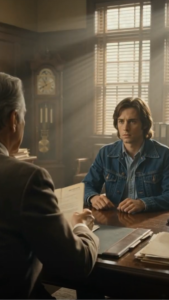
The office of Arthur Pendelton was exactly what one would expect: hushed, paneled in dark wood, and smelling faintly of old paper and leather. Sunlight struggled to penetrate the heavy velvet curtains, casting long shadows across the polished mahogany desk.
Arthur Pendelton was a man sculpted from formality. His suit was impeccably tailored, his silver hair neatly combed, and his gaze was sharp, unblinking. He didn’t offer a handshake, merely gestured to the leather chair opposite him.
“Thank you for coming in, Mr. Barrett,” he began, his voice devoid of warmth. He consulted a thick file on his desk, its pages yellowed with age. “A tragic loss, Mrs. Gardner.”
“It was very sudden,” I managed, my throat dry. “She’d mentioned a heart condition, but we never thought…”
Pendelton raised a hand, cutting me off with a polite but firm gesture.
“Mr. Barrett, according to the official records, Mrs. Gardner was never treated for heart disease. Her passing, while tragic, was due to a cerebral aneurysm, as confirmed by the county coroner.”
I felt a jolt of confusion. Why had Evelyn told me that? It was a minor detail, but it suddenly felt significant, out of place.
Pendelton cleared his throat.
“I understand this may come as a surprise, but your recent marriage to Mrs. Gardner was, in fact, an explicit and mandatory clause within the 1998 Arthur Gardner Family Trust.”
The words hung in the air, heavy and bewildering. My marriage? A clause?
“I don’t understand,” I stammered. “Evelyn and I… we genuinely cared for each other.”
Pendelton’s expression remained unreadable. He tapped a finger on the aged document.
“The late Arthur Gardner, Mrs. Gardner’s ex-husband, established this trust in 1998 with very specific conditions regarding his estate. One such condition mandated that Evelyn—to release certain family assets, particularly her $850,000 historic home, from corporate liens and a substantial tax liability—must marry a legally insolvent individual before her sixty-ninth birthday.”
My mind reeled. Insolvent. Bankruptcy. The accusations from Clara and Maya echoed in my ears. This wasn’t about love; it was about a contract.
“But… how did Evelyn even know I was insolvent?” I asked, a knot forming in my stomach. “My bankruptcy records are sealed, private.”
Pendelton’s gaze sharpened, a faint flicker of something unreadable in his eyes. He leaned forward slightly, his voice dropping to a low, deliberate tone.
“That, Mr. Barrett, is where things become rather… intricate. Our office received an anonymous submission of your personal and corporate bankruptcy records approximately six months ago. The submission included your current financial status, your business history with Barrett & Drake, and even details of your divorce settlement.”
He paused, letting the implication sink in. I swallowed hard, a cold dread spreading through me. Six months ago. Just before I met Evelyn at that historic preservation fundraiser.
“And who,” I asked, my voice barely a whisper, “would have access to all that, and a reason to send it?”
Pendelton picked up a thin, blue folder from the corner of his desk. He opened it, revealing a single sheet of paper, photocopied and stamped.
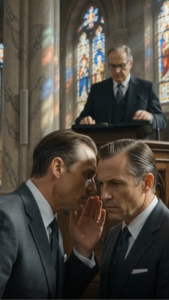
“The sender was identified only by an initials ‘M.D.’ But a cursory check of the digital metadata revealed the email originated from the IP address registered to Barrett & Drake Architectural Restoration. And the specific details provided, Mr. Barrett, could only have come from someone intimately familiar with your personal finances and your business operations.”
My blood ran cold. The image of Marcus Drake, my senior business partner, standing next to me at that very fundraiser, chatting amiably with Evelyn, flashed through my mind. His easy smile, his hand on my shoulder, his insistent nudge to go talk to her.
“The informant,” Pendelton stated, his voice flat, “was your partner, Marcus Drake.”
Part 2
My blood ran cold. The man who had been my partner, the one I trusted to help me rebuild, had orchestrated my entire relationship with Evelyn.
“Marcus?” I managed to choke out. “My partner?”
Arthur Pendelton’s face remained impassive. He merely nodded.
“Indeed, Mr. Barrett. His submission provided our office with the necessary financial profile. As I was explaining, the late Arthur Gardner’s 1998 trust was explicitly designed to release the deed to Mrs. Gardner’s $850,000 historic home.”
He paused, adjusting his spectacles.
“And to discharge significant old corporate tax liabilities. Your marriage to an individual matching your specific financial circumstances, namely a legally insolvent individual, was the precise mechanism for fulfilling those conditions.”
I felt like a puppet whose strings had just been revealed, every move I thought was my own, manipulated from the shadows. My stomach churned. Evelyn wasn’t just kind; she was desperate, pressured. And Marcus, always so helpful, so supportive.
Just then, the heavy oak door of Pendelton’s office swung open. Without a knock.
Marcus Drake stood in the doorway, not alone. Two men in dark suits, holding clipboards, stood behind him. Process servers.
His eyes, usually warm and reassuring, were cold, almost triumphant.
“Julian,” Marcus said, his voice flat, devoid of any past camaraderie. “A moment of your time. This won’t take long.”
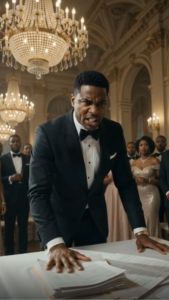
He walked directly to the desk, ignoring Pendelton and me entirely. He set down a thick stack of documents, each page dense with legalese, bound by a red legal ribbon.
One of the men with the clipboards stepped forward, extending a document toward me.
“Mr. Julian Barrett?” he asked, his voice monotone. “You’ve been served.”
I didn’t take the papers. My gaze was fixed on Marcus, the man who had shaken my hand, shared my dreams for Barrett & Drake.
“What is this, Marcus?” I asked, my voice barely a whisper.
Marcus finally looked at me, a chilling smile playing on his lips.
“It’s simple, Julian. By marrying Evelyn, you legally assumed $620,000 of her ex-husband’s legacy corporate debt.”
He tapped the stack of papers with a manicured finger.
“Debt that, as a primary beneficiary and with the full authority of the Gardner Trust’s revised terms, I am now legally entitled to collect against your half of our restoration firm.”
More Stories


+ There are no comments
Add yours