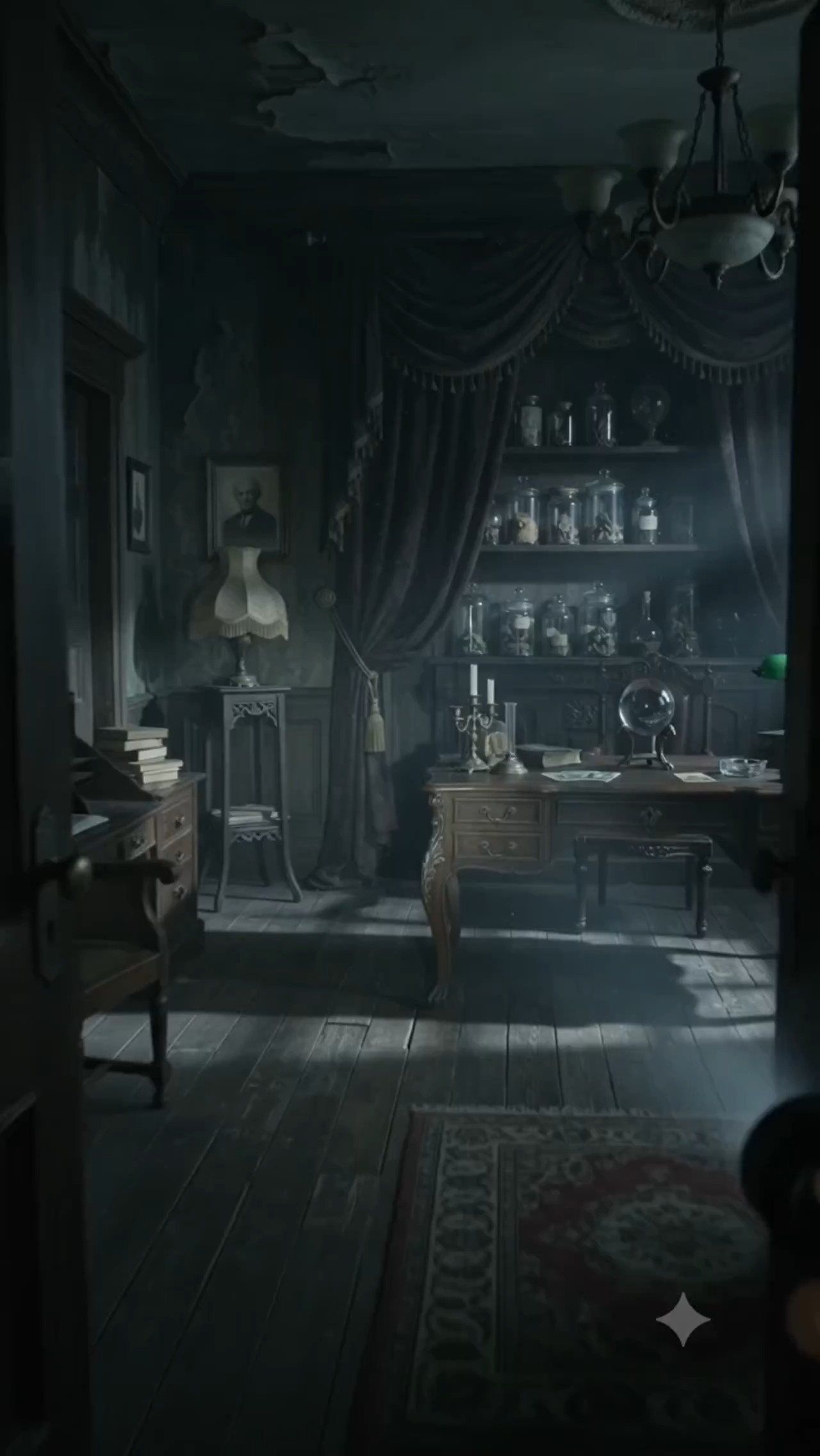
Framed by a mysterious glass sphere in a locked study, a disgraced WWII investigator must outsmart his military mentor.


Part 1
He found her dead inside a study locked from the inside with three knife wounds to her chest.
On her desk sat a custom glass optical sphere projecting a moving film strip that clearly showed Arthur holding the bloodied blade over her body at 10:07 PM.
Arthur had been sober for exactly fourteen months, but he knew nobody in the military department would believe his memory over physical optics.
Now he had to decide whether to shatter the glass device before the local police breached the door or preserve the physical evidence to trap the real killer.
Arthur pushed open the heavy oak front door of Helena Krol’s Alexandria estate. He hadn’t expected it to be unlocked.
The air inside was cold, carrying the faint, cloying scent of stale incense and something else, metallic and sharp.
He stepped onto plush, dark carpet, the sound of his shoes swallowed instantly. The house was silent, too silent.
He had received the urgent telegram from Madame Krol only an hour ago. She had sounded distressed, demanding his immediate presence.
His initial thought was a desperate plea for protection, perhaps from a client or a rival “medium.”
Arthur moved through the foyer, his hand instinctively going to the small service revolver he still carried, a habit from his CID days.
The grand hallway stretched before him, dimly lit by ornate wall sconces that cast long, dancing shadows. Velvet drapes covered every window, sealing the house in an oppressive gloom.
A low, persistent hum vibrated faintly through the floorboards. It pulled him towards a closed door at the far end of the hall.
This door, unlike the front entrance, was a heavy slab of polished mahogany, richly paneled. He tested the handle.
Locked.
He tried again, twisting the brass knob firmly. It wouldn’t budge. He leaned closer, listening. The hum was distinctly louder here, emanating from behind the wood.
A faint, sickly sweet smell, like old perfume mixed with something acrid, also seeped from beneath the door.
He felt a prickle of unease. This wasn’t a standard locked door. It felt sealed.
Arthur, drawing on years of military training, quickly scanned the frame. No obvious jimmy marks. No forced entry. He pressed his ear to the wood, discerning the rhythmic click of a clock and that unsettling, continuous hum.
“Madame Krol?” he called out, his voice a low, steady rumble. No answer.
He took a step back, surveying the heavy door. Locked from the inside, or designed to look that way.
He quickly checked the windows along the corridor, but they were all similarly draped and secured.
His gaze fell upon a small, dusty service bell mounted next to the door. He pressed it. A distant, tinny chime echoed through the silent house, but no footfalls followed.
The air grew heavier, thick with anticipation. He drew his hand away from the bell, a knot forming in his stomach.
Then, a new sound began to filter through the night. Faint at first, but growing louder.
Siren wails. Distant, then closer.
And the distinct crunch of gravel under heavy tires, turning into the long driveway outside the estate. The police.
Panic, cold and sharp, threatened to grip him. He fought it down, his training kicking in.
Someone had called the authorities. Someone knew he was coming here.
His eyes darted around, searching for an alternative. There was no time to force the heavy mahogany door without attracting the arriving officers.
He looked for a window at the front of the house, but the sirens were already too close.
He had to get into that study, now.
He moved quickly, finding a small, ornate axe hanging near a disused fireplace in the foyer, meant for splitting kindling. It was heavier than he expected.
He brought it back to the study door, raising it. With three sharp, controlled blows, he shattered the lock mechanism, splintering the aged wood around the brass plate.
The door swung inward with a groan, revealing a dimly lit room choked with the same heavy, perfumed air.
And the metallic tang was much stronger now, undeniable.
His eyes immediately fell upon the figure slumped over a massive mahogany desk in the center of the room.
Helena Krol.
Her dark hair was fanned out over a ledger, one hand hanging limp. Her silk dressing gown was dark with blood, blooming crimson around her chest.
He took a step, then another. The sight hit him with a sickening familiarity, a flashback to the field hospitals of Europe.
Three distinct knife wounds marred the silk, precisely clustered over her heart. The skin around them was already tinged with an unnatural pallor.
He saw the glint of steel. A knife, a small, elegant stiletto with an ivory handle, protruded from the third wound.
He stopped breathing, forcing himself to observe, not react. This was a crime scene. A murder.
The hum was louder now, a low, resonant thrum coming from the desk itself.
Then he saw it.
Resting prominently on the corner of Helena Krol’s desk, directly facing the far wall, was a curious object.
A large glass sphere, perhaps eight inches in diameter, mounted on a base of polished brass. It glowed with a soft, internal light.
From its center, a focused beam of light shot out across the darkened room, piercing the gloom.
It landed squarely on the velvet wallpaper of the opposite wall, resolving into a vibrant, moving image.
A film.
His breath hitched in his throat. The image was of a man, his back to the viewer, holding a blade.
The man was wearing a familiar woolen overcoat. His posture, the set of his shoulders—it was too familiar.
He took another step closer, his eyes fixed on the projection. The man raised the blade, then plunged it downward.
Into a figure slumped over a desk.
He recognized the dressing gown, the dark hair. It was Helena Krol.
The man on the screen turned slightly, and Arthur saw a glimpse of his own profile, unmistakable. The exact angle of his jaw, the slight scar above his left eye from a training accident.
The projected image was clear, stark, damning. Himself, holding the bloodied knife.
A timestamp appeared in the bottom corner of the image, glowing green: 10:07 PM.
Seven minutes ago.
Just seven minutes before he had forced his way into this locked room.
A wave of nausea washed over him, threatening to break his fourteen months of hard-won sobriety. He tasted bile.
This wasn’t possible. He hadn’t been here at 10:07 PM. He had been driving, still miles away.
He hadn’t touched a drop of alcohol in over a year, his mind sharper than it had been since the war. He remembered every second of his drive, every turn, every thought.
But the image on the wall, so real, so vivid, seemed to mock his memory.
Outside, the sirens were no longer distant. They were right here, wailing to a stop in the gravel driveway.
Car doors slammed. Heavy boots crunched on the stones, approaching the house, nearing the broken front door.
Voices, authoritative and urgent, barked orders.
He was trapped. Framed.
His mind screamed at him: smash the sphere. Destroy the evidence. Erase the lie.
One quick, decisive strike. It would shatter the glass, destroy the film, and give him a fighting chance.
But another voice, colder, more rational, echoed his CID training. Evidence. Physical evidence.
If he destroyed it, he would look guilty. He would be admitting to the crime.
He needed to understand it. How was this possible? What was this device?
He forced his trembling hand into his coat pocket, pulling out a clean, white handkerchief. It was a reflex, a habit ingrained from years of preserving crime scenes.
His eyes never left the sphere, now a pulsing, malevolent eye in the dim room.
He approached the desk, careful not to touch anything else. The projection of his own murderous image continued to loop on the wall, a silent, damning accusation.
His gaze focused on the brass base of the sphere. It wasn’t just a simple crystal ball.
He could see tiny screws, precise seams where the brass met the glass. This was an engineered device, complex and sophisticated.
He leaned closer, using the handkerchief to gingerly touch the brass rim. The metal was surprisingly cold, despite the internal light and hum.
His fingers, wrapped in the linen, traced the subtle indentations, the almost invisible joints.
He saw a tiny, recessed latch, designed to be almost flush with the brass. It was clearly a release mechanism.
With the edge of his thumbnail through the handkerchief, Arthur carefully depressed the latch.
A small section of the brass base clicked and pivoted outward, revealing a miniature internal mechanism.
Inside, nestled snugly, was a tiny, intricately constructed micro-prism assembly.
It glinted with the delicate, almost iridescent sheen of rare, polarized lenses. This wasn’t supernatural “mediumship.”
This was advanced optics. German, he immediately suspected. Army Intelligence had experimented with similar designs during the war, trying to miniaturize projection technology.
This was a miniaturized optical micro-projector, its purpose to display exactly what it was doing now.
He stared at the tiny lenses, the finely machined gears, the delicate spools. Someone had gone to extraordinary lengths to construct this.
And to stage this.
His hand, still shrouded in the handkerchief, began to carefully work at extracting the entire micro-prism assembly. He needed to get it out, intact, before they burst through the door.
He felt the resistance of a tiny, almost invisible screw. He had no tools.
He looked around desperately for anything he could use. A paperclip, a penknife. Nothing.
The thud of boots was right outside the broken front door now. He heard distinct voices, too close.
“Clear the perimeter! Captain Doyle is on approach!”
Arthur pressed down hard on the stubborn screw with his fingernail. He could feel it starting to give. He exerted more pressure, his muscles tensing.
Part 2
The stubborn screw finally yielded with a soft, grinding click. The micro-prism assembly separated from its brass mount, a cold, intricate piece of glass and machined metal in his gloved hand. This was no parlor trick. Arthur instantly recognized the compact gears and the precise optical housing. It was a miniaturized 16mm projector, specialized Army Intelligence issue, precisely like the covert surveillance devices developed during the war.
He quickly plucked out the tiny film strip. Holding it under the dim desk lamp, the miniature frames scrolled past his thumb. He leaned closer, squinting at the looping image of himself, the killer. A detail, stark and jarring, caught his eye. On the screen, the figure of Arthur Finch held the bloodied knife, but the faint, jagged scar on his right knuckles—the one from the shrapnel in Italy—simply wasn’t there. His own hand, holding the delicate film, felt the familiar ridge of healed skin. The footage was a recording. Old. Pre-recorded. He remembered the military gear test three weeks ago, deep in the woods, the combat drills he’d been forced to undergo.
A violent shudder went through the heavy oak study door. “Alexandria Police! Open up, Mr. Finch!” Captain Doyle’s voice ripped through the wood, muffled but clear. The sound of splintering timber followed.
He stuffed the tiny film spindle into the inner pocket of his heavy woolen coat, the cool plastic pressing against his chest. The door strained, groaning under another heavy impact. He didn’t hesitate. He lunged for the rear window, fumbling with the stubborn latch, then shoving the frame open with a squeal of rusted hinges.
Cold, wet air hit his face, carrying the scent of damp earth. He swung his legs over the sill, ignoring the two-story drop, and pushed off into the muddy garden hedge below. The impact jarred his teeth just as the heavy oak door burst inward with a crash.
More Stories








+ There are no comments
Add yours