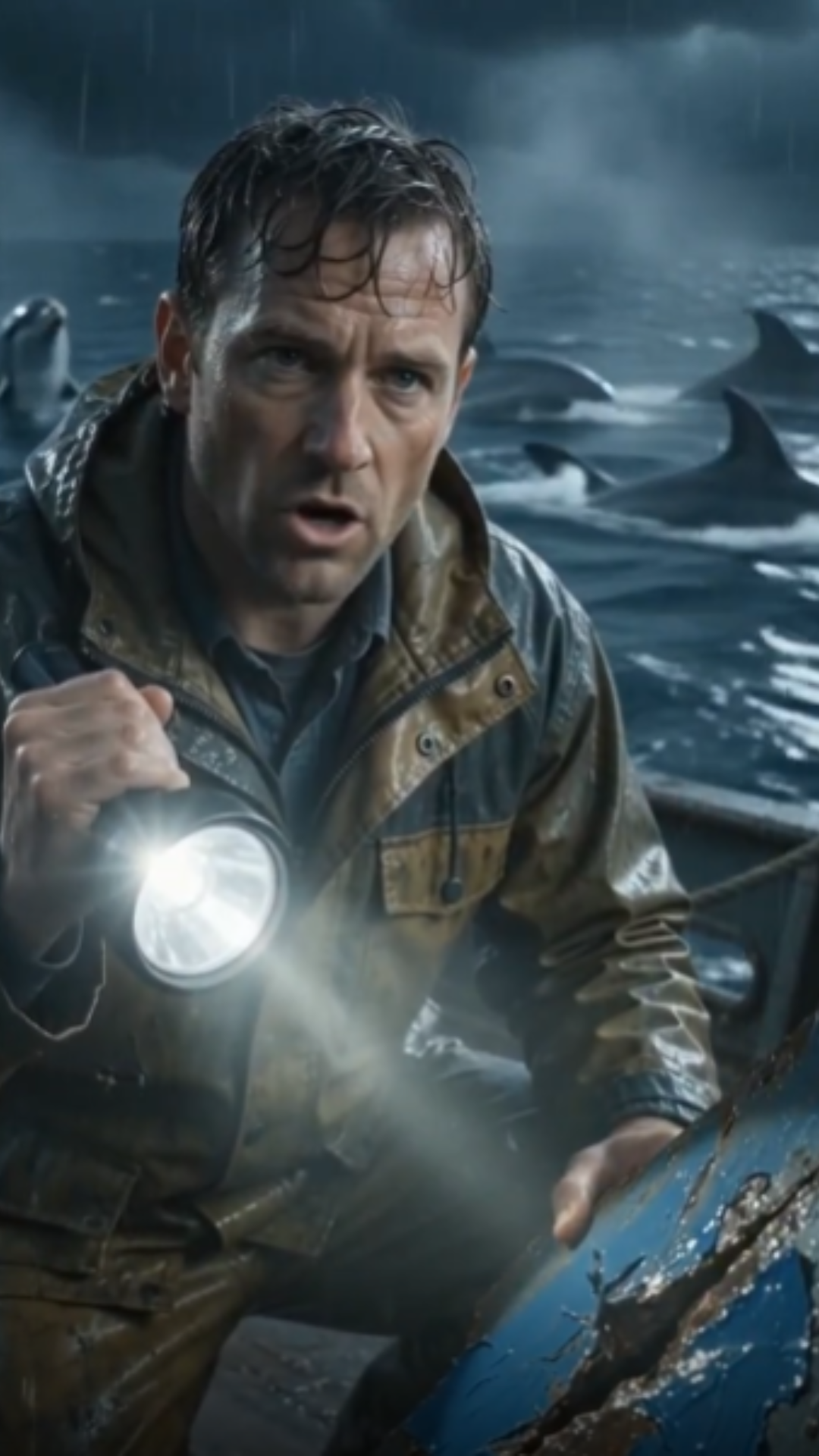
When I dragged my waterlogged boots onto the docks of Baltimore after a Category 2 gale on October 14th, my landlord and port developer Harrison Gable was already standing under the harbor lights w...


The digital clock on my dashboard glowed 2:17 AM. The Baltimore docks were mostly silent, save for the rhythmic creak of mooring lines and the distant clang of metal from a cargo ship being loaded.
My borrowed skiff, a battered wooden relic from an old fishing friend, bobbed gently beside Pier 6. Its tiny outboard motor was barely louder than a whisper.
I navigated through the narrow channels, the darkness an ally. The stars were brilliant, reflecting off the calm bay waters.
Then, a faint chirp on my portable sonar receiver. Then another. The 120 kHz pulses, clear and distinct.
The dolphins. They were circling.
As I approached coordinates 38°53’N, 76°26’W, the pings grew stronger, more frequent. The moon broke through a cloud, illuminating the water ahead. Five dark shapes, sleek and silent, arced gracefully through the surface. They breached, their smooth backs momentarily catching the moonlight, then dove again, always returning to the same precise spot.
They truly were guardians.
I cut the engine, letting the skiff drift. The only sound was the gentle lapping of water against wood.
Carefully, I lowered my high-resolution hydro-acoustic transducer into the dark water. The transducer, usually mounted on my research vessel, was my last piece of operational equipment. It was my eyes in the deep.
I powered up the small display on the burner laptop I’d bought with what little cash I had left. The screen flickered to life, showing a rudimentary 3D bathymetric scan of the seabed thirty feet below.
The image slowly rendered, pixel by painstaking pixel. The familiar contours of the granite reef started to take shape.
But wedged within the reef, impossibly large and out of place, was a massive, rectangular object.
Its dimensions were too perfect, its edges too sharp to be a natural formation. As the scan refined, the image became starkly clear.
It was a steel shipping crate. A standard 40-foot container, sunk deep into the seabed.
And then, the true horror.
Through the faint, ghostly outlines of the container’s interior, the scan resolved a human form. Lying face down amidst what looked like perfectly stacked rectangular blocks.
Eli. His body, still bound to the object that had kept him tethered to the coordinates.
My breath caught in my throat. I zoomed in, adjusting the sonar’s frequency to penetrate deeper into the metallic shell.
The rectangular blocks weren’t just filler. There were twelve of them, clearly discernible, each about the size of a pelican case. And they were dense. Far denser than anything else on the scan.
The image refined further, showing the distinctive stacking pattern. Each block appeared to be a brick of compressed material.
I ran a quick density analysis. My heart hammered against my ribs.
The calculation returned a chilling result: $14,500,000 in wrapped cash bricks.
Eli’s body wasn’t just dumped. It was part of a payload. A massive, illicit fortune hidden away in the deep, and he had been left to guard it.
More Stories








+ There are no comments
Add yours