
My Father-in-Law Tried to Fire Me and Steal My Pension — Until a Trainee's Emergency Revealed the Trident Tattoo on My Arm


Part 1
Twenty minutes later, a young trainee collapsed in the tactical training bay, choking on an obstructed airway while senior officers hesitated.
I cut through the crowd, dropped to my knees, and sliced open his collar to perform an emergency cricothyroidotomy.
As I pulled back my sleeve, the heavy cloth rolled up past my shoulder, revealing a dark Trident tattoo etched alongside a classified operational unit code.
The room froze, and the visiting Navy Commander stopped mid-stride, staring at the mark on my arm.
The fluorescent lights of the Voss Defense Logistics boardroom hummed, reflecting off the polished mahogany table where Arthur Voss, my father-in-law and the Chairman, sat enthroned. His words, sharp and deliberate, echoed in the sudden silence.
Twelve pairs of eyes, belonging to men and women who had watched me quietly manage the company’s health services for years, now swiveled between Arthur and me.
A few cleared their throats, shuffling papers. No one met my gaze.
Arthur, his impeccably tailored suit jacket unwrinkled, leaned forward. A faint, almost imperceptible smirk played on his lips.
He pushed a thick envelope across the table. It slid to a stop directly in front of me, the red ink of the “Termination Notice” stark against the cream paper.
“This is effective immediately, Maya,” he stated, his voice devoid of any warmth. “Your services are no longer required.”
My heart hammered against my ribs, a dull, aching thud. I kept my expression neutral, a skill honed over fifteen years of living in his shadow.
“And as for your spousal health coverage,” he continued, a note of cruel satisfaction creeping into his tone, “that will, of course, be voided by end of day. Voss Defense Logistics cannot be expected to subsidize a charity case indefinitely.”
A low murmur rippled through the room. Board member Robert Chen winced, looking down at his hands.
Arthur held my gaze, challenging me to react, to break.
I simply nodded, my fingers tightening around the edge of the table. I refused to give him the satisfaction.
“Very well, Arthur,” I replied, my voice steady, though it felt like I was speaking through a sheet of ice. “I understand.”
I pushed back my chair, its legs scraping loudly against the expensive carpet. The sound seemed to fill the vast room.
Without another word, I picked up the termination envelope. I turned and walked out, the click of my heels the only sound breaking the silence until the heavy oak door swung shut behind me.
The hallways of Voss Defense Logistics, usually bustling with purpose, now felt like a sterile tunnel. Each step I took was a quiet defeat, a testament to years of quiet subservience, now ending in public disgrace. I had devoted my life to this family, to my late husband, Michael, to this company. And it had all been for nothing.
I clapped the dust from my hands, my resolve hardening. This was Arthur’s victory, but it would not be the end of my story.
Just as I reached the main corridor leading to the employee exit, a piercing, desperate shout ripped through the air.
“Medic! We need a medic! Now!”
The cry came from the direction of the tactical training bay, a specialized facility where new recruits honed their combat skills. Adrenaline surged through my veins, an instinctual rush that bypassed the dull ache of dismissal.
I broke into a run, the termination letter still clutched in my hand. The sounds of alarm grew louder – panicked voices, the heavy thud of gear hitting the floor.
As I burst through the double doors of the training bay, the scene that unfolded was chaos. A young trainee, no older than nineteen, lay sprawled on the padded mat, his face already turning a disturbing shade of purple. He thrashed weakly, clawing at his throat, gasping for air that wouldn’t come.
Senior training officers, bulky men with years of experience, stood frozen, barking useless orders. One was fumbling with a radio, another trying to remember where the emergency medical kit was stored. Hesitation hung thick in the air.
“He’s choking!” someone yelled, the panic infectious.
“Get him on his side! Get him on his side!” another officer commanded, but no one was moving decisively.
I didn’t think. My training, dormant for years beneath layers of corporate bureaucracy, snapped to life.
“Move!” I commanded, my voice cutting through the noise with an authority that surprised even myself.
I pushed past a bewildered Lieutenant, dropping to my knees beside the trainee. His eyes were wide with terror, his lips blue. He had mere seconds.
I quickly assessed him – foreign body airway obstruction. The basic maneuvers weren’t working. He needed an emergency cricothyroidotomy, and he needed it now.
“Get me a scalpel! Anything sharp!” I yelled, glancing around.
No one moved. Their eyes were on me, a low-level nurse they’d barely acknowledged, now taking charge.
“He’s going to die!” I spat, my gaze sweeping the room.
My eyes landed on a sturdy utility knife clipped to a belt on a stunned officer nearby. I snatched it without asking.
The trainee’s body shuddered, his breathing arrested. There was no time for sterile fields or perfect conditions.
I tore open the collar of his uniform shirt, exposing his throat. My fingers flew, locating the cricothyroid membrane, a small indentation between the thyroid cartilage and the cricoid cartilage. It was a precise, high-stakes maneuver.
I took a breath, the stench of sweat and panic filling my nostrils. This was a procedure I hadn’t performed in over a decade, not since…
I pushed the thought away. Focus. Now.
With a swift, practiced motion, I made a small, precise incision. A faint gasp escaped the trainee’s lips, not of pain, but of a desperate, initial intake of air.
I widened the opening, working with speed and precision, the metallic tang of blood filling the air.
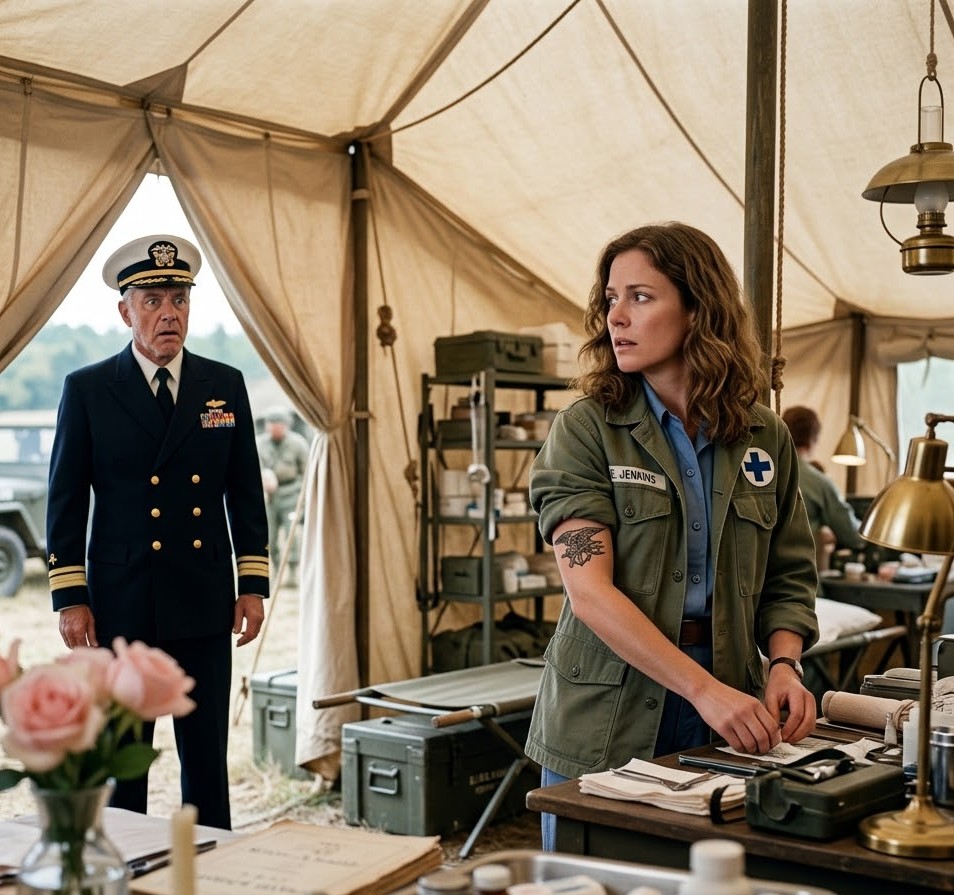
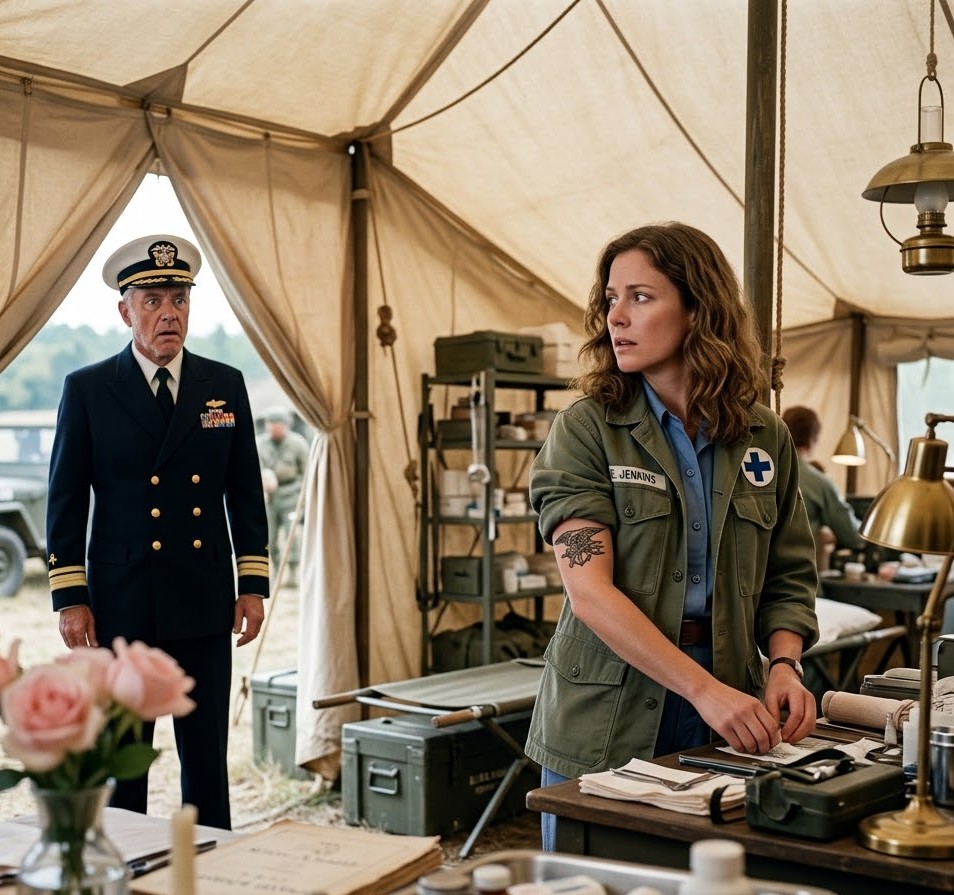
As I leaned back slightly, my right arm brushing against the mat, the sleeve of my nurse’s scrub top rolled up. It slid past my elbow, then my shoulder, revealing a stark, dark tattoo etched deeply into the skin.
It was a Navy SEAL Trident, unmistakable, its sharp points and anchor unmistakable against my skin. Beneath it, in smaller, almost unnoticeable script, was a series of numbers and letters: “DEVGRU 2012 B-Squad.”
A sudden, sharp silence fell over the entire training bay. The trainee was still breathing, slowly, raggedly, but breathing. The immediate crisis was passing.
The officers who had been watching, wide-eyed, now stared not at the recovering recruit, but at my arm.
In the midst of the stunned onlookers, Commander Marcus Burke, a visiting US Navy Captain observing the training, had been moving toward the scene. His stride had been purposeful, but now he stopped dead.
He was mid-step, one foot raised, his eyes fixed on the dark, unmistakable mark on my shoulder. His jaw went slack, and the color drained from his face as he stared, unblinking, at the classified operational unit code emblazoned there.
Part 2
Commander Burke stared at my arm, his face going pale. “DEVGRU 2012 B-Squad… that’s *your* team,” he whispered, recognition flooding his eyes.
He turned abruptly, his gaze locking onto Arthur Voss.
“Chairman Voss,” Burke’s voice boomed across the training bay. “You are attempting to terminate a decorated combat veteran. A member of a classified surgical unit that saved my life in Kandahar.”
Arthur’s face contorted, his voice dangerously low. “This is a corporate matter, Commander.”
“No,” Burke countered, “this is an insult.”
Arthur pointed a shaking finger at me. “She’ll regret this. I’ll destroy her legally before sundown.”
I walked out of the facility. My quiet life was officially over.
More Stories







+ There are no comments
Add yours