The White Painting


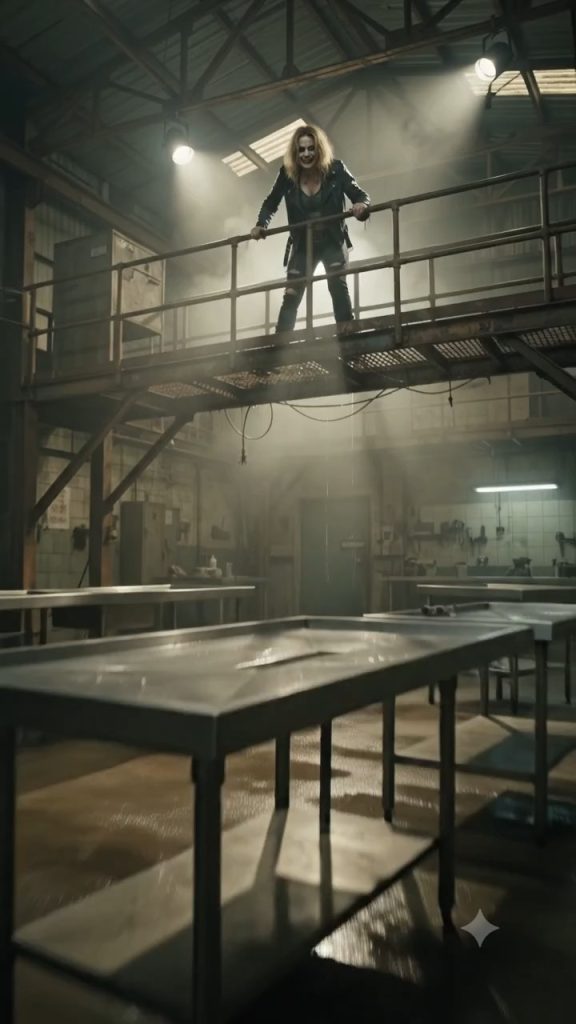
The heavy rain outside Hayes Manor felt less like a storm and more like an impending collapse of the sky itself. Gideon Croft stood motionless in the darkened corridor, the cold display of his phone still pressed to his ear. Marcus Brody’s voice—frantic, static-laced, and drenched in panic—seemed to echo off the wood paneling, repeating the horrific truth again and again: The real Vesper Vance has been decomposing in Lake Rainier for three years.
Ten feet away, framed by a sudden flash of blue lightning through the stained-glass window, stood the woman in emerald silk. She did not move. Her icy blue eyes, uncovered and completely unblinking, were fixed on Gideon with a quiet, lethal intensity.
Gideon did not panic. A decade as a homicide investigator followed by years of dissecting high-stakes art frauds had taught him one fundamental law of survival: when you are ambushed, control the tempo of the room.
Without breaking eye contact, Gideon lowered his phone, slipped it quietly into his coat pocket, and took three slow, deliberate steps backward into the shadows of the stairwell. He didn’t draw his sidearm. He didn’t scream. He simply blended into the darkness, letting the heavy velvet curtains and sprawling architecture of the West Wing swallow him whole.
He knew he couldn’t stay in the open. The woman was not blind, she knew the layout of the manor, and he was currently standing in a house where the walls themselves seemed painted in human blood.

Retreating toward the East Wing, Gideon bypassed his assigned guest suite and slipped down a narrow servant’s passage. His boots moved silently over the carpeted floorboards. He wasn’t fleeing; he was hunting. If this woman was an imposter living in a dead heiress’s skin, she needed a command center—a sanctuary where the real records, the operational log, and the true mechanics of this three-year deception were kept.
He stopped in front of the master study. The heavy oak door was secured with a brass mortise lock and a modern digital keypad—an unnatural addition to a 19th-century manor.
Gideon pulled a slim leather case from his inner lining, selecting two tension wrenches and an electronic decorder probe. Working with practiced, methodical precision in the dim light, he bypassed the mechanical tumblers in less than forty seconds before bridging the keypad’s circuit board with a micro-jumper.
Click.
The heavy lock disengaged. Gideon slid into the room, closing the door behind him until the latch clicked shut.
The master study smelled of old parchment, pipe tobacco, and ozone. Rain hammered violently against the reinforced bay windows overlooking the cliff. Gideon whipped out a low-intensity red tactical penlight, sweeping the beam across the room. Mahogany bookshelves lined the walls, packed with leather-bound art history volumes and legal ledgers.
He stepped behind the massive mahogany desk, bypassing the decoy financial files, and knelt beside the brass-bound floor safe tucked beneath the desk alcove. It wasn’t locked. The heavy door swung open with a faint hiss of air.
Inside lay a single, thick manila folder labeled with a bold red marker: PROJECT CROFT.
Gideon’s brow furrowed. He pulled the file out and opened it under the red beam of his light.
His stomach dropped.
The folder didn’t contain art receipts or bank transfers. It contained him.
Dozens of high-resolution surveillance photographs stared back at him. Photos of Gideon entering his Seattle office; photos of him conducting forensic analysis at the museum; stolen copies of his medical records; detailed logs of his daily routines; and complete case files from his past homicide investigations dating back five years. Every habit, every weakness, every tragic detail of his life had been cataloged, cross-referenced, and analyzed with terrifying obsessive precision.
He hadn’t been chosen at random by a grieving widow. He had been lured here. He was the target.
“You always were remarkably thorough, Mr. Croft.”
Gideon didn’t flinch. He slowly closed the folder and stood up, turning toward the center of the room.
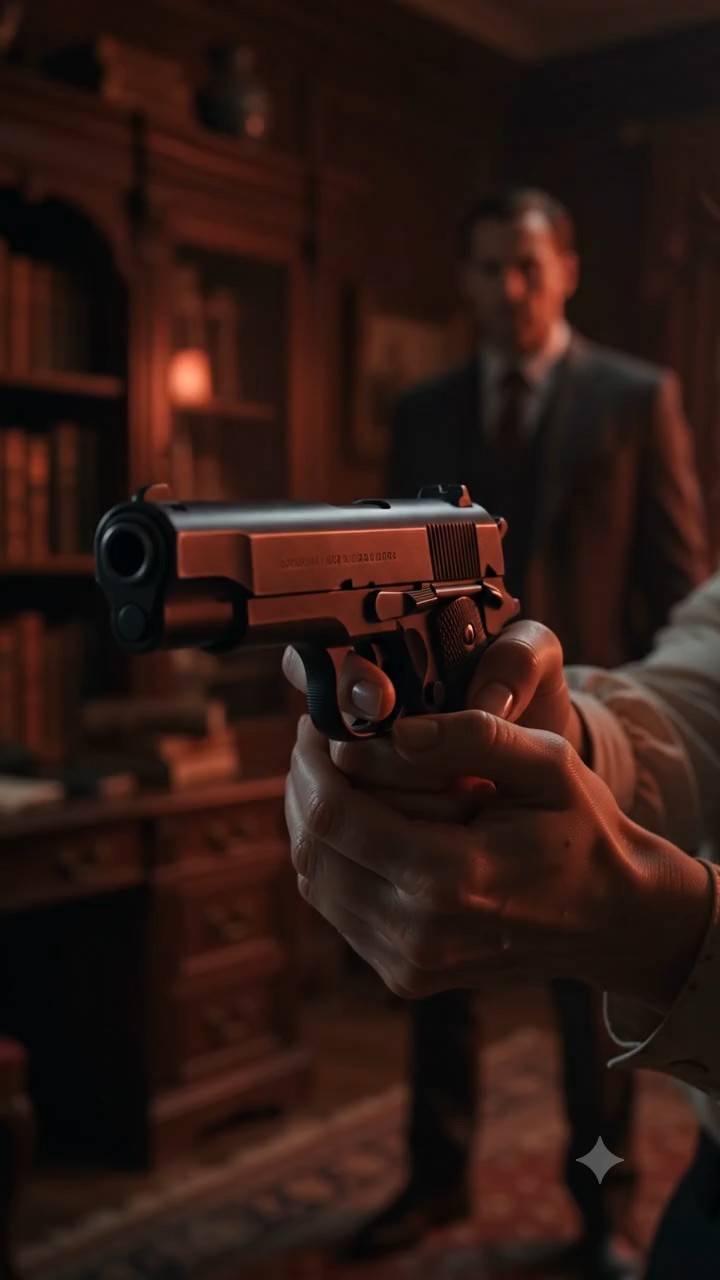
Standing by the doorway, illuminated by the ambient glow of the storm outside, was the imposter. In her right hand, held with a steady, practiced grip, was a sleek black Sig Sauer P226 pistol. The muzzle was pointed directly at Gideon’s chest. Her lace mask was gone, discarded on the floor behind her. Her pale face was devoid of the regal composure she had maintained all evening. Instead, her features were sharp, exhausted, and haunted.
Gideon kept his hands visible, hovering near his waist. He looked at her eyes—bright, piercing, and sharp—and then down at the weapon.
“Unmask yourself, Vesper. You didn’t set me up to appraise paintings—you brought me here to be your witness to a murder, didn’t you?“
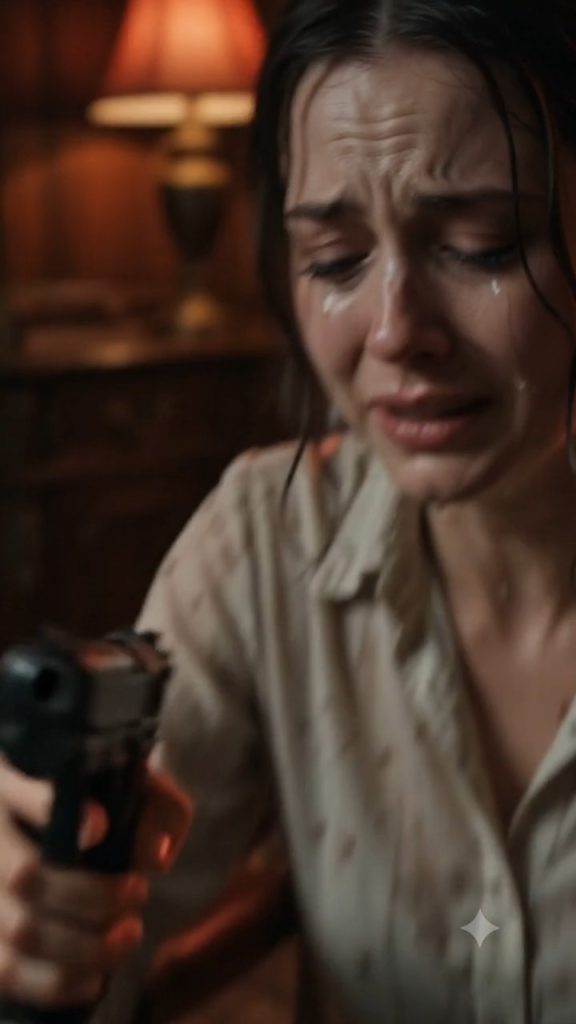
A dry, bitter laugh escaped her lips, sounding more like a sob than amusement. Her gun hand trembled slightly, but the barrel remained centered on his sternum.
“I didn’t lure you here to kill you, Gideon,” she whispered, her voice dropping the cultured, high-society cadence and revealing a raw, desperate rasp. “And my name isn’t Vesper.”
“Then who are you?” Gideon demanded, taking a half-step forward. “Because the police just pulled the real Vesper Vance out of Lake Rainier. She’s been dead for three years.”
Tears welled in her bright blue eyes, spilling over her pale cheeks. She didn’t wipe them away. Slowly, deliberately, she lowered the safety of the pistol, lowered her arm, and let the heavy firearm drop onto the leather sofa beside her. She sank into a chair, burying her face in her hands.
“My name is Evelyn,” she choked out, her shoulders shaking violently. “I’m Vesper’s twin sister. The twin the Vance family hid away in European psychiatric institutes because I was born out of wedlock… the dirty secret they paid to keep buried.”
Gideon kept his guard up, his eyes darting between the gun on the sofa and the weeping woman in front of him. “If you didn’t kill her, Evelyn, why are you wearing her clothes? Why are you living in her house, pretending to be a blind widow for three years?”
Evelyn raised her head, her face pale under the red glow of his penlight. “Because if I didn’t, he would have put me in that lake right next to her.”
Gideon narrowed his eyes. “Who?”
Evelyn reached into the inner lining of her silk gown and pulled out a worn, leather-bound notebook along with a stack of surveillance photos. She slammed them onto the mahogany desk.
“Look at these photographs, Gideon! Dorian Hayes never died in that accident. He bought someone else’s face, and tonight he’s going to use your very name to escape!“
Gideon stepped up to the desk, keeping one eye on Evelyn as he flipped through the photographs.
The first set of images showed the catastrophic car crash from three years ago—a twisted, charred shell of a Mercedes-Benz at the bottom of a ravine near Snoqualmie Pass. The official police report had concluded that Dorian Hayes’ body had been incinerated beyond recognition, identifying him solely through dental records.
But the subsequent photographs shattered that narrative entirely.
They were recent photographs—taken over the last six months—showing a man with a heavily reconstructed face, distinct surgical scars along his jawline, and cold, dark eyes. The man was entering private banks in Zurich, meeting with shell-company brokers in Vancouver, and signing transfer deeds.
“Dorian didn’t die,” Evelyn whispered, her voice trembling with terror and rage. “He staged the entire crash. He brought Vesper to the lake house three years ago, murdered her in cold blood, and shoved her body into that iron trunk because she discovered he was bankrupting her family estate through illegal offshore money laundering.”
She stepped closer to the desk, pointing a trembling finger at the legal documents attached to the photos.
“Dorian knew he couldn’t claim the fifty-million-dollar insurance payout or liquidate the art collection without a living heir. So he hunted me down in Vienna. He brought me here, threatened to frame me for Vesper’s murder, and forced me to play the role of his ‘grieving, blind widow.’ For three years, Gideon… three years I have been locked in this gold cage, forced to paint his cover-ups, forced to sit in the dark while he built his new identity!”

Gideon analyzed the documents with cold, calculating precision. The paper trails, the passport scans, the bank routing numbers—they were intricate, authentic, and terrifyingly detailed. The narrative fit the physical evidence he had uncovered in the gallery.
“The blood on the canvas…” Gideon realized, his voice dropping. “The Silent Confession…”
“Dorian made me paint over the original layers to conceal the hidden vaults behind the gallery walls,” Evelyn sobbed. “He used human blood from his private medical reserves to create an organic compound that would bypass basic spectral scans if the museum checked it! He controlled everything! He’s a monster, Gideon!”
She grabbed Gideon’s forearm, her grip surprisingly desperate and strong. “He knew you were the only independent expert whose authentication the Seattle Museum of Art and the insurance underwriters would accept without question! He brought you here so your certified report would greenlight the final transfer of the $50 million into his anonymous bearer bonds!”
Gideon stood silent, processing the massive, multi-layered trap.
Twist upon twist. The blind widow was an imposter, but she wasn’t the mastermind—she was a prisoner, a puppet manipulated by a ghost. Dorian Hayes hadn’t perished in a fiery tragedy; he had orchestrated a masterclass in faked death, spousal murder, and grand-scale financial theft.
“Where is he now?” Gideon asked coldly.
Evelyn pulled a flight manifest from the bottom of the folder and shoved it into Gideon’s hands.
“His private charter plane—callsign X-90—is sitting on the tarmac at Boeing Field right now,” she gasped, checking her watch with panicked eyes. “He’s transferring the last batch of liquidated bearer bonds tonight. His flight leaves for Zurich at 3:30 AM! If he gets on that plane, he disappears forever, and he’s leaving me here to take the fall for Vesper’s murder!”
Gideon looked at his watch. 2:45 AM. They had less than forty-five minutes before the aircraft departed Seattle airspace.
He pulled his phone from his coat, bypassed the main dispatch line, and dialed Inspector Marcus Brody’s direct encrypted frequency.
The line rang twice before Marcus answered, his voice breathless over the sound of screaming wind and rain. “Gideon! Where the hell are you? Backup is ten minutes out from the manor! Don’t engage that woman!”
Gideon didn’t hesitate. His voice was sharp, commanding, and absolute.
“Airport alert! Intercept private jet callsign X-90 immediately! The man sitting in the VIP seat… is the dead husband who died 3 years ago!“
On the other end of the line, Marcus went dead silent for two agonizing seconds. “Gideon… what are you talking about? Dorian Hayes is dead!”
“He’s alive, Marcus! He faked the crash, murdered his wife, and he’s boarding a flight to Zurich at Boeing Field right now with fifty million in bearer bonds! Lock down the airfield! Do not let that plane touch the runway!”
“God almighty…” Marcus cursed, the sound of car doors slamming and sirens roaring exploding through the speaker. “I’m rerouting all tactical units to Boeing Field now! Get out of that house, Gideon! We’re locking down the city!”
Gideon ended the call and looked down at Evelyn. She was trembling, watching him with a mixture of hope and sheer terror.
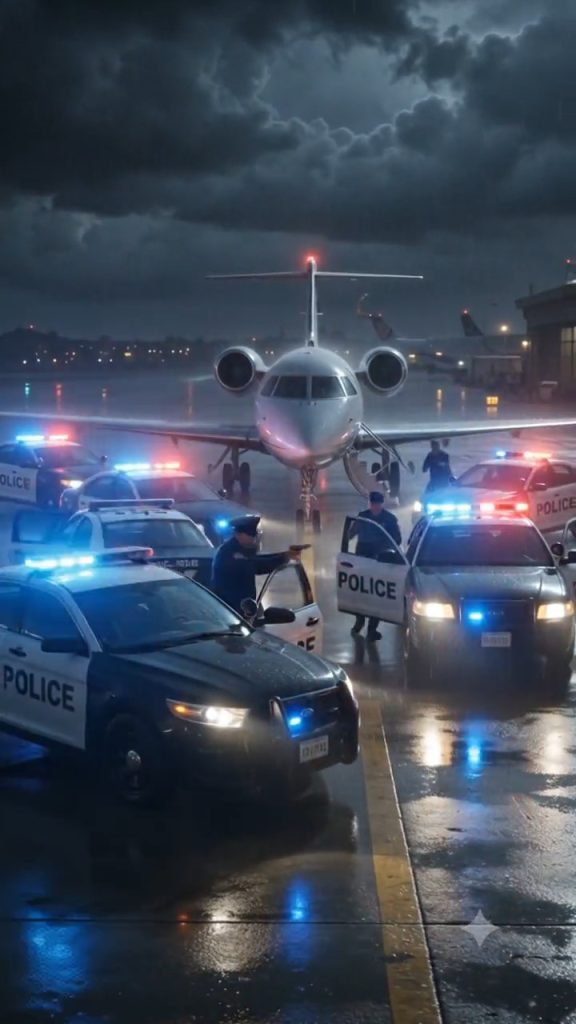
“Cops are locking down Boeing Field,” Gideon said grimly, picking up his forensic case. “You’re coming with me. You’re going to give your statement directly to the District Attorney.”
Evelyn nodded frantically, grabbing a heavy coat from the rack. “Thank you, Gideon… Thank you. I thought I was going to die in this house.”
As they rushed out of the study and down the grand staircase into the stormy night, Gideon felt a cold, persistent knot tightening in his gut. The pieces of the puzzle were falling into place almost too perfectly. The photos, the flight manifest, the sudden revelation of a faked death—it was a flawless narrative.
And in his line of work, Gideon knew that when a story looks too flawless… it’s usually because someone spent a very long time writing it.
More Stories





+ There are no comments
Add yours