The White Painting


The rain over Boeing Field fell in heavy, gray sheets, driven sideways by gusts straight off Elliott Bay. High-intensity floodlights carved blinding white tunnels through the deluge, reflecting off slick black tarmac and the wet, gleaming fuselage of the Gulfstream G650 bearing tail number X-90.
Spoons of water splashed beneath heavy tactical boots as SWAT officers sealed the perimeter. Four Seattle Police cruisers sat idling with their sirens flashing crimson and blue against the low fog.
Inspector Marcus Brody stood near the open passenger doorway of the jet, his heavy waterproof coat slick with rain. Beside him, Gideon Croft and Evelyn watched as two armed officers dragged a man down the mobile airstair.
The man was dressed in a bespoke charcoal wool overcoat, his hands zip-tied tightly behind his back. His face was a patchwork of modern reconstructive plastic surgery—a jawline slightly too sharp, skin stretched taut over cheekbones that did not match his original passport photographs, and dark, hollow eyes that darted frantically between the police cars.
“Dorian Hayes,” Marcus growled, stepping forward to snatch a heavy leather briefcase from the tarmac where an officer had set it down. He popped the latches. Inside sat tightly strapped stacks of unregistered bearer bonds and bundles of Swiss francs.
The man with the reconstructed face spat onto the wet asphalt, his breath coming in ragged white plumes. “You’re making a catastrophic mistake, Brody! You have no legal standing to ground a private charter!”
Gideon stepped into the glare of the floodlights, carrying his aluminum forensic case. He looked dead into the eyes of the man who was supposed to have burned to ashes in a Mercedes three years ago.
“The flight manifest was flagged, Dorian,” Gideon said, his voice flat. “And your wife’s corpse just came up from the bottom of Lake Rainier.”
Dorian’s eyes widened, shifting rapidly from Gideon to Evelyn, who was shrinking back into the shadows of Gideon’s shoulder. A strange, twisted grimace distorted his surgically altered features.
“My wife?” Dorian let out a sharp, hysterical laugh that was swallowed by the roar of the wind. “You think that thing in the lake proves I killed her? You have no idea what you’ve stepped into, Croft!”
“Save it for the interrogation room,” Marcus snapped, shoving Dorian toward the back of a waiting transport van. “Move!”
Thirty minutes later, the air inside Interrogation Room 4 at the Seattle Police Department’s West Precinct smelled of stale coffee, damp wool, and industrial disinfectant. The single fluorescent light fixture overhead hummed with a low, nerve-grating buzz.
Dorian sat handcuffed to the steel table, his expensive coat removed. Gideon stood in the corner of the observation room behind the two-way mirror, watching through the dark glass alongside Marcus.
Inside the room, a lead homicide detective slammed a thick folder onto the metal table.
“We have your financial routing numbers, Dorian,” the detective said, leaning over the table. “We have the Swiss accounts, the fake passport under the name Julian Vance, and the trunk we pulled from Lake Rainier. You murdered Vesper Vance three years ago, faked your death in Snoqualmie Pass, and forced her twin sister to play her ghost so you could cash out fifty million dollars.”
Dorian leaned back in his chair, the steel cuffs clinking against the table frame. His expression had shifted from panic to a terrifyingly cold composure.
“I locked that billionaire in the interrogation room, Gideon. But he just swore on his life that… the person at the bottom of the lake isn’t his wife, but her lover!” Marcus muttered from beside Gideon, repeating the briefing he had just received from the lead detective through his earpiece.
Gideon’s eyes narrowed behind the two-way glass. “What?”
Inside the interrogation room, Dorian leaned forward, his voice cutting through the intercom speaker with chilling clarity.
“I am a tax evader, a fraudster, and a coward,” Dorian said, his dark eyes fixated on the two-way mirror as if he knew Gideon was standing right behind it. “I embezzled twenty million dollars from the Hayes family trusts to cover my gambling debts in Macao. I staged my car crash because loan sharks were going to skin me alive. But I did not murder Vesper.”
“Then whose body is in the iron trunk?” the detective demanded.
“It’s Julian Mercier,” Dorian replied calmly. “Vesper’s secret lover. A French gallery owner she had been sleeping with for eighteen months.”
A heavy silence fell over the room.
“Three years ago, I came home to the lake house unannounced,” Dorian continued, his tone cold and detached. “I found Mercier in the studio. He was dead on the floor, his skull crushed with a bronze sculpting hammer. Vesper was standing over him, covered in blood, whispering gibberish. She was a psychopath—a brilliant, unhinged madwoman who suffered from violent psychotic breaks that her family spent millions to cover up.”
Dorian leaned closer to the microphone on the table. “She begged me to help her. She knew if the murder came out, her art career was over and she would spend the rest of her life in an asylum for the criminally insane. So we made a deal. I needed to vanish to escape my debts; she needed a body that couldn’t be linked to her. We locked Mercier in that iron trunk and dropped him into the lake. I took my burned-out Mercedes, bought a dead man’s dental records, and fled to Europe.”
“And Vesper?” the detective asked.
“She stayed in Seattle, using her ‘blindness’ as an excuse to withdraw from society so no one would ask questions about her lover’s disappearance,” Dorian smiled thinly. “If she’s dead now, ask the woman standing in your hallway. Ask Evelyn. Because when I left America, Vesper Vance was very much alive.”
Gideon stepped out of the precinct into the cold night air, his mind churning with dark equations.
The story was twisting into an incomprehensible labyrinth. Dorian claimed the body in the lake was a male lover, killed by Vesper. Evelyn claimed Dorian murdered Vesper and forced her to play the blind widow. Both narratives were compelling, backed by fragments of real evidence, yet both felt fundamentally unnatural—like a painting where the perspective lines never quite meet at the vanishing point.
“You don’t believe him, do you?” Marcus asked, walking out onto the wet concrete steps behind Gideon, lighting a cigarette.
“Dorian is a professional liar,” Gideon said, pulling his trench coat tight. “But he gave us a detail that can be verified. The medical examiner is performing the autopsy right now. If the corpse in the trunk is a male lover and not Vesper Vance, then Evelyn lied to us about everything.”
“And if it is Vesper Vance?” Marcus asked, blowing a plume of gray smoke into the freezing rain.
“Then Dorian is trying to frame a dead woman,” Gideon said, picking up his forensic kit. “I’m going back to Hayes Manor.”
“Why? We’ve got the house secured.”
“Because the paintings are still there,” Gideon replied, his voice dropping an octave. “And in a room full of murderers, the canvas is the only thing that cannot lie.”
The Hayes Manor was silent as a tomb when Gideon returned at 4:00 AM. The police tape stretched across the massive oak front doors fluttered in the gale.
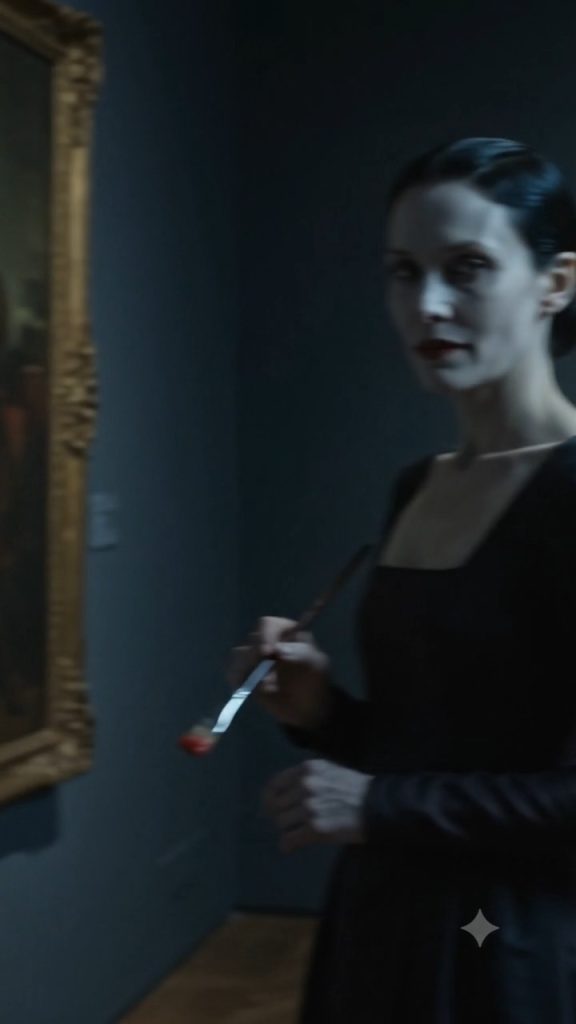
Gideon bypassed the main foyer and made his way directly to the West Wing gallery. The air inside the high-ceilinged room was cold, smelling faintly of old varnish, damp plaster, and the metallic tang he had detected earlier that evening.
He set his aluminum case on the mahogany table beneath the single spotlight and pulled out a fresh set of surgical scalpels, micro-spatulas, and a portable chemical reagent kit.
He walked up to the central easel holding The Silent Confession.
The fifty-million-dollar masterpiece stared back at him—the veiled figure wrapped in deep, suffocating layers of crimson, umber, and black.
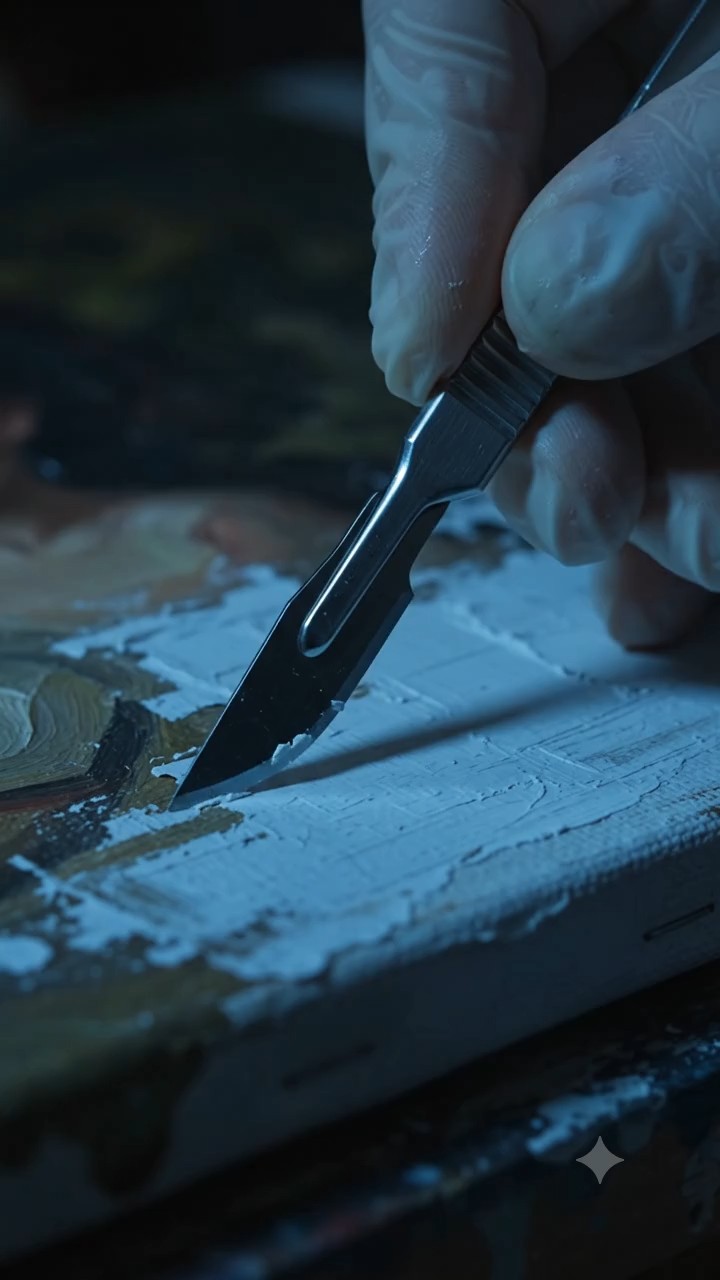
Gideon lowered his loupe and brought a surgical scalpel to the extreme edge of the canvas, right where the painted fabric was stretched and stapled around the heavy oak stretcher bars. He wasn’t sampling the top paint layer this time. He was going deeper—down to the primer, the gesso, and the underlying ground layer used to prepare the raw canvas.
He carefully sliced a two-millimeter cross-section of the ground layer, lifting the tiny white flake with precision tweezers and placing it into a quartz petri dish.
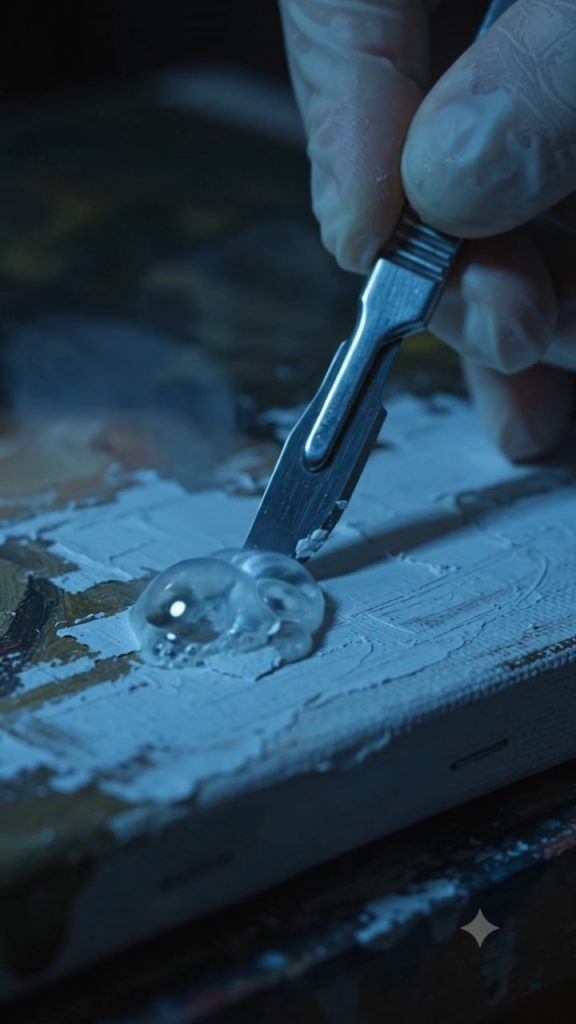
He poured three drops of a specialized nitric acid and hydrochloric acid reagent onto the sample.
In traditional 19th-century oil paintings, the ground layer consists of gesso—a mixture of calcium carbonate (chalk) or gypsum bound with animal glue. When exposed to the acid reagent, standard gesso fizzes gently, releasing carbon dioxide gas in a predictable, mild effervescence.
Gideon leaned over the dish.
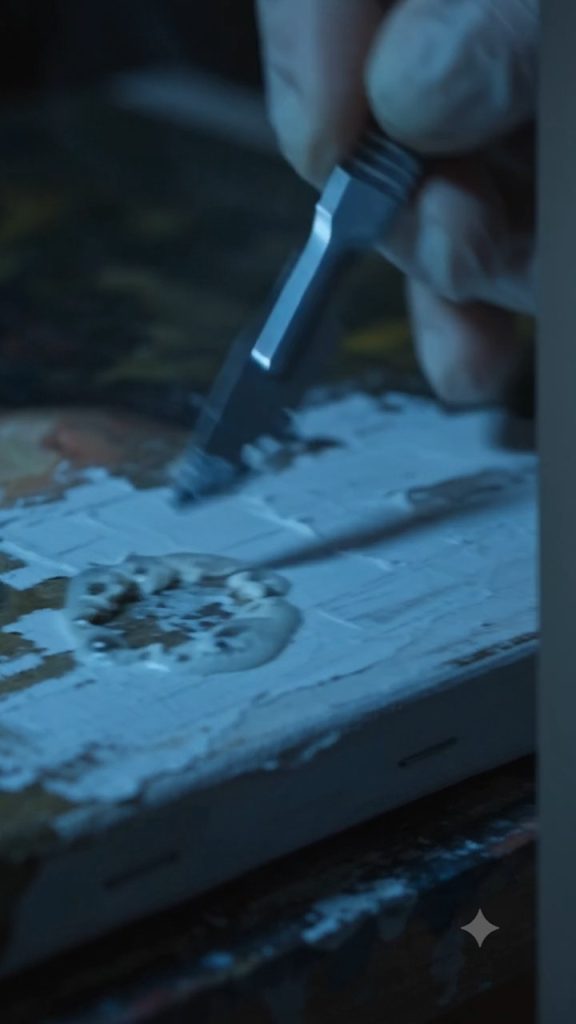
The moment the acid touched the sample, it did not fizz gently. The compound turned a dark, murky brown, emitting a sharp, foul odor of sulfur and burning organic material. Tiny white crystalline structures began precipitating out of the liquid at a violent rate.
Gideon’s breath hitched. He reached into his kit, pulled out his portable FTIR spectrometer, and focused the laser probe directly on the precipitating crystals.
The spectral graph plotted across his monitor screen: High concentrations of Hydroxyapatite. Calcium phosphate ratios exceeding 1.67. High lipid residues embedded in a calcified matrix.
This wasn’t chalk. It wasn’t gypsum. It wasn’t animal glue.
It was bone ash. Human bone ash, calcified at high temperatures and ground into a micro-fine powder to serve as a binding filler for the canvas primer.
Gideon’s hands began to shake—a rare, terrifying sensation for a man who had spent his life analyzing cold, unfeeling objects.
He swept his UV light across the rest of the collection hanging in the gallery—twelve massive, dark canvases spanning Vesper Vance’s entire ten-year career. Under the 365-nanometer ultraviolet beam, the ground layers beneath all twelve paintings glowed with the exact same sickening, iridescent blue luminescence.
Every single canvas in the gallery had been primed with the exact same human bone powder.
“The $50 million isn’t sitting in a Swiss bank account! The entire fortune was ground up and pressed right into the wooden frames of these paintings!” Gideon whispered into the empty, echoing room, realization crashing over him like a tidal wave.
The fifty-million-dollar valuation wasn’t just about artistic genius. The paintings were the physical vault—a grotesque, terrifying storage system for a decade of horrors.
His phone buzzed violently in his pocket, shattering the deathly silence of the gallery. Gideon snatched it out, pressing it to his ear.
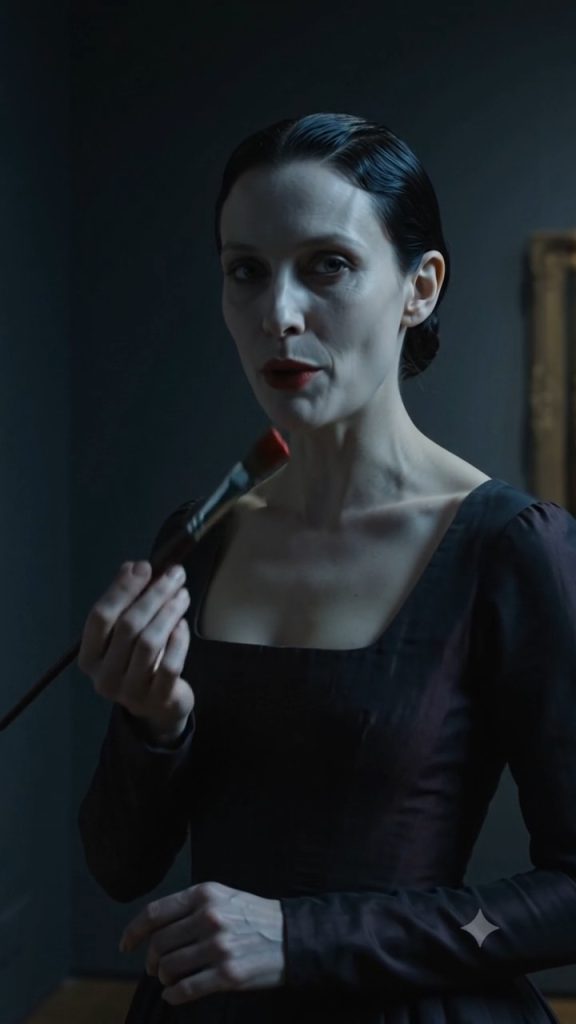
It was Marcus, his voice sounding hollow, terrified, and drained of all color.
“Gideon… the medical examiner just finished the preliminary intake on the trunk from Lake Rainier.”
“What did they find, Marcus?” Gideon demanded, his eyes fixed on the crimson figure on the easel.
“The DNA confirmed it’s Vesper Vance,” Marcus said, his voice trembling. “It’s not a male lover. It’s her. But Gideon… the body inside that trunk… it didn’t have a skeleton.”
Gideon felt the room tilt around him. “What do you mean it didn’t have a skeleton?”
“The M.E. said the soft tissue was preserved in the sealed iron environment, but every major bone in her body—her ribs, her femur, her skull, her spine—was surgically excised before she was put into the water. Someone flayed her, Gideon. They removed her entire skeletal system with medical precision!”
Gideon looked up at the twelve massive canvases surrounding him in the dark.
The white powder in his petri dish. The Hydroxyapatite peaks on the spectrometer. The micro-fine ground layer that gave Vesper Vance’s paintings their legendary, haunting texture and depth.
She hadn’t just been murdered. Her body had been processed. Her entire skeleton had been crushed, calcified, and mixed into the paint ground that supported her sister’s and husband’s multi-million-dollar art empire.
Gideon backed away from the easel, his heart hammering against his ribs like a trapped bird.
Suddenly, from the far corner of the darkened gallery, the soft, rhythmic sound of a footstep echoed against the hardwood floorboards.
Step. Step.
Gideon whipped around, reaching for his sidearm, pulling the flashlight beam across the shadowy alcove near the gallery entrance.
Standing in the beam of light, holding a fine sable paintbrush dipped in a small ceramic jar of dark red glaze, was Evelyn.
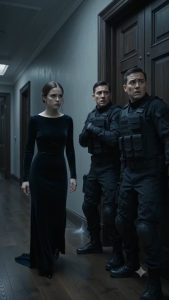
She wasn’t weeping. She wasn’t trembling. She wore an elegant black velvet coat, her pale face completely serene beneath the ambient red glow of his tactical light. She looked at Gideon with a calm, disturbing curiosity, as if he were merely an intriguing subject on her canvas.
Gideon raised his firearm, pointing the barrel directly at her chest, his knuckles white.
“Stop licking the tip of that paintbrush, Gideon! The ingredient making up the shade of red in her final painting… is dead human bone marrow!” Evelyn whispered, her voice smooth, chilling, and completely devoid of the fear she had displayed hours earlier.
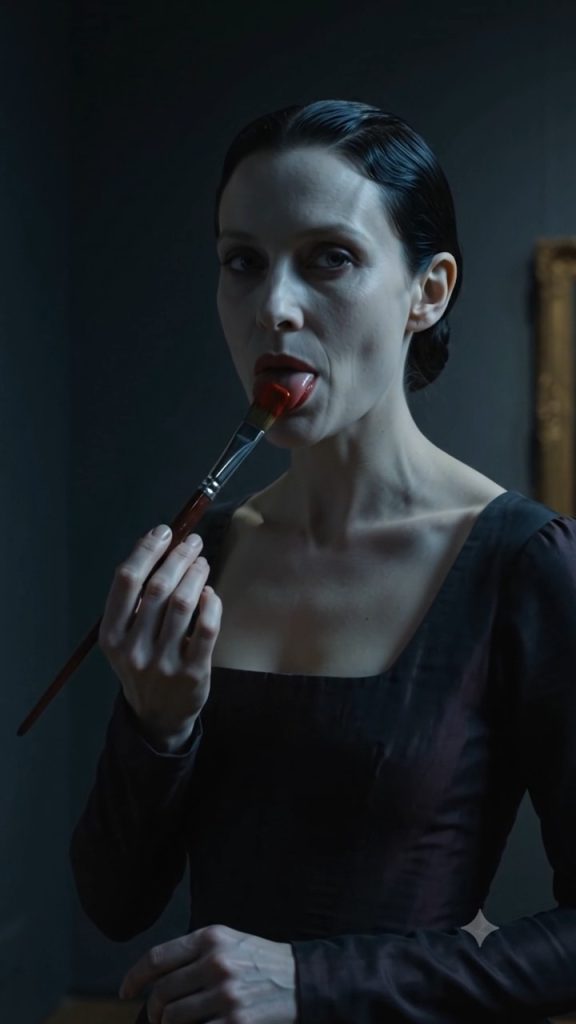
She took one slow step toward him, the paintbrush held delicately between her pale fingers.
“You really are a genius, Gideon,” she murmured, a faint, beautiful smile opening across her lips. “Most experts just look at the colors. You’re the only one who ever thought to look at the bones.”
More Stories




+ There are no comments
Add yours