
After Her Divorce, Evelyn Albright Stripped My Account Bare, But My Son's Offhand Comment Exposed Her 1948 Scheme


The biting November wind tore at Arthur Caldwell’s threadbare military coat as he stepped off the train in New Haven. He’d pictured Eleanor’s familiar, bright smile at the station, perhaps even a new dress. Instead, he found only the biting chill and the grim reality of a city still grappling with the echoes of war.
His telegram from Eleanor had been sparse, a single urgent plea to come. He had expected to find her in a small, respectable apartment, perhaps even back with Philip given time. The address she’d provided, however, led him to a grimy tenement building on the edge of the industrial district, a place reeking of stale cabbage and damp plaster.
He climbed the creaking stairs, each step a mournful groan, his duffel bag heavy on his shoulder. The hallway was dimly lit by a single flickering bulb, revealing peeling wallpaper and countless scuff marks. Arthur’s heart sank with every upward turn. This was not the life he’d imagined for his sister.
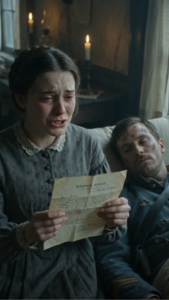
Eleanor opened the door to his knock, and the sight of her nearly knocked the breath from him. Her face, once round and cheerful, was gaunt, etched with lines he’d never seen before. Her dress, though clean, hung loosely on her frame, and her usually vibrant hair was pulled back in a severe, tired knot. Her eyes, however, still held that fierce, protective spark.
“Arthur,” she whispered, her voice barely audible over the rattling pipes.
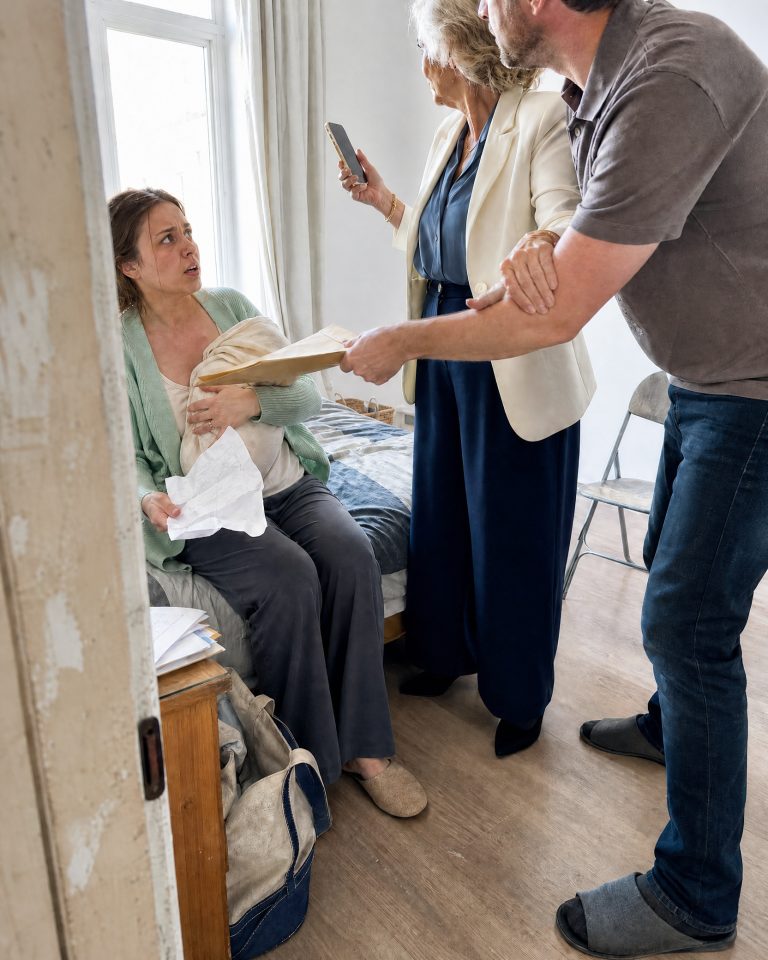
“Eleanor,” he replied, his own voice thick with unshed emotion. He stepped inside, and the cold hit him like a physical blow. The small room was dominated by a single, narrow bed and a makeshift crib fashioned from an old wooden crate. A thin, worn blanket was tucked around a tiny bundle inside.
Thomas, his infant nephew, was pale, his breath shallow and punctuated by a wet, hacking cough that seemed to shake his tiny frame. Eleanor rushed to the crib, placing a hand gently on his forehead. The little boy stirred, whimpering softly.
“He’s been like this for weeks,” Eleanor murmured, her gaze fixed on her son. “The doctor said it’s the damp, the cold. He needs warmth.”
Arthur’s jaw tightened. He had fought through the bitter European winters, seen conditions of hardship, but never had he expected to find his own sister living in such squalor. Evelyn Albright’s letters, filled with vague pronouncements about Eleanor’s “reckless spending” and “unsuitability,” now tasted like ash in his mouth.
“This is not right, Eleanor,” Arthur said, his voice low and firm. He knelt beside the crib, reaching out a hesitant finger to touch Thomas’s small, flushed hand. The baby’s skin felt unnaturally warm.
“It’s what I can afford,” Eleanor said, pulling back slightly, a flicker of pride in her tired eyes. “I’m working. Cleaning, mending. It’s enough.”
Arthur stood, his gaze sweeping the tiny, single room again. There was no stove, just a small hot plate on a crate. A single chipped teacup and a half-eaten slice of stale bread sat on a wooden plank serving as a table. The air was thick with the faint, metallic scent of illness and the underlying dampness of the building.
“Enough for what?” Arthur asked, a hard edge in his voice. “Enough to watch my nephew get sicker? What did Philip say about this?” He knew Philip was weak, easily manipulated by his overbearing mother. Arthur had always suspected Philip’s moral compass was a bit skewed, but this level of neglect seemed beyond simple spinelessness.
Eleanor flinched at the mention of her ex-husband. “Philip isn’t involved. Not anymore. He cut off all support months ago, after Thomas was born.” She paused, her eyes darkening. “Evelyn made sure of it.”
“Evelyn,” Arthur scoffed, shaking his head. “She wrote us endless letters, claiming you squandered everything. That you were irresponsible.” He remembered the thinly veiled disapproval in his mother’s voice when she read those letters aloud, Evelyn’s words painting Eleanor as some kind of spendthrift harlot.
“I didn’t squander anything, Arthur,” Eleanor said, her voice rising slightly, her hands clenching into fists. “There was nothing *to* squander. The settlement was barely a pittance.” Her voice cracked with the memory. “The bank officer said most of it went to ‘unforeseen legal and administrative fees,’ and a $1,200 ‘appraisal adjustment.’ I walked out of that bank with thirty-eight dollars and seventy-five cents.”
Arthur stared at her, dumbfounded. The numbers made no sense. He knew Philip came from a family of means, especially with his recently deceased aunt, Beatrice, having left a substantial inheritance. A divorce settlement, even a modest one, should have been more than that. Much more. This was not merely Philip’s incompetence; this sounded like active sabotage.
“Let me see the papers,” Arthur said, his tone leaving no room for argument. “All of them. Every single document related to the divorce, the property, everything.” His mind, trained by years of sifting through military records and supply manifests, already began piecing together the fragmented story. He saw it as a puzzle.
Eleanor hesitated for a moment, then walked to a small, battered trunk by the bed. She pulled out a stack of papers tied with a faded ribbon. “These are all I have. The lawyers kept most of it. Said it was standard procedure.” She handed him the thin bundle.
Arthur took them, his fingers brushing against hers. Her skin was rough, calloused, a stark contrast to the smooth, soft hands he remembered. It was a small detail, but it punched him in the gut. Evelyn had managed to strip Eleanor of everything, even the softness of her own skin.
He sat on the edge of the narrow bed, the springs groaning in protest. He carefully untied the ribbon, unfolding the official-looking documents. The language was dense, legalistic, full of clauses and sub-clauses designed to obscure rather than clarify. His eyes scanned the pages, looking for anything concrete, any actual numbers that added up.
The first thing that struck him was the sheer vagueness of the “fees.” No itemized breakdown, just large, round figures for “miscellaneous legal costs” and “administrative disbursements.” It felt like a black hole where a significant sum of money had simply vanished. This was beyond Philip’s usual dim-wittedness; this required deliberate obfuscation.
He flipped through to the property valuation. It described the Albright family home on Rosedale Drive, a property he knew well. It was a handsome colonial, well-maintained, set on a sizable plot of land in a desirable part of town. He remembered visits there, the sprawling garden, the solid oak floors, the way the sunlight streamed into the living room.
Yet, the appraisal listed a value that seemed shockingly low, barely half what he would have estimated for a property of that caliber in 1948. A paragraph detailing “structural defects” jumped out at him, citing “significant foundation issues” and “major window damage” that supposedly justified a substantial reduction in value, precisely that $1,200 “appraisal adjustment” Eleanor had mentioned.
He frowned, rereading the description of the defects. He couldn’t recall anything like that from his last visit before leaving for Europe. He remembered Evelyn’s meticulousness about the house, her almost obsessive need for everything to be perfect. The idea of “significant foundation issues” seemed entirely out of character for the Albright residence.
“The Rosedale property,” Arthur mused aloud, tapping the document. “This valuation seems… off.” He looked up at Eleanor, who was now carefully rocking Thomas, humming a soft, tuneless lullaby. “Did you ever notice any of these ‘structural defects’?”
Eleanor paused her humming, her brow furrowed. “No. Not really. Evelyn was very proud of that house. She kept it immaculate.” A dry, bitter laugh escaped her lips. “She wouldn’t have tolerated a broken window for an hour, let alone ‘major damage.'”
Her words resonated with Arthur. Evelyn’s vanity was legendary. She would never allow her home, a symbol of her family’s standing, to fall into such disrepair. This appraisal was a deliberate misrepresentation. His initial suspicion of Philip’s mere incompetence began to recede, replaced by a colder, more unsettling thought. This might not be passive failure; this might be an active, calculated scheme.
He knew Evelyn had always resented Eleanor, viewing her as an interloper from a less affluent background. The idea of Eleanor gaining any significant portion of the Albright family’s assets, especially after Philip’s wealthy Aunt Beatrice had died, would have been anathema to Evelyn. A chilling realization began to settle in Arthur’s gut: Evelyn’s claims of Eleanor’s irresponsibility were a smokescreen. The real story lay hidden within these dry, legal documents.
“I won’t let this stand, Eleanor,” Arthur vowed, his voice tight with resolve. He looked at his sleeping nephew, whose small chest continued to heave with that relentless cough. The injustice burned within him. “I’m going to figure out what happened here. Philip might be a fool, but this… this feels like something far more deliberate.” He carefully folded the documents, slipping them into his duffel bag. His homecoming had become a mission.
Eleanor looked at him, her eyes filled with a fragile hope he hadn’t seen in months. A single tear traced a path down her cheek. “Be careful, Arthur,” she warned, her voice barely a whisper. “Evelyn has long arms in this town.”
He simply nodded, his gaze hardening. He understood the stakes. He had seen the cost of malice firsthand in Europe, and now it was here, in his own family. He would not rest until he had uncovered the truth, even if it meant confronting the formidable Evelyn Albright. His only focus now was the sickly child in the makeshift crib and the deep, personal cruelty that had put him there.
The scent of damp plaster and illness seemed to cling to his clothes as he moved, a constant, sickening reminder of what Eleanor and Thomas had endured. He looked around the small room once more, taking in every detail – the worn linoleum, the single bare bulb hanging from the ceiling, the way Eleanor shivered slightly even indoors. This was not just a financial problem; this was a war waged against his sister’s dignity and her son’s health. He felt a grim satisfaction in the knowledge that he was finally home, ready to fight. He would start with the Rosedale property, the suspiciously low valuation, and the “structural defects” that seemed to exist only on paper.
More Stories











+ There are no comments
Add yours