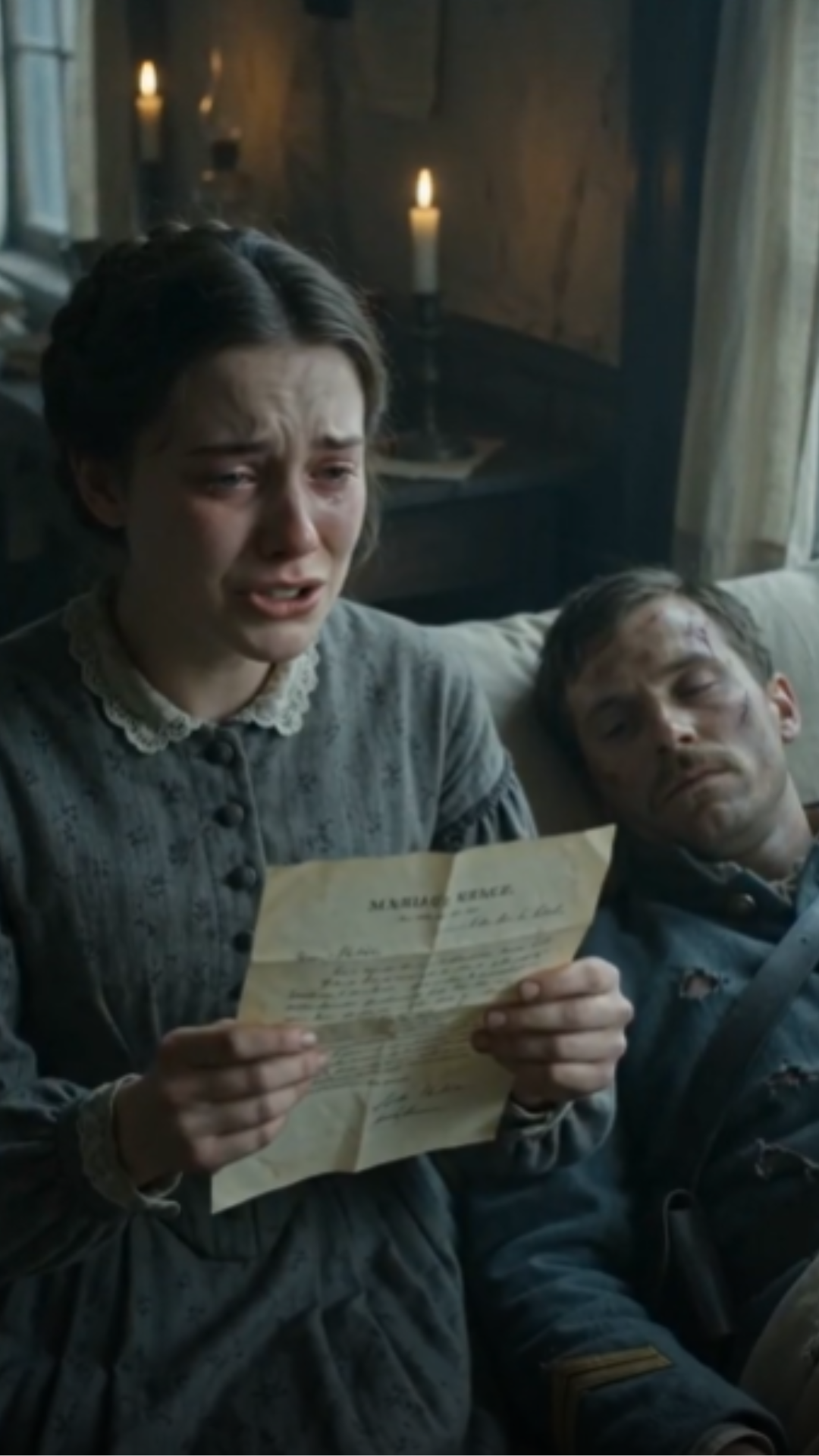
In October 1867, a young woman arrived at my Leavenworth infirmary holding a handwritten marriage proposal from a brain-injured Civil War veteran.


Part 1
Sergeant Thomas Finch stared at her face in complete silence, unable to remember her name or the letter he supposedly wrote two years prior.
Before I could complete my neurological examination, a total stranger named Silas Crain walked into the ward demanding $1,200 in alleged wartime debts.
He produced a land claim threatening to strip Thomas of his post-war homestead and throw him into the county asylum.
I knew then that saving this broken soldier would cost me every single thing I had left in this world.
Martha Gable clutched the yellowed letter in her gloved hands, her knuckles white. She was a slip of a thing, barely twenty-three, and the long journey from Ohio had left its mark in the dust clinging to her simple wool dress.
Her eyes, however, held a fierce, unwavering light as she looked at Thomas.
He sat on the edge of the examination cot, a thin blanket draped over his knees. His gaze drifted past Martha, past me, to a cobweb swaying in the corner of the small, clean ward.
The shrapnel wound that had stolen his memory was starkly visible. A deep, jagged scar bisected his left temple, a testament to the Confederate artillery shell that nearly ended his life.
I gently moved closer to him, my old surgeon’s hands accustomed to such delicate work.
“Thomas,” I said, my voice soft, “do you recognize this young lady?”
He blinked, then slowly turned his head toward Martha. A flicker of something, perhaps mild confusion, crossed his features before settling back into that familiar, distant blankness.
He shook his head, a slight, almost imperceptible motion.
Martha’s breath hitched. She looked at me, a silent plea in her wide eyes.
“And this, Sergeant,” I continued, holding out the letter she had given me. It was dated January 1865, the paper crisp despite its age. “Do you recall writing this?”
Thomas reached out, his fingers clumsy, and took the letter. He held it upside down for a moment, then righted it, his brow furrowed slightly.
He stared at the elegant script, the loops and flourishes that spelled out words of devotion and a promise of a future.
He stared for a long, silent moment.
Then, his gaze lifted to mine, utterly devoid of recognition. He slowly, deliberately, crumpled the paper in his fist.
The action was not violent, but rather the unconscious gesture of a child unfamiliar with the object. He simply did not know what it was.
Martha gasped, a small, choked sound. Tears welled in her eyes, threatening to spill over.
“Sergeant Finch suffered a severe temporal lobe injury,” I explained, my voice low, hoping to soften the blow for Martha. “The shrapnel passed very close to the areas governing memory and language processing. His literacy, particularly regarding anything written in late ’64 and ’65, appears… gone.”
I took the crumpled letter from Thomas’s hand, smoothing it gently. The words, so full of meaning for Martha, were nothing but ink on paper to him now.
A sharp rapping echoed through the quiet infirmary, not on the main door, but on the frame of Thomas’s examination room. I looked up, startled.
A man stood there, silhouetted against the afternoon light from the hallway. He was tall, dressed in a sharp, if slightly travel-worn, dark suit. His mustache was neatly trimmed, and his eyes held an unnervingly cold glint.
He didn’t wait for an invitation. He simply stepped into the room, his boots clicking purposefully on the wooden floor.
“Dr. Danforth, I presume?” he asked, his voice smooth and authoritative, yet entirely devoid of warmth. He didn’t introduce himself.
“I am,” I replied, a sense of unease creeping over me. “And you are?”
“Silas Crain,” he announced, as if the name itself carried weight. “And I’m here regarding Sergeant Thomas Finch.”
He didn’t spare Martha or Thomas a glance. His attention was solely on me, his gaze demanding.
“Thomas is a patient here, Mr. Crain. He requires rest and careful treatment.”
Silas Crain scoffed, a dismissive sound.
“He owes me twelve hundred dollars, Doctor. A debt accrued during his gambling spree in Nashville back in ’63.”
My jaw tightened. Thomas had been comatose in a field hospital in Georgia for much of 1863, recovering from a near-fatal head wound.
“That’s impossible, Mr. Crain. Sergeant Finch was gravely wounded and unconscious in a field hospital during that period.”
Crain’s smile was thin, humorless. He reached into the inside pocket of his coat and pulled out a folded document. The paper crackled as he unfolded it, revealing an official-looking seal.
“It seems Sergeant Finch was more mobile than you recall,” he said, pushing the document across my examination table. “This is a notarized claim on his homestead. One hundred and sixty acres of prime Kansas prairie, Doctor.”
He paused, letting the words hang in the air.
“Either he settles his debt, or the land is forfeit. And without his land, I’m afraid the county asylum is the only suitable place for a man of his… condition.”
Part 2
Silas Crain watched me, his expression unreadable. He held my gaze for a moment, then reached into his coat again.
He pulled out another document, this one a heavier parchment, folded precisely and sealed with a thick red wax.
“Perhaps this will clarify matters,” he said, his voice as smooth as polished stone.
He placed it on the examination table, directly over the crumpled marriage proposal. My eyes fell on the bold script at the top: “Territorial Land Deed.”
“Sergeant Finch signed over his one hundred and sixty-acre homestead to me in November of eighteen sixty-six,” Silas stated. “Voluntarily, and with full legal witnesses present.”
A cold dread tightened in my chest. November 1866.
I knew that month. I knew it intimately.
“That’s not possible,” I murmured, more to myself than to him.
My gaze flickered to the small medical cabinet against the far wall. Inside, tucked beneath jars of tinctures and rolls of bandages, lay my personal patient logbooks.
Every entry, every recovery, every setback, meticulously recorded in my own hand.
I walked to the cabinet, my boots quiet on the wooden floor. Silas Crain did not move, but his eyes followed me.
I pulled out the leather-bound book marked ‘1866’. Its pages smelled of lamp oil and dried herbs.
Flipping through, my finger found the date: November 14th, 1866. Thomas Finch’s name was clearly inscribed.
The entry was stark. “Sgt. Thomas Finch. Ward 3. Recurrent fevers. Non-verbal. Paralysis in dominant hand.”
I closed the book, a sharp, metallic click echoing in the room.
I turned back to Silas Crain, the logbook held tightly in my hand.
“Mr. Crain,” I said, my voice low but firm. “On November fourteenth, eighteen sixty-six, Thomas Finch was bedridden. He was non-verbal. His dominant hand was paralyzed. He could not have held a pen, let alone signed this deed.”
Martha gasped again, a fresh wave of tears in her eyes. Thomas continued to stare blankly at the wall.
Silas Crain’s thin smile did not falter. He simply shrugged, a subtle, dismissive movement of his shoulders.
“Medical records, Doctor, are often open to interpretation. Especially old ones.”
He picked up the forged deed from the table, refolding it with deliberate slowness.
“I have a notarized document. You have a ledger. The law knows which one holds more weight.”
He paused, his cold eyes sweeping over Thomas, then Martha, then back to me.
“I will return to Leavenworth tomorrow,” he announced.
“And when I do,” he continued, his voice dropping, “I’ll bring the county deputy. We’ll have a commitment order for Sergeant Finch. He’ll be in the territorial asylum by sundown.”
More Stories







+ There are no comments
Add yours