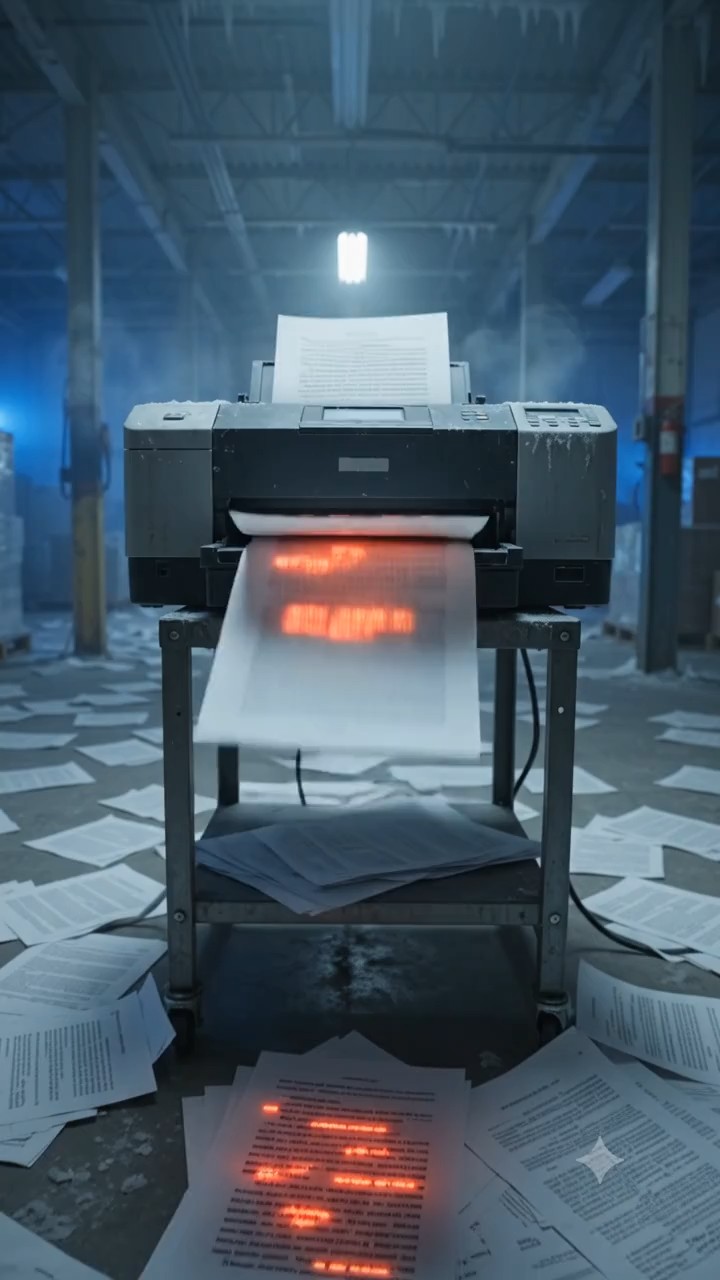
PHOTOS IN THE DARK


The freezing rain off Puget Sound felt like crushed ice against Toren’s raw, feverish skin. He stumbled down the slick asphalt of Elliott Avenue, his boots heavy, his body shivering violently as his central nervous system fought off the lingering paralysis of Dr. Judith Thorne’s psychotropic cocktail.
His vision still swirled with faint, nauseating chromatic aberrations—halos of electric blue and violent magenta bleeding from the streetlights. But inside his chest, a cold, desperate clarity had taken root.
Data did not lie. Even if his own mind had been hijacked, even if his own hands had been forced to wipe his digital footprint while in a somnambulistic trance, physical servers required physical power. Digital transmissions required physical nodes.
Slumping into the recessed doorway of a closed seafood market, Toren pulled his hardened forensic tablet from his storm jacket. His fingers, still stiff from the nerve agent, tapped out a raw hex command on the touchscreen. Before leaving Judith’s office, he had executed a background packet-sniffing script, hijacking her terminal’s active telemetry.
A single, hidden outbound connection had pinged every three minutes from Judith’s desktop, routing data through an encrypted onion network to a fixed, hardwired IP address located in the industrial shipyards of South Seattle.
Pier 42. Abandoned Warehouse 17.
Toren wiped a mixture of sweat and rain from his eyes, ducked into an unattended alley behind a logistics depot, and hotwired a rusted 2012 Ford F-150 utility truck using his forensic bypass lead. The engine roared to life with a hollow, rattling cough. He slammed the gear shift into drive, spinning the tires against the wet pavement as he surged toward the docks.
Pier 42 loomed out of the Pacific Northwest fog like the skeleton of an ancient sea beast. Rusty corrugated steel sheets groaned against the gale-force winds. The smell of salt, rotting timber, diesel, and decaying marine life hung heavy in the air.
Toren cut the truck’s headlights two blocks away, coasting the last hundred yards in total darkness before parking behind a rusted shipping container. He stepped out into the mud, pulling a heavy steel prybar from the truck’s bed.
Warehouse 17 stood isolated at the very edge of the pier, its pier pilings creaking rhythmically over the churning, black sea below. The main sliding doors were chained shut with heavy steel links, but a narrow pedestrian access door around the western perimeter stood slightly ajar, swinging an inch back and forth in the wind.
Toren eased the prybar into his belt, pulled his tactical penlight, and stepped across the threshold.
The interior was a cavernous, pitch-black cathedral of decaying industrial machinery. Massive overhead cranes hung suspended like dormant mechanical spiders. Dust motes and sea mist danced through the narrow beam of his light.
Then, Toren heard it.
It was not the wind. It was not the ocean.
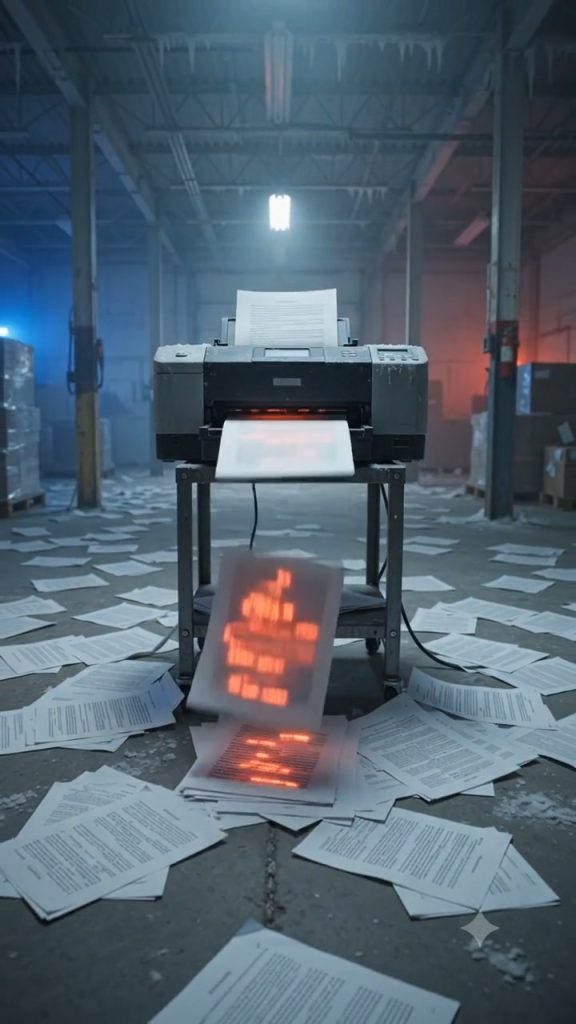
It was the high-pitched, rhythmic whir-click-clack of a industrial-grade laser printer running at maximum speed.
The sound echoed from the far corner of the warehouse, inside a converted glass-walled office structure elevated ten feet above the concrete floor.
Toren crept up the rusted iron staircase, his boots making no sound against the steel treads. He pushed open the office door.
The room was freezing. In the center of a heavy wooden drafting table sat a massive, commercial-grade HP Enterprise laser printer, powered by an external diesel generator humming quietly in the corner. Green LED lights flickered wildly as the machine spat out page after page of crisp, white 20-pound paper.
The floor surrounding the table was buried beneath an avalanche of printed sheets—hundreds of manuscript pages fluttering in the cold draft.
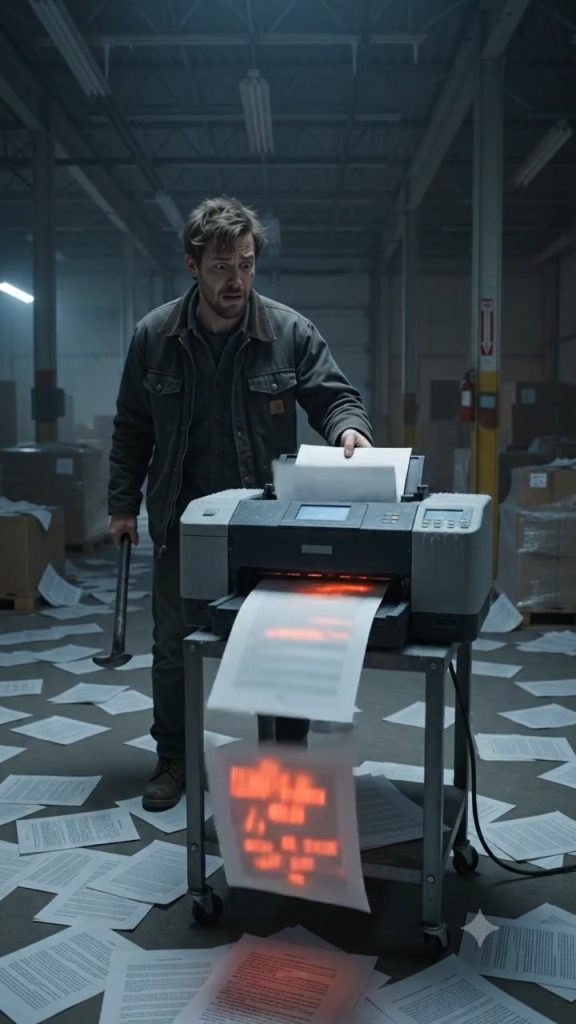
Toren stepped onto the paper, his penlight illuminating the bold text printed across the top of the nearest sheet: CHAPTER 33: THE FINAL DRAFT.
He knelt, picking up three consecutive pages from the top of the output tray. His eyes scanned the text. His heart stopped dead in his throat.
The manuscript was written in Vesper’s signature, chillingly descriptive prose. But it was not fiction.
“There is an unnumbered page in the manuscript, explicitly stating: ‘As Toren reads these words, the killer stands directly behind him with a length of garrote wire.'”
Toren’s blood turned to liquid nitrogen. His body reacted before his conscious mind could process the terror.
He didn’t turn around. He threw his weight forward, diving over the drafting table just as a thin, braided steel wire whipped through the air where his throat had been a millisecond prior. The wire caught the edge of the heavy desk lamp, snapping the steel armature in half with a deafening crack.
Toren hit the hardwood floor, rolled through a pile of loose manuscript pages, and kicked backward with all his strength. His heavy boot connected solid with a knee joint. A grunt of pain echoed through the dark office as a shadow stumbled backward into the glass wall.
Toren scrambled to his feet, flashing his penlight directly into his attacker’s face.
Standing in the doorway, wearing a heavy dark rain poncho, holding a pair of handles attached to a blood-stained garrote wire, was a tall, broad man. But as the white light hit his features, Toren gasped.
The man was wearing a high-grade silicon theatrical mask—a terrifying, hyper-realistic replica of Toren’s own face.
“Who the hell are you!” Toren yelled, lunging forward with the steel prybar he yanked from his belt.
The masked figure didn’t speak. He stepped back with shocking speed, ducking out of the elevated office and vaulting over the iron railing down to the main warehouse floor below. By the time Toren reached the balcony, the figure was already sprinting into the dark maze of shipping crates, his boots slapping against the damp concrete before vanishing into the night.
Toren stood on the balcony, his lungs gasping for air, his hands shaking so violently he nearly dropped his penlight.
Up in the office, the laser printer clicked violently again, spitting out another batch of fresh pages.
Toren turned back into the office. He picked up the newest pages emerging from the tray. The ink was still warm to the touch.
The text on the fresh page read:
“Fresh blood spatters from the machine as the warm ink prints the truth: ‘When the trunk springs open, Toren will look down into the dark and see his own face staring back from the rotting corpse.'”
Toren stared at the words, a cold sweat breaking out across his forehead.
The manuscript wasn’t just documenting what had happened. It was predicting what he was about to do. It was guiding him step-by-step toward a trap built inside this very building.
He slowly walked out of the office, descended the rusted iron stairs, and walked toward the deepest, darkest corner of Warehouse 17.
There, parked directly over a drainage grate in the floor, sat an abandoned, mud-splattered 2019 Ford Explorer. The vehicle belonged to the Hayes estate—a utility car Vesper had bought two years ago and claimed to have sold to a private buyer.
The vehicle’s rear tires were flat. Rain dripped from a hole in the corrugated roof directly onto the vehicle’s dark-tinted rear windshield.
Toren stepped toward the back of the SUV. The electronic latch was dead. He jammed his steel prybar into the seam between the rear hatch and the bumper, leaning his entire body weight into the lever.
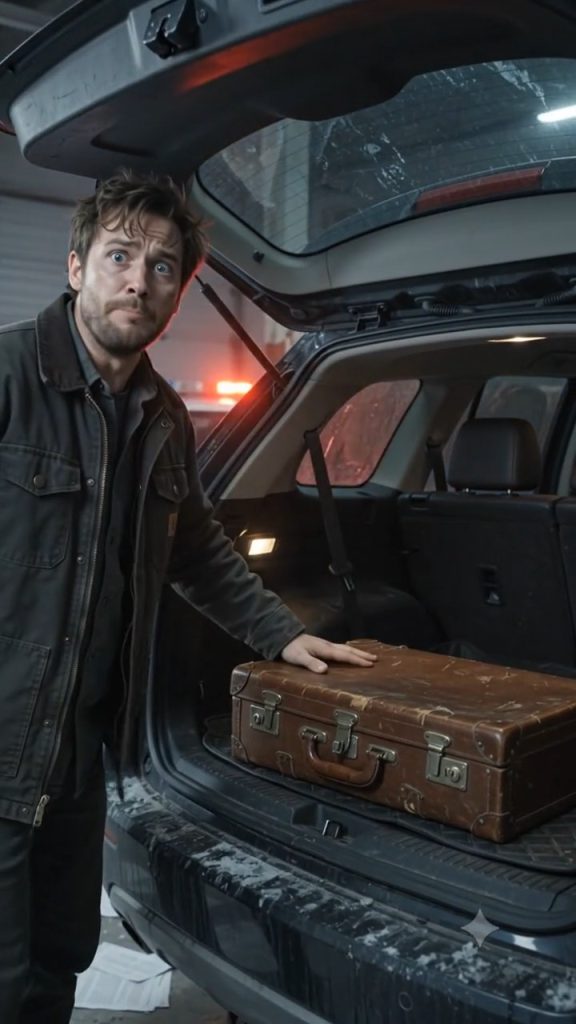
With a sickening screech of tearing metal, the lock mechanism snapped. The rear hatch swung upward automatically on its hydraulic struts.
A wave of overwhelming, putrid decay exploded into the cold air—the stench of rotting human tissue, copper, and advanced decomposition.
Toren raised his flashlight beam into the dark cargo bed.
Lying inside a shredded black canvas tarp was the swollen, decaying body of a woman. Her face had been methodically, savagely mutilated—racked with deep, systematic blade cuts that rendered her facial features completely unrecognizable.
Her hands were bound with zip-ties. But on her left ring finger, gleaming brightly beneath the flashlight beam, was a platinum band set with a cushion-cut diamond—Vesper’s exact engagement ring.
Toren stepped closer, his stomach heaving as he forced himself to perform a forensic inspection. He lowered the beam to the corpse’s torso. The victim wore a dark green cashmere sweater—the exact sweater Vesper had worn the night she disappeared.
And right beneath the hem of the sweater, on the lower right abdomen, was a neat, five-inch surgical scar from a appendectomy, accompanied by a dark, star-shaped birthmark directly above the left breast.
“The face of the corpse was shredded beyond recognition, but the appendectomy scar and the birthmark on her chest confirmed it 100%: This is Vesper!”
Toren fell back against a steel pillar, his hands flying to his hair. “No… no, no, no…”
Vesper was dead. She wasn’t alive in the basement. She wasn’t in Nam America. Her rotting body was sitting in the trunk of his own car in an abandoned warehouse.
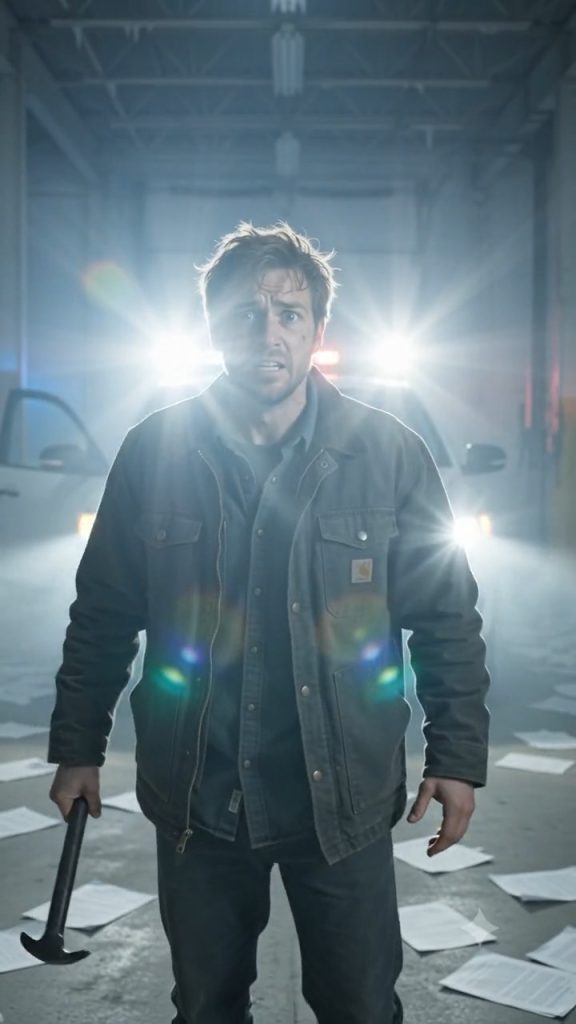
Before the thought could process in his mind, blinding floodlights suddenly shattered the darkness of Warehouse 17.
“SEATTLE POLICE! DROP THE WEAPON! GET ON THE GROUND NOW!”
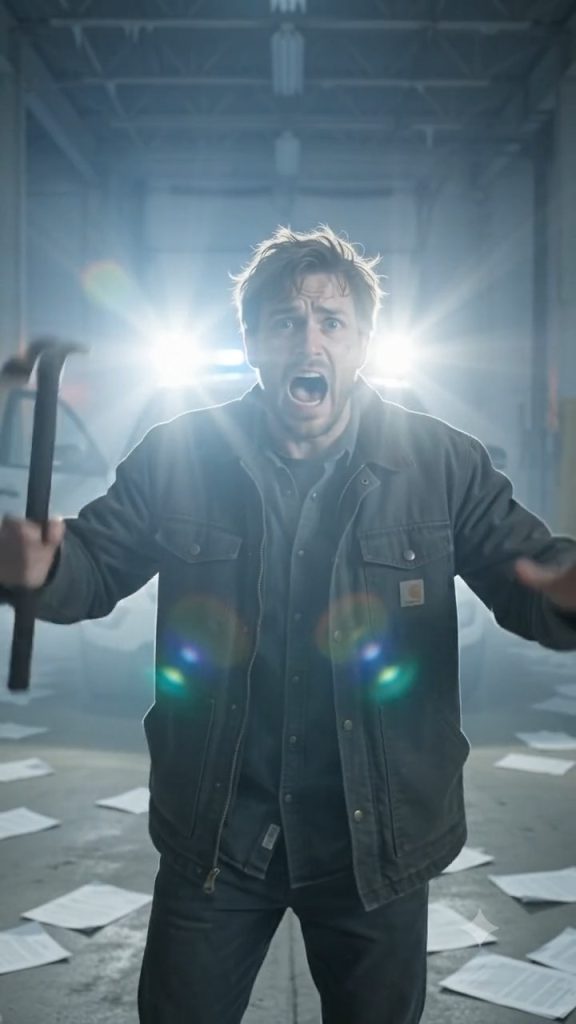
High-lumen tactical halogen beams erupted from every doorway, sweeping across the concrete floor and locking directly onto Toren’s chest. The sudden wall of white light blinded him, casting long, grotesque shadows of the open SUV hatch and the rotting corpse inside against the rusted corrugated walls.
“Drop the iron bar! Hands on your head! Do it now!”
Tactical boots thundered against the concrete from all sides as a dozen armed officers from the Seattle Police Department SWAT unit moved in a tight, overlapping firing arc. Behind them, stepping through the broken pedestrian door with his trench coat billowing in the sea draft, was Detective Vance Callahan.
Callahan held a heavy SIG Sauer P226 drawn and leveled steadily at Toren’s forehead. His weathered face was illuminated by the red laser sight dancing on Toren’s jacket.
“End of the line, Hayes,” Callahan growled, his voice echoing off the high steel rafters. “You ran out of digital tricks.”
Toren didn’t drop the prybar immediately. He stood frozen beside the open trunk, the putrid stench of the decaying corpse filling his nostrils, his tablet still clutched in his left hand.
“Callahan, listen to me!” Toren shouted, his voice hoarse. “Look at the printer up in that office! Look at the manuscript! Someone lured me here! The GPS coordinates were routed through Judith Thorne’s server!”
Callahan didn’t even glance toward the elevated glass office. He stepped forward, his eyes cold, his thumb flicking the safety off his weapon.
“We tracked your stolen utility truck straight from the medical building on 4th Avenue, Hayes,” Callahan said, nodding to two officers who lunged forward. “You broke into your wife’s therapist’s office, assaulted her, and then ran straight to the warehouse where you stashed Vesper’s body three days ago. You came back to burn the evidence, didn’t you?”
The officers slammed Toren face-first against the cold, wet concrete floor. The prybar clattered away. A heavy boot pinned his shoulder down as his arms were wrenched violently behind his back, the steel handcuffs biting deep into his wrists with a cold, definitive click.
“I didn’t kill her!” Toren screamed into the concrete, feeling the grit and salt-water soaking into his cheek. “Check the timestamp on that printer! Check the DNA on the body! That car was sold two years ago!”
“Save it for the grand jury,” Callahan sneered, stepping up and kicking Toren’s tablet across the floor. He knelt down, pulling a pair of latex gloves onto his hands, and reached into the trunk. He pointed a flashlight at the corpse’s abdomen, highlighting the appendectomy scar and the star-shaped birthmark.
Callahan turned to the forensic team entering the crime scene with black evidence kits. “Bag the hands. Secure the vehicle. We have positive visual identification. The victim is Vesper Hayes. Subject Toren Hayes is under arrest for aggravated murder in the first degree.”
Three hours later. Seattle Police Headquarters, Downtown Precinct.
Toren sat chained to a heavy steel ring bolted to the center of a stainless steel interrogation table. The room was freezing, lit by a single flickering fluorescent panel overhead. The one-way mirror on the wall reflected his own hollow, exhausted face—dark circles under his eyes, skin pale from the lingering psychotropic agent, blood dried on his neck.
The heavy steel door swung open. Callahan walked in, tossing a thick blue manila folder onto the table. He didn’t sit down. He leaned over the table, resting his heavy palms on the steel surface, staring down at Toren with a look of pure, triumphant disgust.
“You thought you were the smartest guy in the room, didn’t you, Toren?” Callahan rasped. “The brilliant forensic data analyst who knew every blind spot in the state’s surveillance grid. You thought if you mutilated her face, we wouldn’t be able to match dental records.”
“I am innocent, Vance,” Toren said quietly, his voice hollow. “Look at the physical evidence. Look at the printer in Warehouse 17. The manuscript was generating in real time. How could a dead woman write a book describing me standing over her trunk?”
Callahan let out a harsh, dry bark of laughter. “That’s your defense? A magic printer? Our tech team wiped that printer. It was running a simple scheduled script off a remote cloud server—a publicity stunt Vesper set up for her upcoming book launch before you put a knife through her chest.”
Callahan tapped the blue folder. “Every piece of forensic evidence we pulled from Warehouse 17 points directly to your hands, Toren. Your fingerprints are on the trunk latch. Your boot prints are in the mud surrounding the Explorer. Your DNA was found under the victim’s fingernails—matching those fresh scratches on your throat. The prosecutor is already filing for the death penalty.”
Toren closed his eyes. The room seemed to tilt. The chemical fog in his brain fought against the overwhelming wall of manufactured evidence. She planned this. Vesper built every single layer.
Suddenly, the door opened again. A junior detective stepped inside, looking pale, holding a fresh white fax printout from the King County Medical Examiner’s Office.
He leaned over and whispered urgently into Callahan’s ear, handing him the page.
Callahan’s smug expression flickered. His icy blue eyes scanned the black text on the page, his brow furrowing into a tight, disbelieving knot.
“Are you sure about this?” Callahan demanded, his voice dropping an octave. “Did Dr. Aris run the rapid PCR assay twice?”
“Three times, Detective,” the junior officer whispered, glancing nervously at Toren. “The lab rushed the tissue sample from the victim’s femur because of the high-profile nature of the case. The results just came back from the state database.”
Callahan snatched the paper, reading it again. His jaw twitched violently.
Toren raised his head, his forensic instincts instantly piercing through his exhaustion. “What is it, Callahan? What did the ME find?”
Callahan slowly turned his head toward Toren. For the first time since the night began, the detective’s unshakable confidence cracked, revealing a flash of deep, unsettling confusion.
He slammed the paper onto the steel table in front of Toren.
“The physical markers matched,” Callahan muttered, his voice barely audible. “The ring, the sweater, the appendectomy scar, the birthmark… even the height and blood type were identical.”
Toren leaned forward as far as his cuffed hands would allow, scanning the medical report.
The rapid DNA extraction report showed a 0.00% match to Vesper Hayes’s reference profile on file with the national database.
The victim in the trunk was not Vesper.
The corpse belonged to Jane Doe—an unidentified, homeless woman abducted from the alleyways of South Seattle three weeks prior. She had been subjected to precise plastic surgery, surgical scar grafting, and cosmetic tattooing to transform her body into a 100% physical duplicate of Vesper Hayes before being murdered and dumped in Toren’s car.
Vesper Hayes was still alive.
She had murdered an innocent woman, carved her own identity onto a stranger’s corpse, and staged her own physical death—closing the final lock on a trap that would send her husband to the gallows for a murder that never took place.
More Stories










+ There are no comments
Add yours