
After 22 years and a kidney donation, I overheard my husband giving our house to his mistress.


The legal battle over Daniel’s hidden assets was a grinding, exhaustive process. His legal team, well-funded and aggressive, fought back at every turn, filing counter-motions, delaying disclosures, and attempting to paint me as an embittered, manipulative wife. The financial sabotage had now fully escalated into an all-out war of attrition.
Then came the subpoena for my medical records. Daniel’s lawyers, in their relentless pursuit to discredit me, claimed my health history was relevant to my “stability” and “capacity” to manage assets. It was a transparent tactic, echoing Daniel’s earlier lies to Bethany, but it hit a nerve. My past was a closed book, a chapter I had painstakingly sealed away.
I knew, logically, that they would find something. My childhood had been a landscape of struggle, a stark contrast to the comfortable life Daniel and I had built. I had always been fiercely private about it, unwilling to let that past define my present or future.
Ms. Evans had warned me. “They’re going to dig. They’re going to try and find anything to make you look bad, to undermine your credibility. Your medical history, your financial history – anything.”
The court ordered the release of my records. I braced myself.
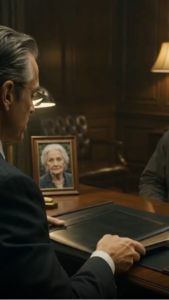
The package arrived at Ms. Evans’s office – a thick file, sealed and official. When I sat across from her, she looked at me with a new, quiet understanding.
“Evelyn,” she began, her voice gentle, “your medical records… they reveal a difficult past.”
I nodded, my throat tight. “I know.”
“It seems you suffered from a severe, undiagnosed autoimmune condition in your youth,” she continued, her eyes searching mine. “It led to chronic kidney issues, among other complications. And… a significant period of extreme poverty and hardship.”
The words hung in the air, clinical and detached, yet they laid bare the scars I had carefully hidden for decades. Growing up, my mother had worked three jobs, but it was never enough. My frequent illnesses, the hospital visits, the mounting medical bills—they had plunged us deeper into debt, into a cycle of precarious living. I remembered nights spent shivering in unheated apartments, the constant ache in my side, the gnawing fear that I was a burden. I had overcome it all through sheer grit, working my way through college, putting myself through night school, meticulously caring for my health, forging a new life brick by painstaking brick.
“I overcame it,” I said, my voice barely a whisper. “I worked my way out of it. I never wanted anyone to know.”
“You did,” Ms. Evans affirmed, her tone full of respect. “Your records show remarkable resilience. Years of diligent medical care, strict diet, consistent follow-ups. You managed what could have been a lifelong disability with incredible discipline.”
But Daniel had known some version of this. He had known about my fragile health as a child, though not the full extent, not the specifics of the kidney issues. He had leveraged that vague knowledge, twisted it, to create his narrative of my “instability.” He had taken my deepest vulnerability, my history of hardship, and used it as a weapon against me.
“He used it,” I stated, the realization hitting me with sickening clarity. “He used what he knew about my past, my childhood health problems, to tell Bethany I was ‘unstable.’ To explain away why I might challenge the transfer. To justify his manipulation.”
Ms. Evans closed the file. “It’s a classic tactic. Take a kernel of truth, distort it, and use it to undermine your opponent. But in your case, it backfires on him completely.”
“Backfires?” I asked, confused.
“Think about it, Evelyn,” she explained. “You, someone with a history of chronic kidney issues, someone who diligently managed their health for decades to keep those issues at bay, chose to donate one of your kidneys to your husband. That is an act of extraordinary selflessness, particularly given your medical history. It makes his betrayal, his attempt to defraud you while you were recovering from that immense sacrifice, exponentially worse.”
The full weight of my sacrifice, once a private act of love, now shone under the harsh light of legal scrutiny. My kidney donation wasn’t just a simple act of a wife for her husband; it was an act of profound courage, a risk that someone with my history should never have taken, a testament to my fierce loyalty. Daniel, knowing this, had still tried to plunder my life savings and seize our home. The depth of his depravity felt boundless.
“He knew,” I murmured, my eyes fixed on a spot on the wall. “He must have known the risk I was taking, even if he didn’t know the full medical details. He knew my kidneys were always a concern.”
“Exactly,” Ms. Evans said gently. “And yet, he orchestrated this elaborate financial scheme. He pushed for expedited surgery, then tried to transfer your home and hide millions. It speaks to a level of calculated malice that will be very difficult for his defense to overcome.”
The pain of my childhood, the fear of never being well, the constant struggle to rise above poverty—all of it resurfaced. But this time, it was not a source of shame. It was a testament to my strength. And Daniel, in his attempt to weaponize it, had only amplified the moral reprehensibility of his actions.
“So, what do we do with this information?” I asked, a new resolve setting in. “Does it become public?”
“It may have to,” Ms. Evans replied. “If he continues to fight, if he continues to try and paint you as unstable, we will use this to highlight the true nature of your sacrifice and his betrayal. It becomes powerful evidence of his character and his motives.”
The thought of my deeply personal history, my long-held secret, being exposed in court, laid bare for public consumption, was unsettling. But the alternative – letting Daniel win, letting him get away with his calculated cruelty – was worse.
“Then we use it,” I decided, my voice firm. “We show everyone who he truly is.”
My hidden past, once a source of quiet resilience, now became a shield, a weapon. Daniel’s attempt to use it against me had ironically strengthened my case, making his betrayal not just an act of infidelity and greed, but a profound violation of trust and an exploitation of the most selfless act one human could perform for another. The price of that kidney donation, the hidden price of my own chronic health issues, suddenly amplified the stakes of the entire legal battle. It was no longer just about retrieving money; it was about reclaiming my narrative, demonstrating the depth of his calculated cruelty against my profound, resilient strength.
More Stories







+ There are no comments
Add yours