
Small town, big secrets: My mother and sister tried to have my daughter removed, but fate had other plans.


I sent out the invitations for a special town meeting with a carefully worded notice: “A Discussion on Local Family History and Community Welfare.” It was vague enough to pique curiosity, but non-threatening enough that Beatrice and Lydia, confident in their power, would surely attend. I needed them there, in front of the whole town. This couldn’t be a private confrontation.
The old town hall was packed. Every chair was taken, and people stood along the back walls, their faces a mix of curiosity and thinly veiled judgment. Mayor Thompson sat at the head of the long table on the raised platform, flanked by council members. Beatrice and Lydia were seated prominently in the front row, radiating an air of composed superiority, their expressions subtly challenging me to speak. Old Mrs. Albright sat a few rows back, her keen eyes fixed on me. Silas Croft was conspicuously absent, by my design.
I stood at the podium, my heart a drum against my ribs, but my voice was steady. “Good evening, everyone. I’ve called this meeting because there are matters of deep importance to our community’s trust and history that need to be brought into the light.”
I started by outlining the events of the past few weeks: the police being called on Maya, the accusations of my being an “unfit mother.” As I spoke, murmurs rippled through the room. Beatrice leaned forward, her lips thinning, but she remained silent, for now.
“These accusations,” I continued, “are not new. In fact, they echo a pattern that goes back decades in my own family, touching upon the very foundations of trust and property ownership in our town.”
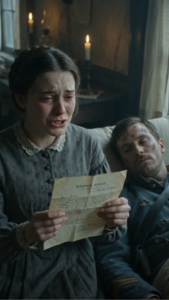
Then, I presented the letter. I held it up, carefully, for everyone to see. “This is a letter, meticulously preserved, written by my paternal grandmother, Elizabeth Finch, to my grandfather, Arthur, decades ago.”
I paused, letting the weight of the old document settle. “In this letter, she details a calculated scheme by Beatrice Finch to declare my father, Arthur Finch Jr., financially incompetent. The goal? To seize control of the valuable family orchard property.”
A gasp went through the room. Beatrice’s face flushed crimson, and Lydia shot me a furious glare.
“This scheme,” I stated, my voice clear and unwavering, “involved a young, then-impressionable notary, Silas Croft, who was coerced into drawing up dubious documents.”
Another wave of murmurs, louder this time. Silas Croft’s name, linked to such a scandal decades ago, was a shock to many.
“This letter,” I went on, “also reveals how Beatrice created a false narrative around my father – that he was ‘unstable,’ ‘incapable of managing his affairs’ – precisely the same accusations now being leveled against me.”
Beatrice suddenly erupted. “This is outrageous! A forgery! Lies, Elara! You’re deranged, just like your father! You’re making this up because you’re angry!”
Lydia chimed in, her voice shrill. “She’s unstable! You can all see it! This is just a pathetic attempt to deflect from her own failings as a mother!”
“Silence!” Mayor Thompson commanded, banging his gavel. He looked at Beatrice, then at me, his expression conflicted. He’d known Beatrice for decades, trusted her implicitly.
“And now,” I continued, ignoring their outbursts, “the full truth of their malice. Just last week, Beatrice and Lydia again pressured Silas Croft – the very same notary – to finalize a *new* deed transfer for that *exact same family orchard*. Using remarkably similar, fabricated documents. To explicitly cut me out, and to further discredit me to this community.”
Before Beatrice and Lydia could launch into another furious denial, Silas Croft, who had slipped quietly into the back of the room, stepped forward. He was pale, his shoulders slumped. “It’s true,” he whispered, his voice trembling but audible in the sudden, shocked silence. “I… I was pressured. Again. I drew up the papers. They threatened me.”
The room erupted. Whispers turned into indignant exclamations. Beatrice and Lydia screamed over the din, their carefully constructed composure finally shattering. “He’s lying! She’s lying! It’s all a conspiracy!”
“This letter is a fake!” Beatrice shrieked, pointing a trembling finger at the document in my hand. “It means nothing! Elara is desperate!”
Just as the argument reached a deafening peak, as Beatrice’s voice rose to a hysterical crescendo, the large, ornate window overlooking Main Street suddenly burst open with a powerful, inexplicable gust of wind. It wasn’t just a breeze; it was a violent, unseen force that ripped through the room. Papers scattered from tables, fluttering like startled birds, and a momentary, shocked silence descended as everyone instinctively ducked or gasped.
The very air seemed to hold its breath.
Then, through the chaos, a single piece of paper, the *original, fragile, restored letter* from my grandmother, caught in the sudden vortex, soared through the air. It landed with an almost ethereal grace, not on the floor, not on some random table, but squarely, undeniably, in the lap of Mayor Thompson.
His eyes, wide with disbelief, immediately fell upon the faded ink. The critical passage detailing Beatrice’s manipulation of his friend Arthur Jr., and Silas Croft’s complicity in the orchard scheme, was clearly visible, magnified by the dramatic circumstances. The Mayor, who had always implicitly trusted Beatrice’s “upstanding” reputation, slowly looked up at her, his face draining of all color. His expression was a horrifying blend of profound betrayal and dawning realization.
Beatrice’s indignant protests died in her throat, cut short by the Mayor’s gaze. The silence that followed was absolute, weighted with the undeniable truth that had literally landed in the town’s lap.
More Stories







+ There are no comments
Add yours