
Her children abandoned her after heart surgery, then tried to steal her company – until a man from her past intervened.


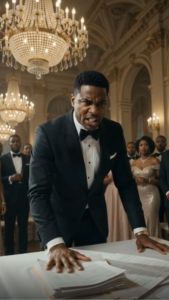
The air in the Jennings Properties boardroom was thick with an uneasy tension. This wasn’t a typical board meeting; it was a showdown. Clara sat at the head of the polished mahogany table, Elias Thorne at her side. Across from them sat Mark, flanked by his own lawyers, his face carefully impassive. Sarah was conspicuously absent. Rick Patel, along with two other long-time board members, looked uncomfortable, their gazes darting between the two opposing sides.
Elias had opened the proceedings by detailing Mark’s coercion of Mr. Davies, presenting irrefutable evidence. He then methodically laid out the altered Articles of Incorporation, demonstrating how Mark had systematically weakened the company’s protections. The offshore accounts, the rapid asset stripping—all presented with cold, hard facts. Mark’s lawyers had stammered, offering weak denials.
Then, Elias cleared his throat, a silence falling over the room. He picked up a plain manila folder.
“We have one final piece of evidence,” Elias announced, his voice carrying weight and authority. “One that brings to light the true motivation behind Mr. Jennings’s relentless pursuit of this conservatorship and his prior corporate maneuvers.”
He looked directly at Mark, whose face remained a mask, though a flicker of something unreadable passed through his eyes.
“Following a persistent hunch from Ms. Henderson,” Elias continued, gesturing to Beatrice, who sat quietly beside Clara, “my team revisited Arthur Jennings’s private legal files. Not the corporate ones, but his personal estate planning.”
He paused for dramatic effect.
“We uncovered a sealed document. A codicil to an earlier will, dated from the same period as the secret trust Ms. Henderson discovered.”
Clara felt a jolt. The secret trust. It had been nagging at her, an unanswered question.
“This document,” Elias stated, holding it aloft, “explicitly states a condition for Mark Jennings’s inheritance of any significant portion of Jennings Properties. It mandates proof of biological relation to Clara Jennings.”
A collective gasp rippled through the boardroom. Rick Patel shifted uneasily in his seat, his eyes wide with shock. Mark’s lawyers immediately objected, their voices rising in a frantic chorus.
“Preposterous!” Mark’s lead lawyer declared. “This is a desperate smear tactic!”
“On the contrary,” Elias countered, his voice like steel. “This document was legally executed, signed, and sealed by Arthur Jennings himself. It casts serious doubt on the legitimacy of Mr. Jennings’s claims as a direct heir through Clara Jennings, which forms the basis of his conservatorship petition.”
He looked at the judge, who was presiding over the conservatorship hearing remotely via video conference.
“Your Honor, given the explicit terms of this document, we formally request an immediate court order for a DNA test between Clara Jennings and Mark Jennings. This is crucial to determining the validity of his claims over this company.”
The judge, a stern-faced woman named Justice Albright, listened intently. After a brief deliberation, she granted the order. The room erupted in hushed whispers. Mark sat frozen, his carefully constructed composure finally cracking, a muscle twitching in his jaw.
The DNA tests were conducted swiftly, under court supervision. The next day, the results, sealed and highly confidential, were delivered to Justice Albright. She reviewed them, then sent an electronic copy to all legal teams involved, including the Jennings Properties board members who were present for the hearing’s continuation.
Clara’s heart pounded as she watched Elias open the digital file. His face, usually unreadable, showed a momentary flicker of profound empathy. He then looked at Clara and gave a faint, almost imperceptible nod.
Mark, across the table, was already scanning the document. His face went ashen. The blood drained from his cheeks, leaving him utterly colorless. His eyes, fixed on the screen, seemed to glaze over. He didn’t make a sound, but his entire posture crumbled, his shoulders slumping as if under an unbearable weight.
Elias leaned closer to Clara, his voice a low whisper, meant only for her.
“The results are in, Clara. Mark is not your biological son.”
Clara felt a profound emptiness open up in her chest. She had loved Mark, raised him, believed him to be her own. But now, a deeper truth was surfacing.
“He is Arthur’s son,” Elias continued, his voice gentle. “From an affair, many years ago. Arthur brought him home, and you, out of love for Arthur and for the child, agreed to raise him as your own. But there was no formal adoption. The legal paperwork confirms he was never legally adopted by you.”
Clara felt a dizzying mix of emotions: shock, grief, anger, and a strange kind of vindication. Arthur, her beloved husband, had kept this secret from her for a lifetime. He had brought his child from another woman into their home, and she, in her boundless love, had accepted him. But the lack of formal adoption, she realized, was the critical detail, the oversight that now invalidated Mark’s entire claim.
The biological connection was to Arthur, not to her. And the codicil, mandating proof of biological relation *to Clara*, was now an insurmountable barrier.
Justice Albright’s voice, calm and firm, cut through the silence in the boardroom.
“Based on the DNA evidence presented, and the explicit terms of the sealed codicil from Arthur Jennings’s personal estate, this court finds that Mark Jennings does not meet the biological relationship criteria to claim a significant portion of Jennings Properties through Clara Jennings.”
She continued, “Furthermore, his conservatorship petition, predicated on his status as a direct heir through Ms. Jennings, is therefore without merit.”
The judge then turned her attention to Mark, her gaze unwavering.
“Mr. Jennings, do you wish to proceed with your petition, given these findings?”
Mark, still ashen, lifted his head slowly. His eyes, devoid of their usual arrogance, met Clara’s across the table. In them, she saw not anger, but a profound, gut-wrenching shame. A lifetime of insecurity, of hiding, of striving for a legacy he felt was always just out of reach, had suddenly been exposed.
He opened his mouth, but no words came out. He swallowed hard, then looked away, his gaze falling to the polished table.
His lawyer, flustered, leaned in, whispering urgently. Mark simply shook his head, a single, decisive movement.
Then, without uttering a single word, without a glance back at Clara or anyone else, Mark Jennings stood up from his chair. He picked up his briefcase, his movements slow and deliberate, and walked out of the boardroom. He did not formally announce his withdrawal. He did not offer an explanation. He simply left.
His lawyers, after a moment of stunned silence, frantically informed Justice Albright that Mr. Jennings was indeed withdrawing his conservatorship petition and, effectively, resigning from his position on the Jennings Properties board, effective immediately. The judge accepted the withdrawal, concluding the hearing.
The silence that followed Mark’s departure was deafening. The carefully constructed scheme, built on years of deception and manipulation, had crumbled under the weight of a truth he had spent a lifetime hiding. Clara sat there, victorious, but with a new, gaping wound in her heart. The company was saved. But the cost, she knew, was a permanent fracture in her understanding of family, love, and loyalty.
More Stories






+ There are no comments
Add yours