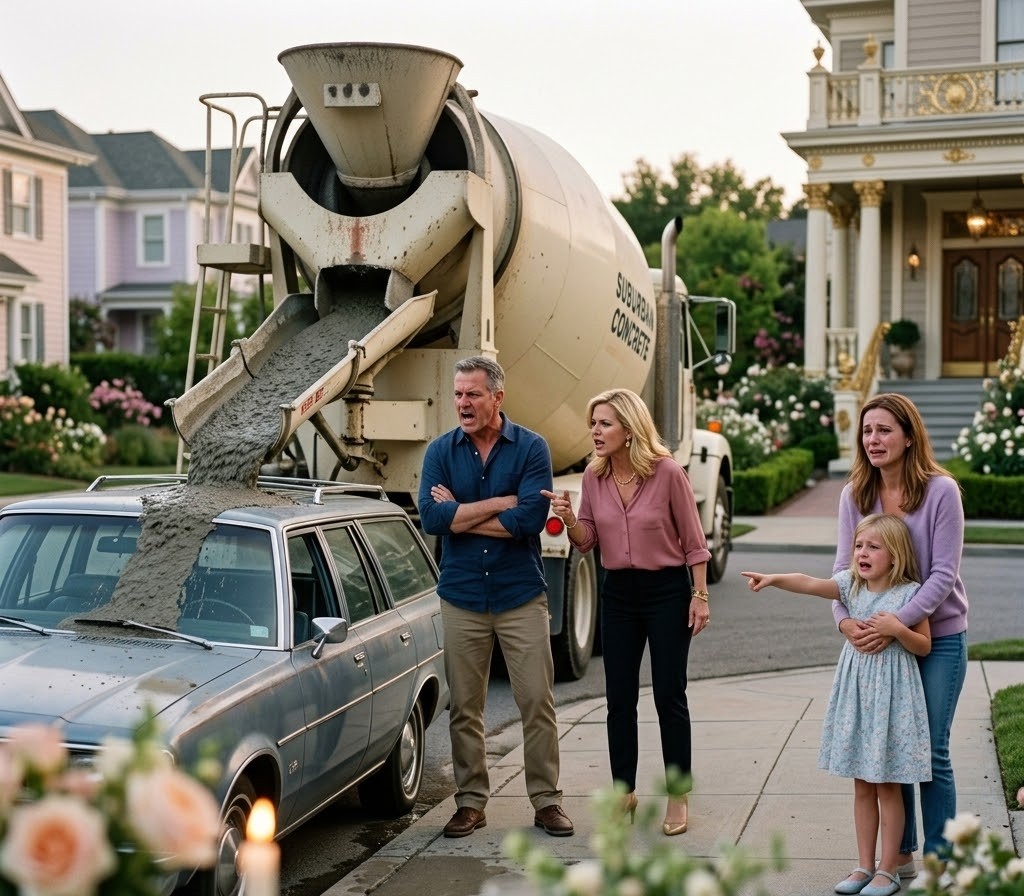
After Her Neighbor Concreted Her Father's Prized Car, a Single Mother Uncovered a Wartime Blackmail Scheme

The drive upstate to the veterans’ care home was long and quiet, filled with a palpable sense of anticipation. The landscape shifted from rolling hills to dense forests, and the lake was long gone from our view. My mind raced, imagining George Davies, wondering what he knew, what he had seen, and if he would even be willing to speak after all these years. Robert drove with his usual calm competence, but I could feel the tension radiating from him too.
The care home was a low, brick building, peaceful and hushed. Inside, the air was warm, smelling faintly of disinfectant and old books. A kind nurse directed us to Mr. Davies’ room. We found him sitting by a window, a thin blanket draped over his knees, gazing out at a small garden. He was frail, his skin papery and translucent, but his eyes, though clouded with age, held a flicker of sharp intelligence.
“Mr. Davies?” I asked softly, stepping into the room.
He turned his head slowly, his gaze settling on us. “Can I help you?” His voice was raspy, thin with age.
Robert introduced us, carefully explaining our connection to Henry Caldwell. At the mention of my father’s name, a faint tremor ran through George Davies’ hand, which was resting on his lap. He looked from Robert to me, his eyes searching.
“Henry,” he murmured, a faraway look in his eyes. “Good man, Henry. What about him?”
“We’re trying to understand some things about his time after the war, Mr. Davies,” I explained, trying to sound as gentle and non-threatening as possible. “Specifically, a veterans’ support group by the lake in 1945.”
George’s gaze darted to the door, then back to us. A flicker of fear, undeniable and profound, crossed his face. He swallowed hard. “That was a long time ago. Some things are best left in the past.”
“We understand that, Mr. Davies,” Robert said, his voice calm and reassuring. “But our father was deeply affected by what happened then. And it seems to be affecting his family even now. We believe Arthur and Patricia Albright were involved.”
The mention of the Albrights seemed to solidify his fear. He closed his eyes for a moment, then opened them, a deep weariness in their depths. “They have long memories,” he whispered, almost to himself. “And long arms.”
“We’re here to protect you, Mr. Davies,” Robert promised, leaning forward slightly. “We’re just trying to find the truth for our father. He deserved peace.”
George looked at me then, truly looking, and saw perhaps a reflection of my father, or simply the desperate plea in my eyes. He sighed, a long, shaky breath. “Henry… he wasn’t himself when he came back from the Pacific,” George began, his voice barely audible. “None of us were. But Henry… he had it bad. The shell shock. Couldn’t sleep, jumped at every sound. Tried to hide it, but we all saw.”
My heart ached. My father had never spoken of “shell shock,” of course, a term now understood as PTSD. He had simply been “quiet” or “moody.” The image of him struggling, alone, was a fresh wound.
“Arthur Albright,” George continued, his voice gaining a fragile strength, “he preyed on that. He knew Henry was vulnerable. Knew he just wanted to retreat to his lake property, find some quiet.”
He paused, collecting his thoughts. “Arthur came to those meetings sometimes, uninvited. Said he was ‘supporting the troops,’ but he was always sniffing around. Asking about land, about timber. Especially Henry’s land.”
“He pressured him?” I asked, a wave of cold anger washing over me. The image of Arthur Albright, a ruthless businessman, circling my vulnerable father like a predator, made my blood boil.
“Ruthlessly,” George confirmed, his voice firming slightly. “He sweet-talked him first, offered him small amounts for logging rights. Then, when Henry was at his worst, barely sleeping, drinking too much to numb the memories… Arthur brought out the papers.”
George’s gaze met mine, steady now. “He made Henry sign over the timber rights to most of the woods around his lake property. Said it was ‘for the future,’ ‘a good investment.’ But Henry was barely coherent some days. He didn’t know what he was signing. Arthur took advantage, pure and simple.”
The words hit me with the force of a physical blow. Arthur Albright had indeed exploited my father, taking his land when he was at his most vulnerable, suffering from the invisible wounds of war. The small, peaceful haven my father had sought was compromised by the very man who now sought to destroy my home. George’s testimony wasn’t just a confirmation; it was a devastating indictment of Arthur’s greed and cruelty. It was a specific, tangible wound, deeply personal, and decades old. The injustice of it all pulsed through me.
More Stories



+ There are no comments
Add yours