
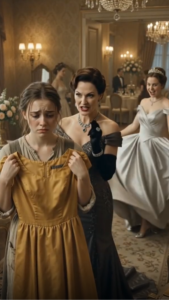
At a lavish Civil War gala, my husband humiliated me, denied our child, and introduced his mistress wearing my mother's necklace — then I exposed his million-dollar wartime fraud.


Silas Grant’s story was a chilling testament to Augustus’s ruthless machinations, a dark mirror reflecting my own recent experience of his betrayal. The parlor, once merely a secluded meeting place, now felt charged with the weight of shared suffering and a burgeoning, dangerous alliance.
“The scheme is elaborate,” Silas began, his voice flat, devoid of emotion as he laid out the details. “Augustus uses his legitimate contracting business as a front. He secures contracts for critical wartime supplies – uniforms, medical provisions, ammunition. He then inflates the costs, sometimes by five or ten times the actual market value.”
He pointed to entries in a ledger I had brought, matching them against his own manifests.
“Once the supplies are acquired, he diverts a significant portion of them. They never reach the Union Army. Instead, they’re sold on the black market, often to Confederate sympathizers, or even just unscrupulous merchants looking to profit from scarcity.”
My blood ran cold. Selling supplies to the enemy? The thought was sickening. It was beyond mere fraud; it was a direct act of sabotage against the very cause he claimed to support.
“The money from these sales, and the hundreds of thousands of Union war bonds he diverts from public drives, is then laundered through a network of shell companies I was forced to establish,” Silas continued, his gaze distant. “Companies under names like ‘S. Grant Enterprises,’ with accounts in neutral European countries – Switzerland, primarily. The money is converted into untraceable assets, diamonds, gold, foreign currency. Ready for his eventual escape.”
He pushed a small, tattered map across the table. It showed sections of Richmond, marked with crude Xs.
“And the Jasper Caldwell properties?” I asked, my voice tight. “How does he factor into this?”
Silas tapped one of the Xs on the map.
“Ah, the land speculation. A clever, albeit small, part of the laundering. He acquires dilapidated properties in war-torn Richmond, using proxies like your cousin Jasper. He injects some of the illicit funds into their ‘renovation’ or ‘improvement.’ The property values are then ostensibly raised, and when they’re ‘sold’ – usually to another shell company or a complicit buyer – the dirty money is transformed into legitimate-looking real estate profits.”
He shrugged, a bitter twist to his lips.
“Jasper Caldwell, bless his simple heart, is a convenient, unwitting pawn. Augustus knows he won’t ask questions. He’ll just be grateful for the sudden windfall, ignorant of the poisoned source.”
The specific, petty cruelty of using an innocent relative, exploiting his naivete for such a treacherous purpose, solidified my hatred for Augustus. He not only stole from the Union but also corrupted the lives of those around him, turning them into unwitting accomplices or tools. Jasper’s new carriage and tasteless renovations, Aunt Clara’s description of his changed demeanor, now painted a picture of a man unwittingly tangled in a web of treason.
“So, he’s committing treason,” I murmured, the word tasting like ash in my mouth.
“Absolutely,” Silas confirmed, his eyes hard. “Against the Union. He doesn’t care about patriotism, Mrs. Beaumont. He cares only about profit and power. This war is merely his greatest opportunity.”
He laid out copies of the coded correspondence between Augustus and the Union procurement officer. The officer, a Colonel Albright, was clearly being manipulated, led to believe he was securing “special deals” for critical supplies through “discreet channels,” unaware he was facilitating massive fraud and diversion. Albright was a victim too, though one whose complicity made him dangerous.
“This Colonel Albright,” Silas explained, “he’s a man of some influence. Augustus cultivated him for months, feeding him stories of ‘strategic acquisitions’ and ‘bypassing bureaucracy.’ Albright believes he’s a patriot, serving the Union by cutting through red tape. He has no idea he’s a key cog in Augustus’s machine.”
The layers of deceit were staggering. Augustus hadn’t just betrayed me personally; he had betrayed the very fabric of society, leveraging the chaos of war to line his pockets, exploiting patriotism for profit, and dragging innocent or unsuspecting individuals into his orbit of corruption. The scale of the fraud was not just financially devastating; it was morally repugnant. It revealed a man utterly devoid of conscience. This wasn’t just about proving his infidelity or denying our child; it was about exposing a traitor. The gravity of the situation pressed down on me, heavy and cold. The true scope of Augustus’s treachery had fully revealed itself, painting a picture of betrayal far grander and more insidious than I had ever imagined possible.
More Stories










+ There are no comments
Add yours