
My Husband Accused Me of Neglecting My Dying Grandmother — But Her Hidden Note Exposed His Treacherous Plot



Part 1
💊 **My Husband Accused Me of Neglecting My Dying Grandmother — But Her Hidden Note Exposed His Treacherous Plot.**
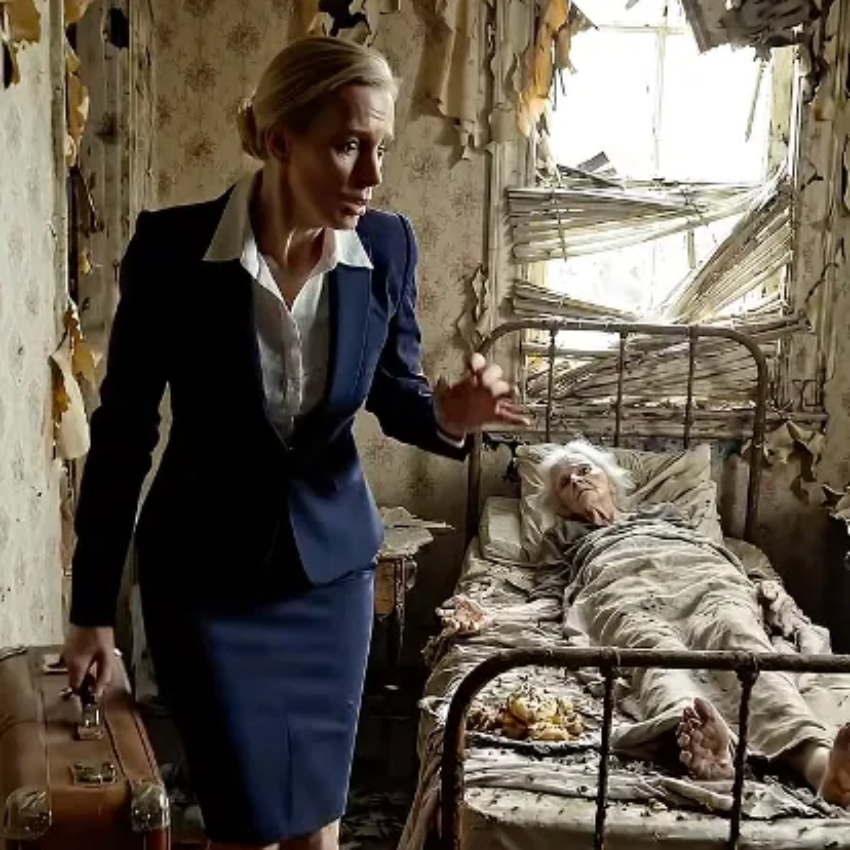
I just returned from a draining medical conference, utterly spent. But before I could even unpack, my husband, Robert, sent a chilling text: a cruel, impersonal command to “handle the old woman in the back room,” referring to my ailing grandmother, Eleanor, in her private care suite. He claimed her condition had worsened drastically, requiring heavy sedation for her “comfort” — a decision he’d made without me. The message was a dagger, designed to keep me away from the woman I loved, but what he didn’t know was that Grandmother Eleanor had already slipped me a clue.
My phone screen glowed, cold and stark.
“Handle the old woman in the back room.”
Robert’s words hung in the air, sharper than any surgical steel. My grandmother, Eleanor, was not an “old woman.” She was the matriarch who had raised me, the sharpest mind I knew.
I felt a sudden, profound chill.
This was more than just his usual disregard.
The mention of “heavy sedation for her comfort” echoed ominously. Eleanor had always valued her lucidity above all else.
Without even changing out of my travel clothes, I grabbed my keys.
The drive to the St. Jude Elder Care facility felt endless, each mile amplifying a growing sense of dread.
The evening shift nurse at the front desk, a young woman named Sarah, gave me a sympathetic glance.
“Mrs. Jenkins? I’m so sorry about your grandmother. She’s had a really rough couple of days.”
“What happened?” I asked, my voice tight.
Sarah hesitated, shifting her weight.
“The doctor increased her sedation, per family request. She’s resting peacefully now.”
“Family request?” I repeated.
My husband and his mother, Patricia, had been hovering around Eleanor’s care for weeks, but I was the medical proxy. I hadn’t authorized any changes.
My heart pounded.
I pushed through the double doors, heading directly to Eleanor’s private suite.
The room was dim, the air heavy with the scent of antiseptic and something vaguely sweet.
Eleanor lay in the bed, pale and frail.
Her breathing was shallow, barely a whisper. Her eyes fluttered open for a moment, unfocused, then closed again.
She was barely lucid.
My throat tightened. This wasn’t the Eleanor I knew, even weakened by age. This was someone barely clinging to consciousness.
As I gently adjusted the blanket around her shoulders, her hand twitched, a faint, almost imperceptible movement.
Her fingers brushed against my palm.
Something small and cold was pressed into my hand.
My gaze darted to her face. Her eyes remained closed, but a single tear tracked a path down her temple.
I quickly tucked the object into my pocket, my fingers confirming it was a small, ornate wooden box, intricately carved.
A shiver ran down my spine.
This was it. The clue she had slipped me before the conference.
I stayed a little longer, watching her breathe, trying to memorize the rise and fall of her chest, then quietly slipped out of the room.
The hallway was empty, bathed in the soft, clinical glow of the overhead lights.
I found an unused consultation room, locked the door, and pulled the box from my pocket. It was no bigger than my palm, made of dark, polished mahogany.
My fingers fumbled with the tiny brass clasp. It clicked open.
Inside, resting on a faded velvet lining, was a folded piece of paper and a small, typewritten list.
I unfolded the paper first. It was Eleanor’s familiar, elegant script, shaky but legible.
“They changed my Medical Proxy. Don’t let them take everything.”
My breath hitched.
I snatched the typewritten list beneath it. My eyes scanned the lines. It was a meticulous record, dated over the past two weeks, detailing specific drug names and dosages.
Tranquilizers.
Benzodiazepines.
The doses listed were unusually high, far exceeding typical therapeutic levels for an elderly patient.
My mind raced, connecting the dots. Robert’s text. Sarah’s hesitation. Eleanor’s barely conscious state.
“They changed my Medical Proxy. Don’t let them take everything.”
The words burned into Mara’s mind, a cold, hard truth that turned her grief into a burning, dangerous resolve.
Part 2
My dangerous resolve hardened.
I texted Robert back a curt reply.
“Understood.
I’ll check in on her.”
It was a lie designed to placate him.
For the next two days, I maintained a low profile at the facility.
I observed the nurses and the rhythms of Eleanor’s care suite.
I pretended to be overwhelmed by grief, allowing others to believe I was simply accepting Eleanor’s decline.
Then I saw Nurse Kelly Davies.
She was a young, earnest woman.
Her movements were hesitant as she prepared Eleanor’s evening medication.
I watched from a slight distance, hidden by the doorway.
She drew a syringe, the liquid inside a clear, viscous solution.
The volume looked concerningly large.
She approached Eleanor’s bedside.
With a practiced but slightly trembling hand, Kelly administered the full dose directly into Eleanor’s IV line.
Eleanor stirred briefly, a soft moan escaping her lips, then settled back into a deeper, almost unnatural sleep.
My stomach churned.
This wasn’t just neglect.
This was deliberate, active sedation, far beyond “comfort care.”
Nurse Kelly was an unwitting participant in their scheme.
A terrifying thought crystallized in my mind.
If Nurse Kelly is being deceived, who else in Eleanor’s care team is unknowingly complicit?
More Stories














+ There are no comments
Add yours