
My Husband Accused Me of Neglecting My Dying Grandmother — But Her Hidden Note Exposed His Treacherous Plot


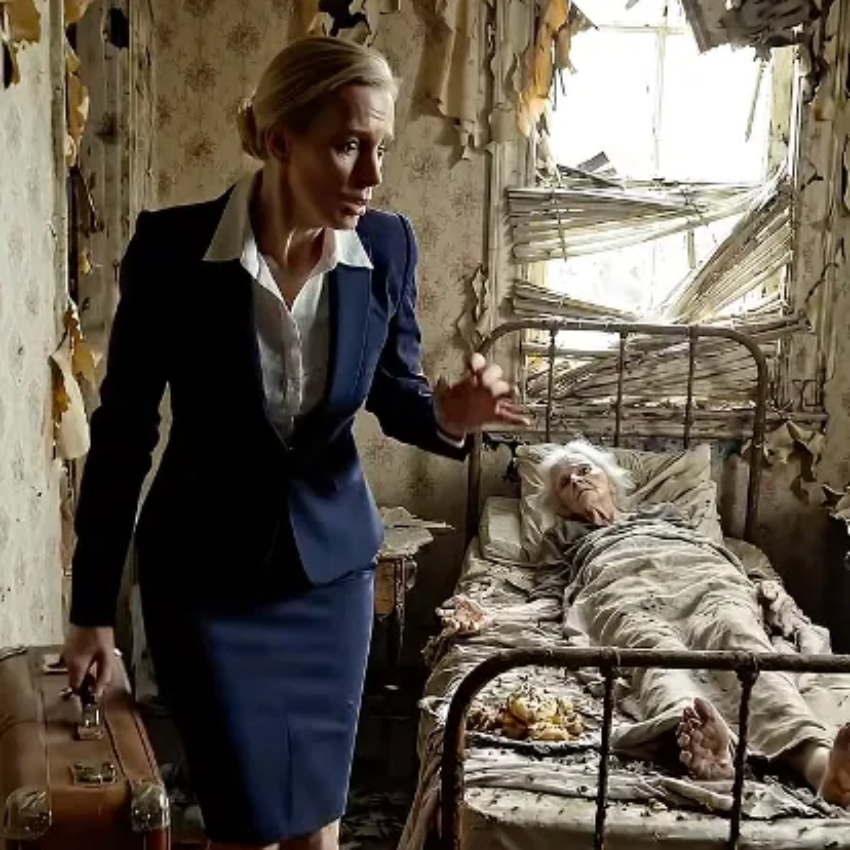


Patricia’s chilling words echoed in my mind long after she left Eleanor’s room. “Robert has the paperwork, the legal authority. You have nothing.” Her confidence, however, only fueled my determination. I knew they considered Robert’s newly acquired Medical Power of Attorney to be the unassailable cornerstone of their scheme. But what if it wasn’t?
My grandmother, Eleanor, was a meticulous woman. She organized everything, from her antique coin collection to her tax returns, with an almost obsessive precision. She believed in planning for every contingency. This wasn’t just a hunch; it was a deeply ingrained knowledge of Eleanor’s character.
The care facility offered limited access to Eleanor’s older personal documents, deeming most of them irrelevant to her current medical state. That meant only one place to look: Eleanor’s old home office. It was a space I knew intimately, having spent countless hours there as a child, watching her categorize and file.
I made my excuses to Robert, claiming I needed to retrieve some sentimental items from Eleanor’s house that might “comfort” her. He agreed readily, probably viewing it as a harmless distraction. His condescending assumption that I was merely grieving, rather than investigating, allowed me invaluable access.
The scent of aged paper and Eleanor’s faint lavender perfume hit me as I unlocked the front door of her house. Dust motes danced in the shafts of sunlight slicing through the closed blinds. Her office, untouched since she’d entered the care facility, was exactly as I remembered it. Rows of precisely labeled filing cabinets lined one wall.
My fingers traced the familiar labels: “Investments,” “Property Deeds,” “Legal Documents.” It was under “Legal Documents” that I found the file marked “Power of Attorney – Medical.” Inside was a sturdy, cream-colored document, crisp and formal, dated fifteen years ago. This was Eleanor’s original Medical Power of Attorney.
I pulled out the document, my hands trembling slightly. Eleanor had initially appointed her closest friend, Martha, as her primary agent, with me as the secondary. Robert wasn’t even mentioned. I quickly scanned the document, my eyes searching for any anomaly, any clause that might invalidate a more recent change.
My gaze snagged on a dense paragraph, tucked away near the bottom of the second page, in slightly smaller print. It was a specific, nuanced clause, clearly added by a lawyer well-versed in elder care complexities. This wasn’t standard boilerplate language. It was a bespoke addition.
The clause stated, in no uncertain terms, that “any subsequent alteration, amendment, or revocation of this Medical Power of Attorney agreement shall require the explicit, documented consent of no less than two independent medical specialists, not directly involved in the patient’s current care, who shall formally attest to the patient’s full cognitive capacity and understanding of the proposed changes.” This was a significant hurdle.
But there was more. The same clause continued: “Furthermore, such changes must be formally discussed and agreed upon in a recorded family consensus meeting, involving all directly designated beneficiaries and immediate family members, with minutes formally lodged and witnessed, all documented *prior* to the patient’s condition becoming critical or any loss of full cognitive function.”
I reread it, my breath catching in my throat. Two independent medical specialists. A family consensus meeting, formally recorded. And crucially, all of this had to happen *before* Eleanor’s condition became critical.
Robert’s recent POA, which Patricia had flaunted as ironclad, had none of these safeguards. Eleanor had been in a rapidly declining state, heavily sedated, when Robert allegedly obtained his new POA. There had been no family consensus meeting, certainly no recorded minutes, and absolutely no two independent medical specialists attesting to her full cognitive capacity. He had presented it as a simple update, a routine formality.
A slow, triumphant grin spread across my face. This was it. This was the leverage I needed. Eleanor, in her foresight and meticulous planning, had built an unassailable legal fortress around herself, a barrier Robert, in his greed and haste, had entirely overlooked. The personal cruelty was how Robert and Patricia had steamrolled over Eleanor’s carefully laid plans, assuming her meticulous nature was now just part of her “old-woman fussiness.” They dismissed her autonomy, only to have it rise from the grave.
I carefully folded the document, a sense of vindication washing over me. This wasn’t just a piece of paper; it was Eleanor’s voice, speaking from the past, protecting herself and me from their treachery. It was a testament to her fierce intelligence, even in her vulnerability.
I thought about how Robert had probably gone to a notary, maybe even a lawyer he had on retainer, and presented a confused, heavily sedated Eleanor as perfectly capable of signing off on a new POA. He had likely used his charm, his supposed “concern,” to bypass any rigorous checks. He never imagined that Eleanor, through her original document, had built in protections against exactly this kind of exploitation.
The sheer arrogance of Robert and Patricia, believing they could simply override Eleanor’s long-standing wishes, now felt like their greatest weakness. They had seen an ailing old woman, not a shrewd matriarch who had carefully planned her legacy and protections.
This forgotten clause wasn’t just a procedural detail; it was a testament to Eleanor’s unwavering commitment to her own autonomy and her trust in those who truly loved her. It was a deeply personal victory, a secret weapon against their blatant disregard for her dignity.
I slipped the document into a waterproof folder I’d brought, tucking it deep inside my bag. It felt like holding pure gold. The immediate danger to Eleanor remained, but now I had a legal foundation, a concrete tool to challenge Robert’s fraudulent control.
Leaving Eleanor’s quiet house, I felt a renewed sense of purpose. The dust motes still danced in the afternoon light, but now they seemed to glitter with the promise of justice. Robert and Patricia thought they had nothing to fear from a grieving relative. They were about to learn how wrong they were.
More Stories

















+ There are no comments
Add yours