
My Husband Accused Me of Neglecting My Dying Grandmother — But Her Hidden Note Exposed His Treacherous Plot

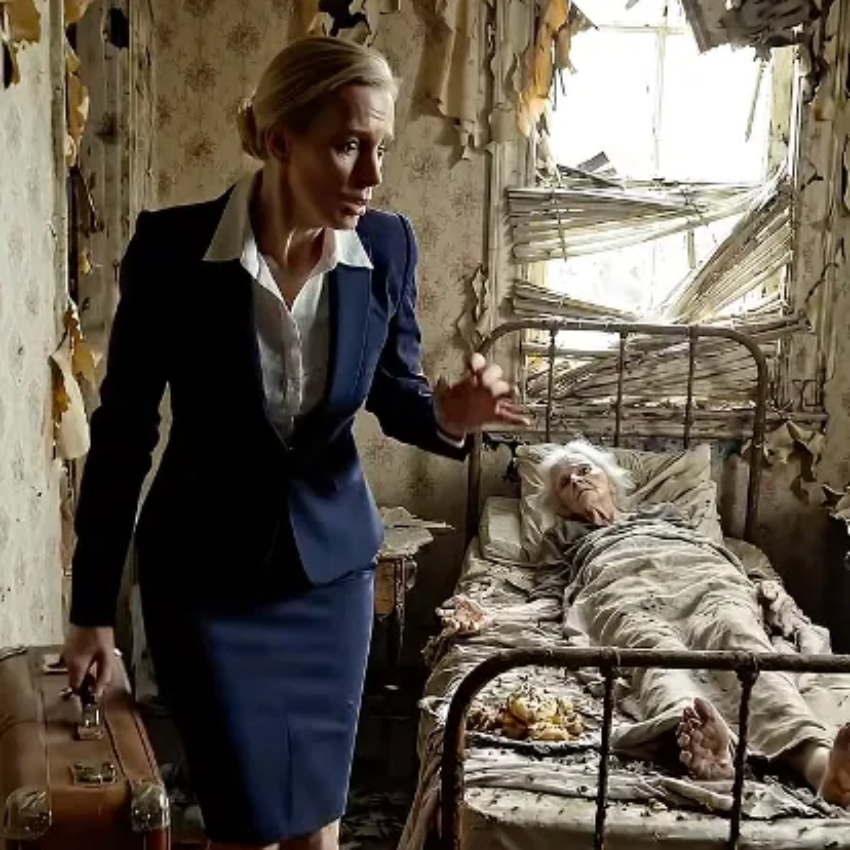


The sterile smell of antiseptic still clung to my clothes as I walked down the long, quiet hallway of the care facility. My mind replayed Eleanor’s barely lucid state, the hidden list of tranquilizers, and the chilling note about her Medical Power of Attorney. Every step felt heavy with the weight of what I had uncovered.
I was heading towards the nursing station, planning how to subtly gather more information, when a figure emerged from a patient room ahead of me. It was Dr. Evelyn Reed, Eleanor’s attending geriatrician.
She spotted me and paused, her hand still on the doorknob. Dr. Reed was usually a picture of professional calm, but today her shoulders seemed slightly slumped.
Our eyes met, and for a moment, an unspoken understanding passed between us. She hesitated, then pushed the door shut behind her.
“Mara,” she said, her voice soft, almost a murmur.
Her brow was furrowed, a slight tension visible around her mouth. She glanced around the empty hallway before stepping closer to me.
“Do you have a moment?” she asked, her gaze steady but tinged with something I recognized as profound discomfort.
I nodded, my heart quickening. This was it, the first crack in the wall of Robert’s carefully constructed deception.
“Of course, Dr. Reed,” I replied, keeping my own voice even. “Is everything alright with Eleanor?”
She sighed, a small, almost imperceptible exhalation. Her fingers went to the silver cross necklace she always wore, nervously adjusting it.
“Eleanor is stable, for now,” she said.
Her words were carefully chosen, but the subtext was clear.
“It’s just… I’ve been increasingly uneasy about some of the changes to her care plan.”
This was the twist, exactly as I had suspected. The professional concern, now voiced aloud, felt like a jolt.
“Changes?” I prompted, trying to maintain a neutral expression.
I didn’t want to tip my hand too early, but I needed her to trust me.
She took another cautious glance around. The hallway was still deserted, the quiet broken only by the hum of the ventilation system.
“Specifically, the recent increase in sedative doses,” Dr. Reed admitted, lowering her voice further.
Her gaze met mine, a flicker of genuine distress in her eyes.
“And the requests from Robert and Patricia.”
The mention of their names hung in the air, a tacit acknowledgement of the pressure they exerted.
“They’ve been… insistent,” she elaborated, choosing her words with extreme care.
“Demanding, almost. For Eleanor to be ‘more comfortable,’ as they put it.”
A personal cruelty beat hit me then, a small detail Dr. Reed shared that cemented the true nature of Robert and Patricia’s demands. She recounted how Patricia had once, in front of a junior nurse, casually waved away Eleanor’s gentle whimpers of discomfort, saying, “Oh, she’s just being dramatic, give her more of the good stuff. We can’t have her interrupting our peace.” It wasn’t just about sedation; it was about silencing Eleanor entirely.
“I’ve always prided myself on patient advocacy,” Dr. Reed continued, her voice tight.
“But this… it feels different.”
She rubbed her temples for a moment, then straightened, her professional demeanor reasserting itself, albeit imperfectly.
“I tried to explain the potential side effects of escalating benzodiazepines, especially with Eleanor’s age and delicate system,” she told me.
“But they were unyielding.”
She had documented her concerns, she assured me, but the directives had come from Eleanor’s current Medical Power of Attorney.
“Which, as you know,” she added, her eyes holding mine, “is currently Robert.”
The implication was clear: her hands were tied, but her conscience was not.
“And you’ve noticed this since when?” I asked, pushing gently for specifics.
My mind raced, connecting her discomfort with the dates on Eleanor’s hidden list.
“In earnest, since your last conference,” Dr. Reed confirmed.
“It seemed to accelerate rapidly after you left.”
This timing directly aligned with Robert’s chilling text and the sudden, drastic escalation of Eleanor’s sedation.
“I’ve made my recommendations,” she said, “but I’ve also been given… direct instructions.”
She didn’t need to elaborate on the nature of those instructions. I understood the unspoken power dynamic at play.
“You believe they’re overmedicating her?” I asked, choosing my words carefully.
It was a bold question, but her distress signaled she might be ready to acknowledge the truth.
Dr. Reed looked away for a moment, her gaze landing on a framed picture of a smiling elderly patient hanging on the wall. Her jaw tightened.
“I believe the current regimen is inappropriate for Eleanor’s condition, given her specific medical history,” she responded, her tone firm now.
“And it’s certainly not in her best interest.”
It was a cautious, legally sound statement, but her expression spoke volumes. It was an admission of ethical compromise, forced upon her.
“Thank you, Dr. Reed,” I said, a wave of relief mixed with grim determination washing over me.
“For your honesty.”
A flicker of a smile, sad and tired, touched her lips.
“My duty is to my patients, Mara,” she replied, her gaze meeting mine directly.
“Always.”
Her words solidified an unspoken alliance. She was risking her professional standing by even speaking to me like this.
“Do you have any records, any official observations that could support this?” I pressed, knowing I needed concrete evidence.
Her hesitation was brief. “I keep meticulous notes,” she affirmed.
“And I’ve requested additional labs, though I haven’t received specific approvals yet.”
She was laying the groundwork, subtly. It was a lifeline.
“Robert and Patricia have been very vocal about limiting any ‘unnecessary’ procedures or costs,” she added, a note of frustration in her voice.
Another layer of their calculated cruelty. They weren’t just sedating Eleanor; they were actively blocking any attempts to monitor her health properly.
“I see,” I said, my mind already formulating new strategies.
Their financial motive was becoming clearer with every piece of information.
“Is there anything else I should know, anything specific I should look for?” I asked, needing to learn everything.
Dr. Reed hesitated again, then leaned in slightly.
“Eleanor has a very rare neurological predisposition,” she whispered.
“It’s not usually a factor in routine care, but with specific medications, it can have… paradoxical effects.”
My medical researcher’s brain immediately latched onto that. A rare neurological predisposition? This could be crucial.
“Paradoxical effects how?” I questioned, my mind already racing through potential drug interactions.
“Heightened sensitivity, unpredictable responses to certain sedative classes,” she explained, her gaze serious.
“It’s why I’ve been so concerned about these increasing doses.”
This was more than just simple oversedation. This was a targeted, dangerous drug regimen for Eleanor’s unique physiology.
“I will keep a very close eye on Eleanor,” Dr. Reed promised, her resolve hardening.
“And I’ll continue to document everything.”
We exchanged a quick, meaningful glance. The shared secret now bound us.
“Thank you, Dr. Reed,” I repeated, feeling a surge of hope and renewed urgency.
“This changes everything.”
I left her, my mind buzzing with the new information. Dr. Reed’s discomfort, her quiet admission of pressure, and the hint of Eleanor’s rare condition were powerful confirmations. The path forward was still shrouded in uncertainty, but at least now, I wasn’t walking it alone.
More Stories
















+ There are no comments
Add yours