
My Son Stole My Sacred Hymns and Sold Them to a Seattle Megachurch for $85,000 — Then I Sang the Unpublished Second Verse in Front of His Congregation


Part 1
I was standing near the back doors, shivering from the Seattle downpour, when the 80-piece choir began singing the sacred hymn I had written thirty years ago for my late mother in Busan.
When I stepped forward and declared that the music belonged to me and had been stolen, the woman laughed and revealed that the church had just paid $85,000 for exclusive licensing rights to my work.
She didn’t know that the publisher who sold her my life’s work was my own adult son.
The rain beat against the cathedral’s massive oak doors, a relentless rhythm mirroring the frantic pounding in my chest. My thin coat, soaked through from the sudden Seattle downpour, clung to me like a second skin. Water dripped from the brim of my hat, forming small puddles on the polished marble floor.
I just wanted a moment’s reprieve from the storm, a quiet corner to regain my breath before walking the rest of the way home. The sheer grandeur of Grace Cathedral felt overwhelming, almost suffocating, to a humble seamstress like me.
A sudden swell of music, rich and powerful, filled the cavernous space. An 80-piece choir, dressed in crisp white robes, stood bathed in the soft glow of stained-glass windows, their voices rising in perfect harmony.
The melody struck me, instantly familiar. It was a tune I knew better than my own name, a song woven into the very fabric of my soul.
“Song of the Quiet River.”
My breath caught in my throat. This was impossible. This was *my* song.
I had composed it thirty years ago, a private devotion, a spiritual offering to my late mother in Busan. Every note, every interval, was etched in my memory, a personal lament, a cherished secret.
Yet here it was, reverberating through a grand American cathedral, sung by strangers. My legs felt like stone, rooted to the spot near the back doors.
A tall woman, her hair perfectly coiffed, her silk scarf draped elegantly, marched across the foyer with an air of absolute authority. Clara Choi, the pastor’s wife and executive director, was known throughout Seattle for her sharp tongue and even sharper sense of propriety.
Her eyes, sharp and dismissive, fixated on my dripping coat and worn shoes. She paused just a few feet from me, her perfect smile tightening at the corners. The joyful chorus of the hymn swelled around us, a beautiful, painful irony.
“Excuse me,” she said, her voice cutting through the music like a razor.
Her gaze swept over my appearance, lingering on the puddles forming at my feet. A flicker of disdain crossed her face.
“Are you quite alright, madam?” she asked, though her tone suggested the opposite. “You seem to be… causing a bit of a disturbance.”
The last notes of the first verse faded, leaving a hush in the vast sanctuary. Every head began to turn, a sea of polite curiosity now directed toward the wet old woman by the back doors.
A flush of shame warmed my cheeks, but it was quickly overshadowed by a growing surge of indignation. This was *my* song they were singing. This was *my* mother’s memory being commodified.
“This hymn,” I began, my voice a mere whisper, then growing stronger, “this hymn is mine.”
Clara Choi arched an eyebrow, a patronizing smirk playing on her lips.
“I’m afraid I don’t understand,” she said, her voice dripping with condescension. “This is a sacred piece, a gift from Grace Hymnal Media. It’s copyrighted.”
“No,” I insisted, taking a tentative step forward, my eyes fixed on the choir. “It is not. I wrote it. Thirty years ago. For my mother.”
A ripple of murmurs spread through the congregation. The choirmaster paused, his baton held aloft, his eyes wide with confusion.
Clara Choi let out a short, sharp laugh, a sound devoid of humor.
“My dear woman,” she said, her voice loud enough to carry, “you are mistaken. Perhaps you are confused. This composition was purchased for a considerable sum, licensed exclusively to Grace Cathedral.”
She straightened her shoulders, her expression hardening.
“Security!” she called out, her voice echoing through the quiet cathedral. “Please escort this woman out. She’s disrupting the service and making baseless accusations.”
My heart hammered against my ribs, a drumbeat of anger and disbelief. Baseless accusations? My life’s work, stolen and sold.
I took another step, my worn shoes squeaking faintly on the marble. I moved past Clara Choi, past the usher who now approached hesitantly. My gaze was locked on the altar, on the choir director, on the silent faces of the congregation.
“This music,” I declared, my voice ringing out with a newfound strength, “this ‘Song of the Quiet River’—it was stolen from me. It is *my* composition, from *my* private collection.”
Part 2
Clara Choi scoffed, a tight smile on her face. “Stolen? Mrs. Park, this music was legally acquired. We paid Grace Hymnal Media eighty-five thousand dollars for the exclusive rights.”
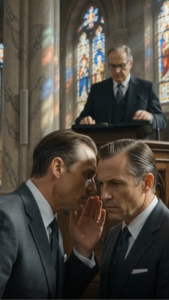
From the choir loft, a young man in a tailored suit descended the steps. Daniel. My son.
His eyes met mine, then quickly darted away, sweeping over the bewildered congregation. He approached Clara, putting a reassuring hand on her arm.
“Mother, please,” he said, his voice loud and clear, full of feigned concern. “The service. You’re confused.”
He turned to the congregation. “My mother sometimes struggles with her memory. This is simply a misunderstanding.”
“Prove it then, old woman,” Clara challenged, thrusting a microphone toward me.
I took the cold metal, my hand trembling slightly. Then, I closed my eyes, and from deep within, the second verse of “Song of the Quiet River” flowed.
My voice, clear and strong, filled the sanctuary, singing the unwritten Korean lyrics, each note perfectly placed in the ancient calligraphic meter.
The choirmaster’s jaw dropped. The choir members exchanged stunned glances.
More Stories






+ There are no comments
Add yours