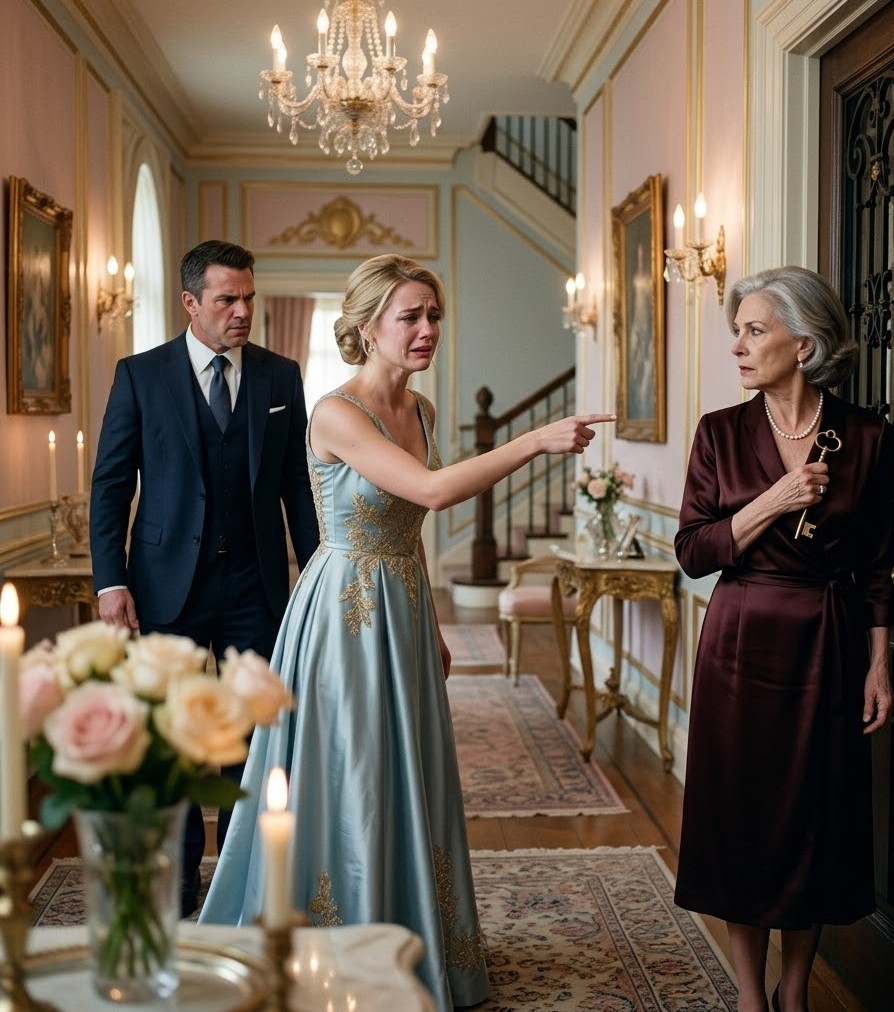
At Her Baby Shower, My Mother-in-Law Accused Me of Instability and Locked My Newborn in a Crib—Then Her Decade-Old Trust Clause Exposed Her Motive







The courtroom was an austere, imposing space, a stark contrast to the opulence of the Caldwell villa. The air was hushed, thick with anticipation and the weight of legal formality. Judge Evelyn Carter, a woman with piercing eyes and an unyielding demeanor, presided from the bench, her gaze sweeping over the assembled parties.
I sat beside Marcus, Henry on my other side, his hand a steadying presence. Across the aisle, Beatrice sat poker-straight, her face a carefully composed mask of concern, flanked by her own formidable legal team. Arthur Finch, looking pale and nervous, sat further down the row.
Beatrice’s lawyer, a slick, self-assured man named Mr. Thompson, began his opening statement. He painted a picture of a concerned grandmother seeking to protect her vulnerable grandchild from a mother struggling with severe mental health issues.
He relied heavily on the disputed 1982 trust clause, presenting it as an absolute and necessary safeguard for the Caldwell lineage. He then introduced Beatrice’s ‘family consultant’s’ report, highlighting its selective observations about my alleged instability.
“Dr. Reed’s preliminary assessment clearly indicates Mrs. Harding-Caldwell’s present emotional fragility,” Mr. Thompson announced, holding up the report. “A pattern of erratic behavior and resistance to appropriate medical oversight.”
My jaw tightened, but I remained still. It was a cruel distortion, but I knew Marcus was ready.
Then came the financial statements. Mr. Thompson called Arthur Finch to the stand. Finch, looking utterly miserable, fidgeted with his tie as he took the oath.
“Mr. Finch,” Thompson began, his voice smooth. “You are the Caldwell family accountant. Did you, in your professional capacity, observe and document unusual or unexplained medical expenditures in Mrs. Eleanor Harding-Caldwell’s financial history?”
Finch cleared his throat, his gaze darting nervously towards Beatrice.
“There were… certain expenditures,” he mumbled, his voice barely audible. “That were… not typically categorized.”
He was attempting to backtrack, to soften his confession, to protect himself. It was another small, specific act of cowardice, aimed at undermining my case even as he feigned cooperation. The casual betrayal felt like a pinprick, but it still stung.
Judge Carter leaned forward, her gaze sharpening.
“Mr. Finch,” she interjected, her voice crisp. “Can you clarify ‘not typically categorized’? Were these personal medical expenses of Mrs. Harding-Caldwell? And if so, why were they included in a report to the trustee for a petition concerning parental fitness?”
Finch stammered, his face reddening. “They were… a matter of record, Your Honor. For… comprehensive review.”
His evasiveness did not escape the judge. She watched him for a long moment, a slight frown creasing her brow.
“Comprehensive review of what, Mr. Finch?” Judge Carter pressed, her voice unwavering. “Medical history, or financial records for the Caldwell Trust?”
He wrung his hands, visibly sweating. “Financial records, Your Honor. But they were… noted.”
The judge looked from Finch to Beatrice, then back to Finch, her expression unreadable but clearly displeased. She was seeing through the attempt to obfuscate.
Mr. Thompson, sensing the judge’s skepticism, quickly tried to pivot back to the 1982 trust clause, reiterating its “binding authority” and the “paramount importance of family legacy.” He continued to emphasize my alleged uncooperative stance regarding the demanded psychiatric evaluations.
He focused on the lack of a second “independent” evaluation, portraying it as further evidence of my resistance and therefore, my unfitness.
Throughout his presentation, Judge Carter listened intently, her questions sharp and focused on procedural inconsistencies and the precise wording of the trust. She seemed particularly interested in the interpretation of “independent” versus “court-ordered” evaluations.
“Mr. Thompson,” she asked, cutting him off mid-sentence. “Are you asserting that any independent evaluation, regardless of its source, meets the criteria for determining ‘severe mental health condition’ under this trust clause?”
“Yes, Your Honor,” Thompson replied confidently. “The trust states ‘two independent psychiatric evaluations’.”
Judge Carter nodded slowly, but her expression gave nothing away. It was clear, however, that the stage was set for Marcus to deliver our counter-arguments. The subtle discomfort in the courtroom, and Finch’s nervous demeanor, suggested that Beatrice’s carefully constructed narrative was already beginning to fray under the judge’s scrutiny.
More Stories











+ There are no comments
Add yours