
The Widow's Root: How an Old Woman's Humble Stew Exposed a Wartime Fraud and Silenced a Frontier Baron


I watched the dust cloud approach from the main road, growing larger, until it resolved into Sheriff Beaumont on horseback. His uniform, though clean, was already coated with a fine layer of prairie grit. He rode with an air of official importance, though his eyes seemed to dart around the Holt Farm with a hint of unease.
Jeremiah Holt met him at the edge of the property, a wide, practiced smile plastered across his face. He clapped the sheriff on the shoulder, a gesture of familiarity that made my stomach churn. I stood near the barn, pretending to examine a loose board, but my ears strained to catch their muffled conversation.
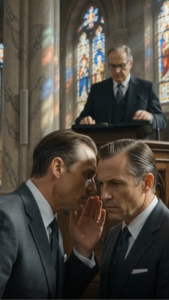
The sheriff nodded at something Holt said, then glanced in my direction. Their eyes met mine for a fleeting moment, and I could practically feel the weight of their judgment. Holt gestured toward me, then whispered something into Beaumont’s ear, his voice low and conspiratorial.
A frown creased the sheriff’s brow. He pushed his hat back slightly, wiping a hand across his forehead. I knew then that the conversation was about me, and it wasn’t good.
Beaumont dismounted, his boots thudding softly on the dry earth. He walked towards me with a slow, deliberate pace that felt designed to unnerve. His gaze was firm, but there was a flicker of something else there, a hint of discomfort that he tried to mask.
Holt remained by his horse, observing with a triumphant smirk. The heat of the sun beat down, but a chill ran through me nonetheless. I folded my hands at my waist, meeting the sheriff’s gaze evenly.
He stopped a few feet away, his thumbs hooked into his belt. The badges on his chest glinted.
“Ma’am,” he said, his voice flat and official.
“Sheriff,” I replied, keeping my own voice steady.
“We’ve received… concerns regarding your presence here.”
He paused, glancing back at Holt, who now busied himself adjusting his horse’s bridle. The performance was clear enough.
“Mr. Holt is a respected member of this community,” Beaumont continued. “And he feels you’ve overstayed your welcome.”
My mouth tightened, but I kept my expression neutral. Overstaying my welcome was hardly a crime.
“I am merely seeking a meal, as promised,” I said, my voice barely above a whisper.
Beaumont scoffed softly, shaking his head.
“A meal? You’ve been here three days, ma’am. And stirring up trouble, by some accounts.”
He didn’t elaborate on what “trouble” I had caused. He didn’t need to. The implication was enough.
“Mr. Holt says you’re making… accusations,” the sheriff pressed, his eyes narrowing slightly. “Speaking ill of him.”
I met his gaze, unflinching. “I speak only the truth.”
Beaumont let out a long sigh, running a hand over his clean-shaven jaw. He seemed more tired than angry, a man caught between his duty and a powerful local.
“Look, ma’am,” he said, lowering his voice slightly. “I’ve been asked to tell you to move along.”
He paused, giving me a moment to process his words. The sun beat relentlessly on my head.
“The good people of this town have a right to feel safe. And a lone woman, wandering the prairie, making… claims…”
He let the sentence hang in the air, a thinly veiled judgment. It was a common enough fear, a lone woman, vulnerable, perhaps even unhinged, in this wild land.
“You’re disrupting the peace, ma’am,” he stated, firmer now. “You’re considered a public nuisance.”
The words stung, intended to diminish and dismiss. I felt the familiar burn of injustice.
“I’m not disrupting anything,” I replied, my voice sharper than before. “I am merely seeking what is owed.”
Beaumont leaned in slightly, his voice dropping to a low rumble that only I could hear.
“The prairie ain’t a safe place for solitary women, ma’am,” he warned, his eyes holding mine. “Especially those who stir up trouble. Accidents happen out here. Folks go missing. No one ever hears from them again.”
His gaze shifted briefly toward the endless expanse of dry grass beyond the farm fences. It was a clear, unambiguous threat, echoing Holt’s earlier intimidation. My throat tightened. The casual cruelty of it, delivered with such an air of concern, was chilling.
He stood back upright, his official demeanor returning.
“You have until sunset to leave the Holt Farm property and this town,” he announced, his voice carrying just enough for Holt to hear. “If I see you here come morning, I’ll have no choice but to take you into custody.”
He didn’t wait for a response. He simply nodded once, then turned and walked back to his horse. Holt grinned at him, then mounted his own horse. They rode off together, leaving me standing alone in the dusty yard.
The sun was high overhead, already beginning its slow descent. My time was running out. But the threat, rather than deterring me, solidified something deep within my gut. This was no longer just about Thomas. This was about a pattern, a system of injustice that Holt had built, and I would not be another victim swallowed by the prairie wind. I would not give him the satisfaction of seeing me flee. I would not allow his casual cruelty to break me.
I watched the dust cloud recede, the two figures shrinking in the distance. The silence that followed was heavy, broken only by the chirping of crickets and the distant lowing of cattle. My hands, calloused from my journey, clenched into fists at my sides.
The sting of being labeled a “public nuisance” settled in my chest. It was a way to dismiss my legitimate grievances, to turn the community against me before I even had a chance to speak my truth. Holt was a master of manipulation, using his influence to paint me as the villain.
But his casual dismissal, the veiled threats about “accidents” on the prairie, had only fueled my resolve. He underestimated the tenacity of an old woman with nothing left to lose. I had walked forty-two miles. I wouldn’t be chased away by a sheriff’s warning, no matter how ominous.
I made my way towards the small, dilapidated shed where I had been allowed to sleep. The air inside was stifling, thick with the smell of old straw and mouse droppings. It was a stark contrast to the grand house where Holt lived, a constant reminder of the chasm between our stations.
My few belongings were neatly packed into my worn canvas bag. A tattered blanket, a small tin cup, and the small, carefully wrapped bundle containing the Devil’s Tongue root. I unwrapped it, holding the gnarled, dark root in my palm. Its dry, earthy scent filled my nostrils. This was my quiet rebellion.
Holt’s violent reaction to it the first day now made perfect sense. It wasn’t just an unusual ingredient; it was a symbol, a direct challenge he recognized. And his immediate response, calling for the sheriff, confirmed his fear. He feared exposure. He feared the truth that this root represented.
I ran my thumb over the rough surface of the root. It was ugly, unassuming, yet held such power. My husband, Thomas, had shown it to me years ago, explaining its unique characteristics and the secret meaning it held for our family. It was a marker, a silent testament to our claim, our life.
The humiliation of being told to leave, of being seen as a senile beggar, tightened my jaw. I had survived too much to be cowed by a petty tyrant and a compromised lawman. The sun was indeed beginning its slow descent, painting the western sky in hues of orange and red. I had a deadline, but I wouldn’t spend it fleeing. I would spend it preparing.
I thought of Thomas, his kind eyes, his strong hands. His disappearance had shattered my world, but not my spirit. I carried his memory, and with it, a burning desire for justice. This was for him. This was for all the other Thomases swallowed by Holt’s greed.
The weight of the canvas bag felt familiar in my hands. I slung it over my shoulder, the setting sun casting long shadows behind me. I wouldn’t leave town. Not yet. I had other errands to run, other preparations to make, before Holt could declare his victory.
The sheriff’s words, “accidents happen,” echoed in my mind. They were meant to scare me, to make me see the vast, empty prairie as a predator. But I had walked its unforgiving miles. I knew its dangers. And I knew that some dangers came not from the wilderness, but from the hearts of men.
I closed my eyes for a moment, taking a deep breath of the dry, dusty air. The scent of sage and sun-baked earth filled me. I was tired, yes, but not defeated. Not by a long shot. I had a plan, and the Devil’s Tongue root was just the first, subtle strike.
I opened my eyes, a new resolve burning within them. The sun was dipping lower, casting the world in a warm, golden glow. My time was limited, but my purpose was clear. I would not be a public nuisance. I would be a reckoning.
My feet carried me not towards the dusty road out of town, but towards the faint outline of the small, bustling general store in the distance. There were things I needed, specific items that would aid in my silent battle. The thought of Holt’s smug face, thinking he had rid himself of me, brought a grim satisfaction. He was about to learn that some weeds, once rooted, were impossible to pull out.
The prairie wind, which had once felt like a mournful lament for my lost husband, now felt like a steady, insistent whisper, urging me forward. It carried the scent of possibility, of a quiet, brewing storm that Holt would never see coming. He had his power, his wealth, his sheriff. But I had something more potent: truth, and a root that symbolized everything he sought to bury.
More Stories






+ There are no comments
Add yours