
The Widow's Root: How an Old Woman's Humble Stew Exposed a Wartime Fraud and Silenced a Frontier Baron


I heard the loud voices from the study. Elara’s accusations, Jeremiah’s furious denial. The words “fraud” and “stolen land” pierced through the thick oak door, making me pause in the hallway, a silver tea tray balanced precariously in my hands. Jeremiah’s enraged roar, calling her a “crazy old hag,” made me flinch. He never used such language.
When Elara finally emerged, her face pale but resolute, I pretended to be adjusting a decorative vase, my back to her. She didn’t look at me, just walked past, her footsteps quiet on the polished floor. I heard the front door open and close softly.
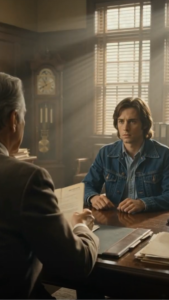
Jeremiah’s study door burst open a moment later. He stood there, red-faced, his eyes wild with fury. He ran a hand through his hair, dishevelled.
“That madwoman!” he spat, slamming his fist against the doorframe. “Trying to spread lies! She’s nothing but a delusional beggar!”
I turned, feigning calm, though my hands trembled. “Jeremiah, what happened? What was all that commotion?”
He glowered at me. “Nothing, Abigail. Just that old hag, trying to accuse me of… of ridiculous things. Fantasies. She belongs in an asylum, not on my property.”
He dismissed it too quickly, too vehemently. His agitation was unusual, not his usual controlled anger. The word “fraud” echoed in my mind, a chilling whisper.
Later that evening, after Jeremiah had retired, still fuming, I found myself drawn to his study. The air still carried the scent of his anger, thick and unpleasant. I began to tidy his desk, a task I often performed, finding a strange comfort in the familiar order.
My fingers brushed against a loose panel on the side of the desk, a small, almost invisible seam in the dark wood. It wasn’t something I had ever noticed before. Curiosity, a rare indulgence for me, pricked at me. I pressed it gently, and a small, shallow compartment sprang open with a soft click.
Inside, nestled among a few old war medals and a tarnished silver locket, lay a faded photograph. It was old, the edges curled with age, the sepia tones almost indistinguishable. I picked it up, my heart giving an odd flutter.
The photograph showed two young men, grinning broadly, their arms slung over each other’s shoulders. They were dressed in worn Union Army uniforms. One of them, I vaguely recognized from his more mature features as our foreman, Silas Kincaid, much younger, his eyes full of youthful exuberance.
The other man… he had a kind face, a gentle smile. And underneath the image, scratched faintly into the emulsion, was a tiny, almost imperceptible symbol. It was a gnarled, twisted root. The very same “Devil’s Tongue” symbol that Elara Maeve had brought with her, the one Jeremiah had reacted so violently to.
My breath hitched. “Thomas Maeve,” I whispered, recognizing the name Elara had spoken, the name Jeremiah had so vehemently denied. And Silas Kincaid’s father.
This wasn’t just a photograph of random soldiers. This was a direct, undeniable link between Elara’s husband, Silas, and the war—all of whom Elara had mentioned in her heated accusations. The connection, once dismissed as the ramblings of a “madwoman,” now felt disturbingly real.
I stared at the symbol, then at the young, hopeful faces. Jeremiah had called these “war souvenirs.” But why keep a picture of these specific men, labeled with a cryptic symbol, in a hidden compartment? Why not display them, if they were truly just mementos of a glorious past?
A cold dread began to creep into my stomach. Jeremiah’s frantic denial, his disproportionate anger, his attempts to physically remove Elara – it all started to coalesce into a terrifying new picture. He had been too agitated, too dismissive. His fear was palpable.
I recalled Elara’s words: “falsified casualty reports,” “predatory schemes.” Jeremiah’s wealth, his sudden rise to prosperity after the war, had always been a point of quiet pride for him. But now, it took on a sinister hue. Was it truly built on hard work and shrewd business dealings, or on something far darker?
The image of the “Devil’s Tongue” root Elara had offered him, and his violent reaction, now made chilling sense. It wasn’t just an odd ingredient. It was a recognized symbol, a direct accusation. He had understood its meaning immediately.
I carefully placed the photograph back into the hidden compartment, sliding the panel shut. My hands were shaking, my mind racing. The quiet comfort of my life, the secure foundation of Jeremiah’s good name, felt suddenly fragile, built on shifting sand.
The woman he had dismissed as mad seemed less so now. Her words, though harsh, now carried an unsettling weight of truth. This wasn’t just about a meal or a misplaced accusation. This was about a hidden history, a secret that Jeremiah had guarded with furious intensity.
I left the study, the grand, opulent room now feeling cold and alien. The air outside was cool, but I felt a clammy sweat on my brow. My sheltered world, built on trust and unquestioning loyalty to my husband, had just cracked. And the tiny, almost invisible “Devil’s Tongue” symbol on that faded photograph was the wedge that had started the fracture.
My doubt was no longer a fleeting thought. It was a gnawing certainty, a seed that had taken root, threatening to consume everything I thought I knew about my husband, and about our life. The quiet unease had turned into outright suspicion. And the thought that I had, unknowingly, benefited from such a scheme, filled me with profound revulsion.
I walked to the window, staring out at the darkened fields. The moon, so bright earlier, was now partially obscured by clouds. The farm, usually a source of pride, now seemed ominous, a silent monument to a hidden, terrible truth. My comfortable life, once a haven, now felt like a gilded cage.
More Stories









+ There are no comments
Add yours