
Un vecino racista intentó destruir el restaurante de mi familia, pero un secreto de su campaña lo detuvo.


The meeting was set for Friday morning in Councilman Jenkins’s office. Sofia and I had arranged it under the pretense of presenting our grievances and seeking a “peaceful resolution” to the diner’s ongoing harassment. We knew Harrison would attend, eager to watch us squirm. What he didn’t know was that he was walking into a trap.
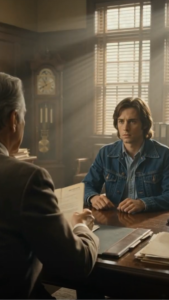
Jenkins’s office was predictably opulent, plush carpet and dark wood, with a panoramic view of the city. He sat behind a large mahogany desk, his smile forced, probably annoyed by our persistence. Across from him, in a padded leather chair, Wallace Harrison exuded an air of smug superiority, his expensive suit perfectly tailored, a glint of amusement in his eyes. He clearly thought this was a formality before his final victory.
“Mr. Castillo, Miss Castillo,” Jenkins began, clasping his hands. “I understand you have some… concerns regarding the recent building inspections and property developments on Main Street.”
“Concerns, Councilman,” I said, my voice steady, “is an understatement. We are being targeted.”
Sofia placed her meticulously organized folder on Jenkins’s desk. “Councilman, Mr. Harrison,” she began, her tone professional, “we’ve done some research. Our diner has received an unusual number of citations in recent months, largely from Officer Reynolds, whose history of disproportionately targeting minority-owned businesses in areas slated for development is now publicly documented.”
Harrison scoffed. “Fabricated nonsense. The officer is simply enforcing the law.”
Sofia ignored him. “And then there’s the matter of campaign finance, Councilman Jenkins.” She opened the folder, revealing the detailed chart of donations. “Our investigation shows a clear, consistent pattern of financial contributions from Mr. Harrison’s various shell corporations and associated PACs directly to your re-election campaign. Contributions that began precisely when your ‘interpretations’ of city zoning laws became more… flexible.”
Jenkins’s forced smile faltered. His eyes flickered nervously from Sofia to Harrison. “Those are legitimate campaign donations, Miss Castillo. From various concerned citizens who support my vision for the city.”
“Or Mr. Harrison’s vision, for Main Street,” I interjected, leaning forward. “A vision that just happens to require the demolition of every small business on our block, including my family’s diner. We demand an end to this harassment. We demand that you withdraw Officer Reynolds’s citations and ensure fair treatment for all businesses.”
Harrison laughed, a harsh, dismissive sound. He leaned back, crossing his arms. “You think a few spreadsheets and some wild accusations are going to stop anything? Please. This is business, kids. And frankly, your little diner is an archaic inconvenience.”
He reached into his inner jacket pocket and pulled out a crisp, official-looking document. He placed it squarely on Jenkins’s desk, sliding it across for us to see. My blood ran cold.
“Your diner, Mr. Castillo,” Harrison smirked, “is no longer your problem. Or rather, it’s about to become my problem to… clear away.”
It was an eviction notice. Stamped and signed, expedited. Dated just two days prior.
“I acquired the original ground lease for your property months ago, through another one of my perfectly legal shell companies, ‘Historic District Revitalization LLC’,” Harrison explained, a predatory glint in his eye. “It contains a rather fascinating clause, a relic from the 1950s: a ‘right of immediate termination’ with thirty days’ notice if the tenant fails to ‘maintain the aesthetic integrity of the commercial premises in keeping with new district guidelines.’ A clause, I might add, that Councilman Jenkins and his office recently, and quite helpfully, re-certified as valid.”
Jenkins shifted uncomfortably, avoiding our gaze. He had clearly signed off on this, enabling Harrison’s final, crushing move. Harrison had played the long game, not just buying up surrounding properties, but secretly acquiring the very lease that governed our diner, and then manipulating Jenkins to validate an obscure loophole.
“So,” Harrison gloated, his voice dripping with condescension, “your little charts and your accusations are utterly meaningless. You have thirty days, Mr. Castillo. Then your ‘cultural presence,’ as you so eloquently put it, will be part of my luxury condominium complex.”
My heart sank. We had walked into his trap. All our efforts, all of Sofia’s hard work, all for nothing. Harrison had outmaneuvered us completely.
Just as a wave of despair threatened to engulf me, the door to Jenkins’s office swung open.
Marco “El Halcón” Mendez strolled in, unannounced, utterly unfazed by the sudden silence. He wore a simple, dark suit, but his presence filled the room, radiating an unspoken authority that made Harrison’s casual arrogance suddenly seem small. In his hand, he held a small, leather-bound ledger, aged and worn.
“Councilman Jenkins,” Marco said, his voice calm, polite even, but with an undercurrent of steel. “Robert. We need to talk about your outstanding accounts.”
Jenkins’s face, already pale, turned ashen. He instinctively pushed back from his desk, knocking over a pen holder.
Harrison looked at Marco, confused, annoyed. “Who is this?”
Marco ignored him, his eyes fixed on Jenkins. “The twenty-seventh of last month, Robert. Horseshoe Club, eleven thousand dollars. The week before, underground poker game, eight thousand. And let’s not forget the outstanding marker from two years ago, when you were desperate for your re-election funds. That one’s… substantial. Very substantial.”
Marco tapped the ledger lightly. “My friend, he’s a very patient man. But even patient men expect to be paid. Especially when they have… friends in very visible places. Friends who might be interested in a councilman’s hobbies.”
Jenkins was sweating now, beads of perspiration forming on his forehead. The color drained from his face. His eyes darted to Harrison, then back to Marco, pure terror in them. The threat wasn’t just financial; it was career suicide, a public humiliation that would destroy his reputation overnight.
“This is ridiculous,” Harrison blustered, trying to regain control, but even his voice lacked its former confidence. “This has nothing to do with—”
“It has everything to do with it, Mr. Harrison,” Marco interrupted, his gaze finally flicking to the developer, cold and unwavering. “Councilman Jenkins here is a man of his word. And he’s about to make a very important decision that will reflect his commitment to the community. Isn’t that right, Robert?”
Jenkins took a ragged breath. He looked at the eviction notice, then at Marco’s impassive face. He knew he was trapped. The gambling debts, the exact dates and amounts, Marco’s quiet power—it was all undeniable.
He grabbed his desk phone, his hand trembling. “Yes, Brenda? Get me a press release draft, immediately. Yes, publicly. And call the city planning commission. Tell them to put an immediate halt to all pending demolition and zoning variance approvals related to the Main Street Redevelopment project.”
He looked directly at us, his eyes wide with a desperate plea. “Effective immediately, the eviction notice for Castillo’s Diner is hereby rescinded due to a previously overlooked technicality regarding the ‘new district guidelines’ clause. We will also be initiating a comprehensive review of all downtown zoning permits, effective today, to ensure full compliance with public interest. Make it sound official, Brenda. Very official.”
He hung up, his chest heaving. Harrison stared at Jenkins, his face a mask of thwarted rage, his carefully constructed plan unraveling before his eyes. His jaw was clenched, his eyes blazing with fury. Marco merely closed his ledger, a faint, knowing smile gracing his lips.
The silence in the room was thick, heavy with the weight of Marco’s unexpected victory. Harrison was outmaneuvered, not by law, but by a different kind of justice, one forged in the shadows, leveraging the very corruption he had exploited. We had walked into a trap, but Marco had turned it into a master stroke, saving our diner in the most unconventional, terrifying, and utterly brilliant way possible.
More Stories










+ There are no comments
Add yours