
Teenage daughter reveals ownership of family manor amidst Civil War, shocking grandmother and absent father.


Eleanor remained slumped in the chair, her once-imperious posture utterly broken. The grand Matriarch, who had commanded every corner of Oakhaven, was now just an old woman consumed by her own self-inflicted defeat. She looked up at me, her eyes red-rimmed and swollen.
“So,” she whispered, her voice raspy. “It is done, then. Oakhaven is yours. What will you do with it, child? Let it fall into ruin?”
I shook my head slowly. “I will protect it, Grandmother. As my mother intended. As I always have.”
She gave a single, bitter nod, a grudging acknowledgment of my legal dominion. There was no apology, no softening in her gaze, only the grim acceptance of a defeat she could not undo. She rose slowly, painfully, and without another word, retreated from the drawing-room, her footsteps heavy and dragging up the grand staircase. The silence she left behind was profound, a vacuum of her once-dominant presence.
The morning light, now brighter, streamed through the windows, illuminating the dust motes dancing in the air. The furnace hummed steadily in the basement, a constant, low thrum. Oakhaven was mine. But the victory felt cold, heavy, burdened by the enormity of what lay ahead.
A short while later, the muffled sound of a horse approaching broke the quiet. I walked to the front door as a young messenger, bundled in a thick Union Army coat, dismounted. He held a sealed envelope, crisp and official.
“Telegram for Miss Eliza Reed,” he announced, his breath pluming in the cold air.
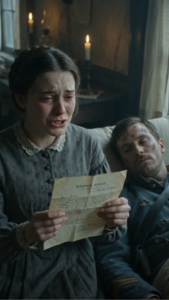
I took the envelope, my heart pounding with a mixture of dread and anticipation. It was from my father. I tore it open, my eyes scanning the terse lines of text.
“REED MANOR SITUATION AWARE. NEUTRALITY CLAUSE NOTED. TAKING IMMEDIATE LEAVE OF ABSENCE TO FACILITATE COMPLIANCE. FINCH ADVISED. EXPECT NO FURTHER MILITARY ENCROACHMENT. ELIAS REED, CAPTAIN.”
I read it twice. My father. He acknowledged it. He was taking leave. He was ensuring Provost Marshal Finch would respect the clause. But there was no apology, no word of comfort, no softening of his distant, military tone. His complicity in Eleanor’s scheme, fueled by her manipulative letters, was glaringly absent from his message. He had acted, but only because the situation had escalated to a point where it directly impacted Union strategy and his own position. It was a victory of pragmatism, not affection.
I folded the telegram slowly, a bitter taste in my mouth. He was still the same Elias Reed, choosing duty and self-preservation over emotional confrontation. His absence, his detachment, now felt like a permanent, silent choice.
The messenger shifted nervously. “Any reply, Miss Reed?”
I looked at the telegram again, then out at the snow-covered fields stretching towards the distant woods. The vast, empty landscape of Oakhaven, now legally mine, seemed to yawn before me, full of unknown dangers.
“No reply,” I said, my voice quiet but firm. “Thank you, soldier.”
He nodded, saluted briskly, and remounted his horse, riding off into the vast, silent morning. I stood there, the telegram still in my hand, watching his receding figure.
The immediate relief of Eleanor’s defeat and my father’s reluctant intervention quickly faded, replaced by the immense, immediate responsibility that now pressed down on my shoulders. I had claimed Oakhaven, but in doing so, I had stepped onto a battlefield far grander than any family squabble.
The neutrality clause, my mother’s ingenious protection, now demanded my absolute vigilance. I was a sixteen-year-old girl in the heart of a civil war, tasked with defending a strategic property from two warring armies, with no true allies. Eleanor was broken, my father was distant, and Aunt Bethany, for all her wisdom, was frail.
I was alone.
I walked back into the drawing-room, the deed still on the table. I picked it up, feeling its weight, its brittle strength. I looked out through the tall windows, beyond the frozen gardens, to the winding river that marked Oakhaven’s eastern boundary. Union patrols would no longer ride through our lands, but the threat remained. Confederate scouts, desperate for supplies or shelter, might see a neutral manor as an easy target.
My victory was not one of celebration, but of immense, precarious responsibility. I had defended my home from my family, but now I had to defend it from the entire war itself, with no one truly by my side. The weight of Oakhaven settled upon me, cold and formidable.
More Stories













+ There are no comments
Add yours