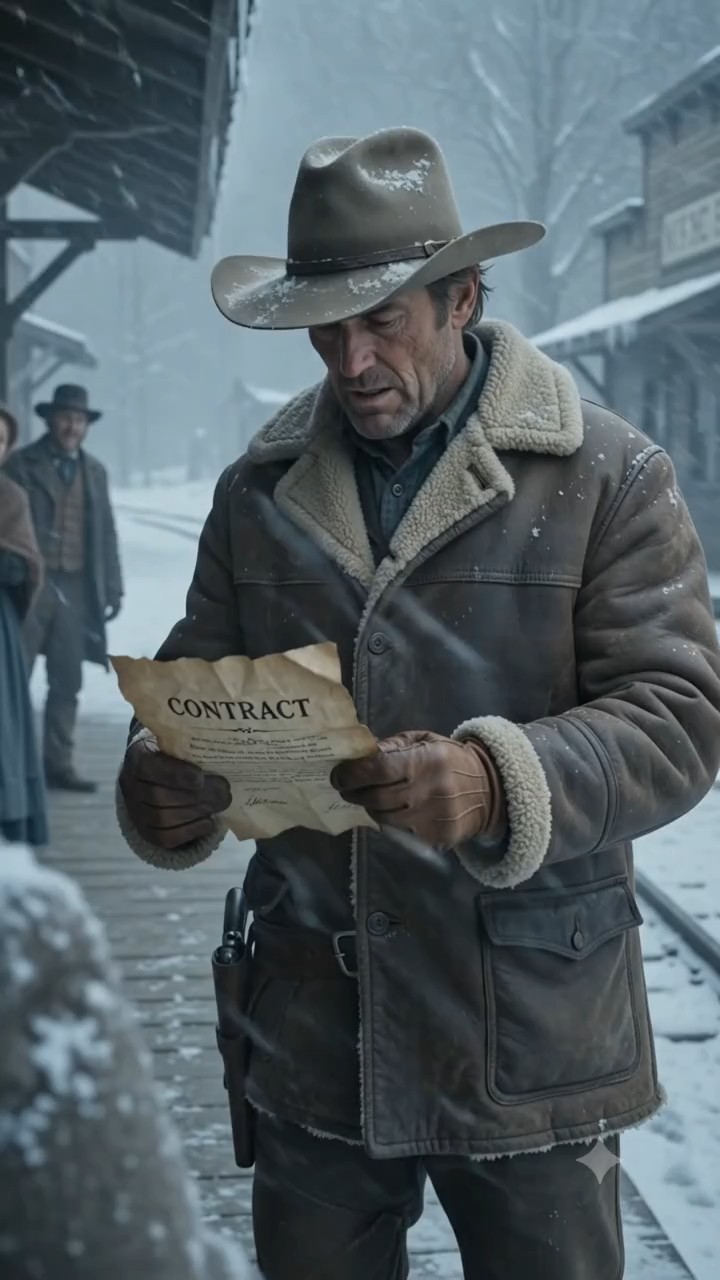
If no rancher in Dakota wants a three-hundred-pound bride, she can earn her keep in my barn or starve in the blizzard, my father declared as he pushed me onto the morning stagecoach.


Part 1
I arrived in the freezing Dakota Territory believing I was entering a legitimate mail-order marriage contract my father arranged to settle my failed bakery debt.
Instead, the cold-eyed rancher who met me at the station revealed he had never written the advertisement, never signed the papers, and that my father had forged his name as a cruel way to discard me.
Yet with fifty-mile-an-hour arctic winds sweeping down the mountain, he couldn’t leave me to die on the wooden platform.
The stagecoach lurched to a halt, a sharp whistle of air escaping the brake lines. My heart hammered against my ribs, a frantic bird trapped in a cage. Snowflakes, hard as pellets, rattled against the grimy windowpane.
I pressed my face closer, peering out at the desolate landscape. Deadwood, Dakota Territory. It was less a town and more a cluster of dark, unyielding structures huddled against the vast, gray sky.
A thin plume of smoke curled from a distant chimney, the only sign of life against the white expanse. The wind howled like a hungry wolf, making the whole coach shudder.
The driver, a burly man with a frost-nipped nose, swung open the door.
“Deadwood station! Last stop!” he bellowed, his voice half-swallowed by the wind.
He didn’t offer a hand. I gathered my bulky skirts and my worn satchel, my fingers already numb with cold. Every movement felt like hauling a heavy sack of flour up a hill.
I stepped out onto the creaking wooden platform. The air was a physical blow, stealing my breath. It tasted of ice and pine.
Around me, a small handful of men in thick coats and hats huddled, their faces obscured by scarves. A few turned their heads, their gazes lingering on me for a moment before returning to the warmth of their collars.
The driver pulled my trunk from the coach’s belly, dropping it with a thud that echoed in the bitter silence. He didn’t bother to wait for me to take it. He climbed back onto his seat, cracking the whip. The stagecoach rumbled away, disappearing into the swirling snow in minutes.
I was alone, a solitary figure on a windswept platform, my breath pluming like white smoke.
Then, a tall figure detached himself from the shadows of the station house. He moved with an economical grace that spoke of hard work and endless space. His face was sharp, etched with lines, framed by a dark, broad-brimmed hat.
Elias Montgomery.
He was exactly as my father had described in his letters: lean, formidable, a man who seemed carved from the Dakota earth itself. His eyes, the color of slate, met mine without a flicker of warmth.
I managed a nervous smile, adjusting the shawl around my shoulders. The wind whipped a stray strand of hair across my face, stinging my cheeks.
“Mr. Montgomery?” I called out, my voice thin against the gale. “I’m Lara Higgins. I’ve come for the marriage contract.”
His expression did not soften. He walked closer, his boots crunching on the packed snow. In his hand, he held a single, creased piece of paper. It looked like the very letter my father had shown me, with Elias Montgomery’s bold, looping signature at the bottom.
“Lara Higgins,” he stated, his voice a low growl, like stones grinding together. It was completely devoid of emotion.
My smile faltered. I could feel a knot tightening in my stomach. Something was wrong. Terribly wrong.
He held up the letter.
“I never wrote this. I never signed any contract.”
The words sliced through the biting wind. They were blunt, unambiguous, and delivered without a hint of apology or explanation.
My jaw dropped. I stared at him, then at the letter in his hand, then back at his unyielding face.
“But… my father sent it. He said you were looking for a wife. A partner for your ranch.” My voice was barely a whisper. “He showed me the advertisement.”
A low chuckle rippled through the small group of onlookers who had now paused their own journeys, drawn by the sudden tension. Their eyes, though mostly hidden by hat brims, felt like physical jabs.
One man, his face ruddy from the cold, snorted.
“A three-hundred-pound partner, eh, Montgomery? Looks like you’ll need a reinforced barn for this one!”
The laughter grew louder, harsh and derisive. It was a sound I knew well, a cruel echo of the whispers that had followed me since childhood. My cheeks burned, not from the cold, but from humiliation. I wanted the ground to swallow me whole.
Elias Montgomery’s gaze, however, did not waver from the letter. He ignored the jeers of the men, his eyes scanning the elegant script. Then, he looked up, directly at me.
His expression was still hard, but something shifted in his eyes. A flicker of recognition, a dawning comprehension that was almost imperceptible. He had seen that handwriting before. It was Arthur Higgins’s, my father’s. There was no mistaking the flourishes.
He understood, in that moment, that I was not a trickster, not a scammer. I was simply a victim.
A raw, primal gust of wind tore across the platform, whipping my skirts around my legs, stinging my exposed skin. Snow began to fall in earnest, thick, swirling curtains that devoured the distant hills. The sky was no longer just gray; it was a menacing, bruised purple.
“Get in the wagon,” he ordered, his voice still flat, but with a new edge of urgency. He gestured toward a sturdy, canvas-covered wagon hitched to a team of shaggy horses, tucked into the meager shelter of the station house.
My mind reeled. He was telling me to get into his wagon, the man who had just publicly declared me a fool, the man whose name had been used in this cruel charade.
“But… why?” I choked out, my teeth chattering. “You said…”
He cut me off, his eyes sweeping the darkening sky. The blizzard was closing in, fast.
“Because I’m not leaving you to freeze to death on my doorstep, Lara Higgins. Not while your father’s handwriting is staring me in the face.”
Part 2
I scrambled into the wagon, pulling my trunk in after me. The canvas flap snapped shut behind us, muffling the wind but doing little to block the cold. Elias climbed into the driver’s seat, his back to me.
The horses shifted, hooves crunching, then we were moving, the wheels grinding through the freshly fallen snow. The ride was silent, save for the creak of the wagon and the relentless howl of the wind. I huddled in the corner, clutching my satchel, trying to make myself small.
It felt like an eternity before the wagon finally swayed to a halt. When Elias pushed open the canvas, a small, dark timber cabin appeared through the swirling snow, a faint glow of firelight spilling from its single window.
He didn’t offer to help with my trunk this time, simply pointed towards the cabin door. I wrestled the heavy thing out, my shoulders aching, and stumbled inside.
The warmth hit me first, a welcome embrace after the arctic chill. A small hearth crackled merrily in one corner, casting dancing shadows on the rough-hewn walls. The air smelled of pine smoke and something earthy.
Elias followed, kicking snow from his boots. He gestured towards a small table and a few chairs, then towards a narrow, well-stocked pantry.
“Supplies are here. Help yourself.” His voice was gruff.
I nodded, my throat tight. My hands, though still numb, instinctively went to work. I found dried beef, a few potatoes, some onions, and a small tin of herbs. A deep, iron pot hung over the fire.
Without a word, I began chopping, the rhythmic sound filling the quiet cabin. The raw ingredients, simple as they were, brought a sense of purpose. This was something I knew. This was something I could do.
Soon, the rich, savory smell of beef stew began to mingle with the pine smoke, warming the small space even further. Elias sat at the table, quietly watching me from under the brim of his hat. He didn’t speak.
When the stew was ready, thick and steaming, I ladled two generous portions into wooden bowls. I placed one before him, then sat opposite, my own bowl warming my hands.
We ate in silence, the only sounds the clinking of spoons and the crackle of the fire. The stew was simple, hearty, exactly what my frozen body craved. Elias ate slowly, deliberately, his gaze occasionally meeting mine.
He finished first, pushing his bowl back. Then, he reached into his coat pocket and pulled out a folded, brittle piece of paper, yellowed with age. He slid it across the table to me.
It was a promissory note, written in elegant, looping script, dated nearly twenty years ago. The amount was small, but the words were clear: “To the Montgomery family, for assistance during the winter crop failure. Paid in full, with thanks. Eleanor Higgins.”
Eleanor was my mother. I looked up, my eyes wide.
Elias’s gaze was steady. “Your mother saved my family that winter, Lara. My father never forgot it.”
He paused, then pushed his chair back slightly. “You work with a good hand. I could use a winter homestead manager. Paid position. You’d earn your keep and more, independently.”
More Stories




+ There are no comments
Add yours